Story code: ST-000076
Part 2: The Blind Set
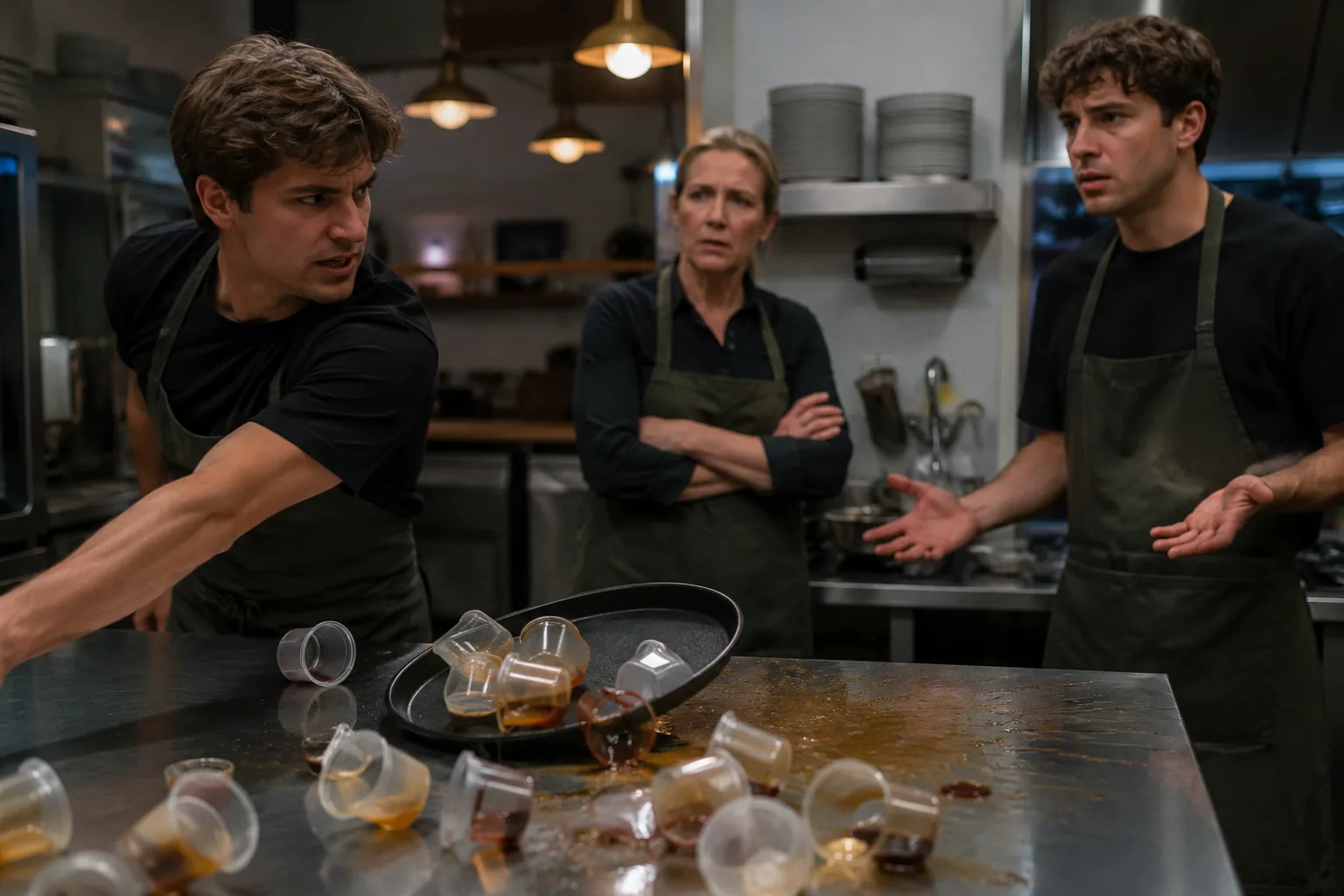
Uncle Ray didn’t say anything when Dylan finished those three cups. He just watched the line of sample trays, then looked at me standing there with the half-finished set in my hands. Tanya was already calling for an extra basket on table twelve, and the dishwasher door kept banging open and shut behind us.
“Maya,” Tanya said, “put that tray on the counter and help Dylan finish the rest. We need it out now.”
That was how it stayed all night. The pressure came down on me, then got handed to me again, then got called teamwork. I set the tray down, checked the cups, and Dylan reached for the next stack. He missed the first one on purpose so badly that one lid skated off the table and landed by the sanitizer pump. A server walking by laughed once under his breath, not mean enough to stop the room, just enough to make me bend down and grab it before it rolled under the cart.
Dylan gave a small helpless shake of his head. “See? I’m not good at this part.”
But the second he thought nobody was looking, he lined the cups up by feel without even glancing at the rims. Clean line. Same spacing. Same motion the prep lead used when the kitchen was slammed. He caught himself doing it, froze, and then fumbled the next lid so hard it bounced off the tray.
Tanya saw that one. So did Uncle Ray.
He reached over, lifted the tray, and turned it so the cups faced Dylan. “No talking,” he said. “Just finish the sample set. Eyes down. Pick a flavor, portion it, and label it.”
Dylan blinked at him. “What?”
“You heard me. No one helps you. No one calls it out. Just do the tray.”
The room got quieter in pieces. Not silent, not at first. A spoon clinked against a pan. Someone called for extra napkins at the counter. Then even that noise thinned out because the only thing moving was Dylan’s hands over the sample tray.
He started rough. He reached for the wrong cup, corrected fast, and coughed out a laugh like the mistake was funny. Then he tried again. This time he rotated the tray a few inches, lined up the labels, and kept going without looking up. One cup after another. No coaching. No excuses. No more dropped lids. His fingers moved with the same quick control the whole line uses when orders pile up and nobody has time to think about it.
I was standing close enough to see the mark of the Sharpie on his thumb and the clean way he pinched the paper boats so they didn’t crumple. He had not been reaching like that a minute ago when he was acting stuck. Now he was moving too fast for the story he had been selling all night.
Tanya set both hands on the edge of the prep table. “Dylan,” she said, “where did you learn that?”
He didn’t answer right away. He kept finishing the tray, one sample cup after the other, until the last lid clicked into place. Then he reached for the marker again and wrote the final label in one smooth pass that didn’t look like a beginner’s hand at all.
Uncle Ray picked up the tray, checked the rows, and said, very flat, “That’s not learning.”
Dylan’s fingers stopped on the marker.
I looked at the tray, then at his hands, then at the neat line of cups he had just finished without help. If he could do that the whole time, why had I been the one wiping up his mess and carrying his work from the start?