Story code: ST-000265
Part 3: The Name On The Label
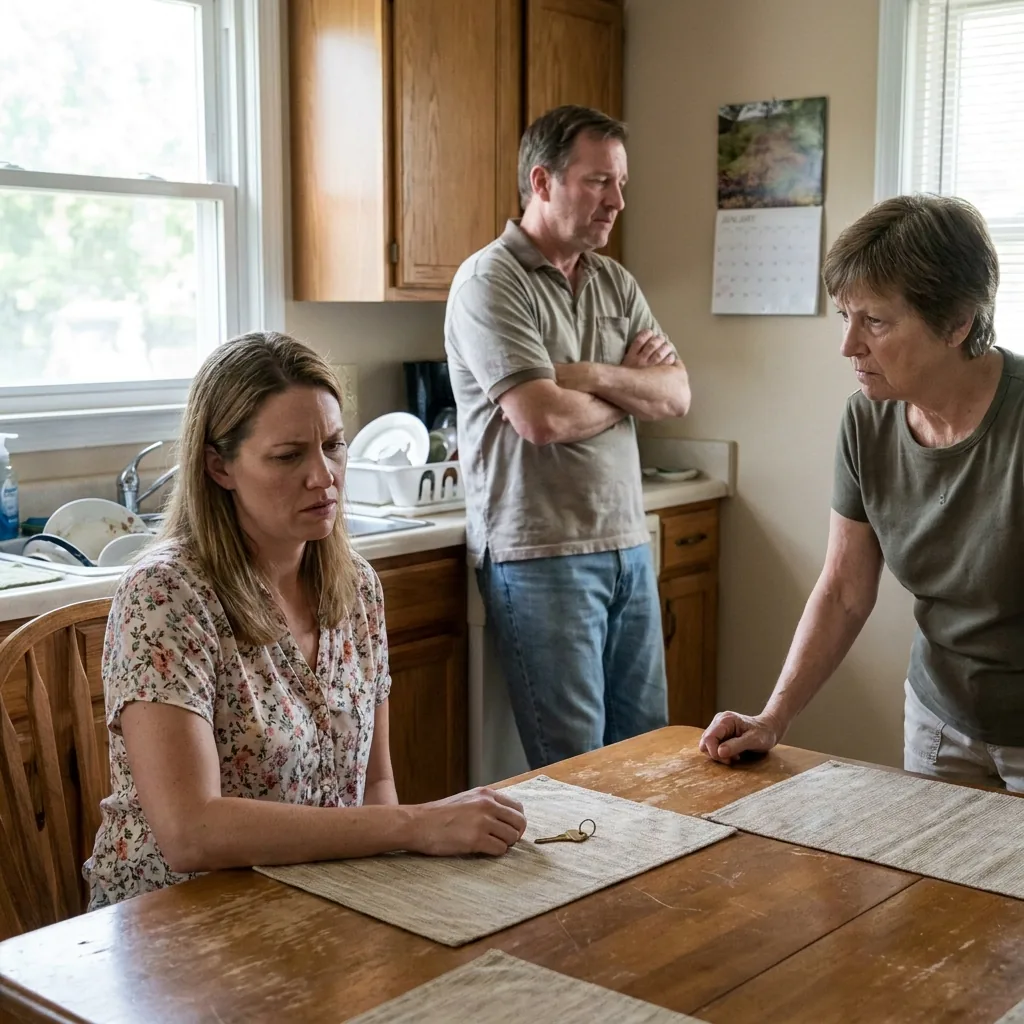
Linda did not hand the label to me. She left it on the table between my plate and the key, like she wanted me to look at it until I had no choice but to read it again.
The name on the paper was a woman’s name. The street was not ours. I read it once, then again, because names on labels are stupid little things until they are the only thing in the room that does not move. Cal’s mouth opened and closed. He kept one hand on the back of his chair and the other near the table edge, like he could hold himself in place by gripping wood.
Eileen looked at the label, then at Cal. “That is an apartment,” she said.
Cal said, “No.”
It came out too fast, and everybody heard it.
Linda tilted her chin at the label. “Then what is it?”
He did not answer. He just stared at the paper as if there were a second answer hidden under the first one. I could hear the sink running in the kitchen, a thin steady stream somebody had left on while the rest of us sat there with our food cooling. It was such a normal sound that it made the whole thing worse.
I said, “Whose name is that?”
Cal dragged a hand over his face. “Mara, not here.”
“Here is where you brought it,” I said.
Linda let out a short breath through her nose. “He has been going there after work. That is all I know for sure.”
That sentence was aimed like a dart. She did not say what she had seen in that place. She did not say how often. She did not have to. Cal’s shoulders pulled tight, and Eileen’s fork slipped down onto her plate with a small metal click.
I looked from Linda to Cal. “Why does he need a key to an apartment?”
Nobody answered me right away. That pause was answer enough to change the shape of the room.
Then Eileen said, very carefully, “I saw him with a grocery bag last week. He said he was dropping it off somewhere.”
Her voice was flat, not dramatic. She did not look at me when she said it. She looked at the table. But the words landed hard because they were ordinary. A grocery bag. A last week. A place he said he was going.
Cal snapped his head toward her. “Eileen.”
She lifted one shoulder and let it drop. “What? You told me it was nothing.”
There it was. Not a confession, not a full explanation, just the kind of small support that cracks when you press on it. He had brought one story to one person and another story to another, and now both stories were sitting in my kitchen with the key between them.
Linda leaned back in her chair and folded her arms. “You see why I brought it out here? I am tired of watching everybody pretend this is a misunderstanding.”
I said, “You are not helping.”
“I am the only one telling the truth in this room,” she said.
That was the first time I heard my own breathing change. Not because I believed her. Because the room had started arranging itself around what she was willing to say in front of witnesses. Cal looked at me then, really looked, and I saw something in his face that had not been there when we sat down for dinner. It was not an apology. It was the moment he understood that I was not going to make this easy for him.
“Tell me the address,” I said.
Cal shook his head once.
“Tell me who lives there.”
He pressed his lips together so hard they turned pale. Linda watched him and said, “Say it.”
He did not.
Eileen pushed her chair back an inch. The scrape against the floor was small, but it was enough to make all three of us turn. She looked at Cal and then at me. “I did not know it was this,” she said.
That was the crack. Not because she said something grand. Because she stepped away from him just enough for me to see the room differently. Linda had brought one key. Cal had brought a second life. Eileen had just told me she could see where the line was, and she was not standing on his side of it anymore.
I picked up the key, turned it over in my hand, and set it back down in front of Linda.
“You can stop speaking for him now,” I said.
Then I looked at Cal and knew I was done trying to steady the table for anybody.