Story code: ST-000116
Part 4: The Line He Finally Took
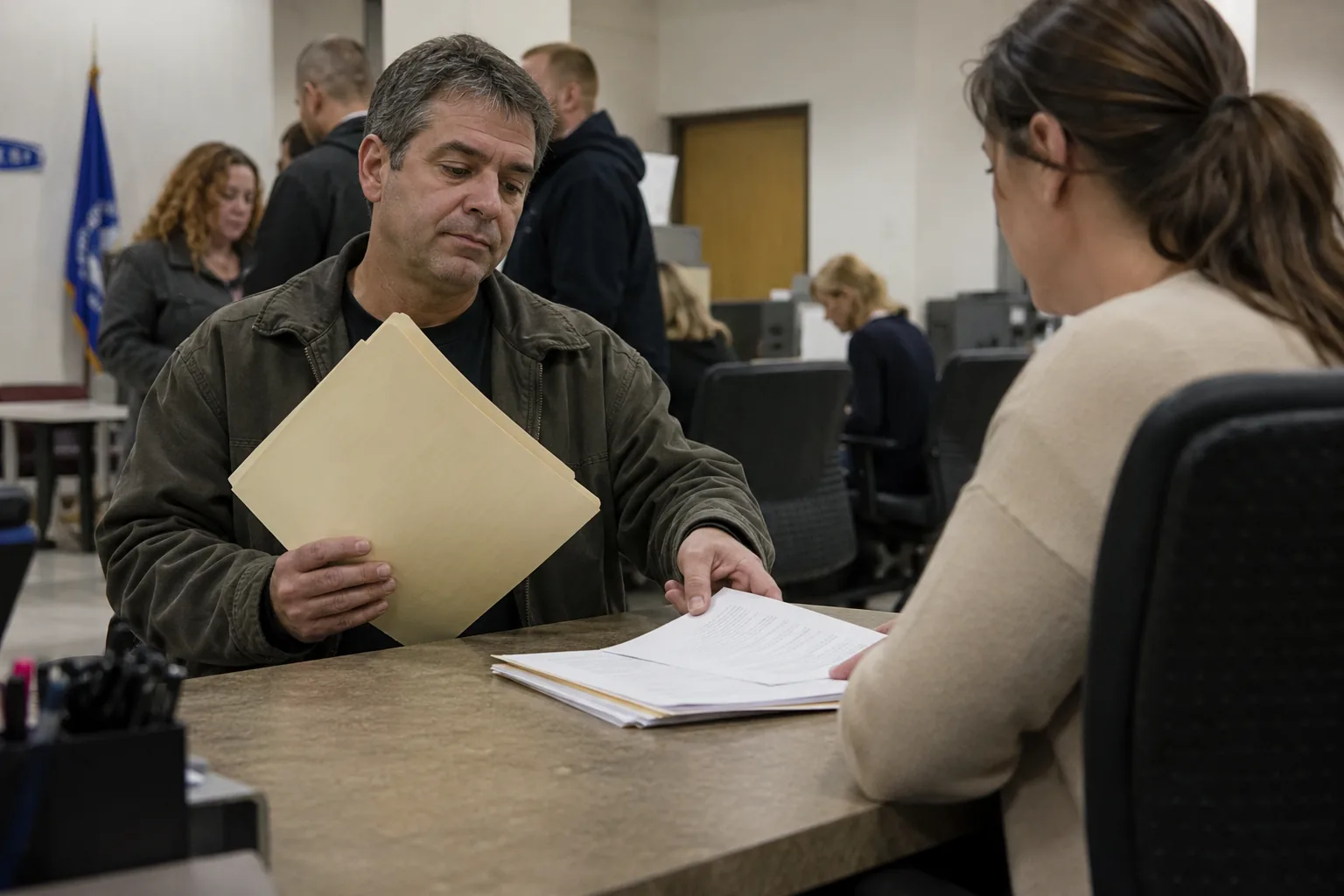
When Ray leaned over the desk, the whole packet changed with him. The red tab stayed in place. The clerk kept her hand beside the tray. Nobody moved to help him. The office noise went on behind us, but the space around the signature page tightened to a quiet strip of air and paper.
He held the pen over the line for a second, then set the tip down and wrote. Not a scribble. Not a guess. A clean, steady signature that matched the initials in the margin and the way he had handled the packet from the start. He followed it with the date, the exact format the clerk had repeated twice already. When he finished, he paused with the pen still in hand, waiting for a reaction that did not come.
The clerk took the page, checked the line, then checked the identification copy beside it. She did not speak fast. She did not need to. “This section is complete now,” she said. Then she pressed the stack into a neat square and removed the red tab with one measured pull.
That was the moment the lie lost its grip. Not because anyone argued with him. Not because he got caught in some dramatic way. Because the room had the proof lane in front of it, and he had just used the same hand that claimed confusion to finish the exact act he had pushed onto me. His signature sat there on the page, plain and visible, with his initials in the log and his earlier performance still hanging over the desk.
He tried to say something, but the clerk was already writing on the intake sheet. “From here, the packet goes to review,” she said. “You won’t be able to retrieve the old copy once it’s logged.”
That was the consequence in plain sight. The folder got stamped, then slid into the outgoing bin behind the window. The clerk tore off the claim stub and placed it face down on the counter. Then she reached to the side terminal, typed a few keys, and said, “I also need to note that the prior version was incomplete on arrival.”
Ray’s head turned toward her so fast the collar of his shirt shifted. “Don’t put that in there,” he said, and his voice came out thinner than before. He looked at me next, but I did not speak. The clerk kept her eyes on the screen.
“It’s already part of the intake record,” she said. “The correction supersedes the earlier condition.”
The words landed dry and flat, but they changed everything in the room. His old version of the story was no longer the working version. The intake line carried his name. The signature page carried his hand. The clerk’s note carried the incomplete state back to him, not me. And because the packet had moved forward, the access moved with it. The clerk closed the drawer at the end of the station and set the small stamp aside. That was the last visible path for the paper in this room.
Ray reached for the claim stub, but the clerk had already turned it over and filed a copy under the intake sheet. “If you need the next step, you’ll have to come back with the required party,” she said. “Until then, this office is done with this packet.”
He stood there with his hand half-raised and nowhere to put it. The pen stayed on the desk. The red tab was gone. The packet was no longer ours to argue over. It had moved into procedure, and procedure had taken his room away from him.
I gathered the empty folder he had brought in and slid it back across the desk. He did not touch it. He looked at the intake copy one last time, then at the line with his initials, then at the clerk’s screen where the note had already been entered. No one raised a voice. No one needed to. The proof had been written into the process, and that was enough.
When he finally stepped back from the window, he did it without the folder, without the packet, and without the leverage he had been trying to hand me all afternoon. The clerk closed the file tray and called the next name. I kept my hands on the desk until she cleared the space completely.
That was the end of it in the room: not a fight, just access removed by process, cold and final, with his own signature sitting on the page that proved he had known exactly how to do it all along.