Story code: ST-000836
Part 3: She Ran Out of Ways to Fail
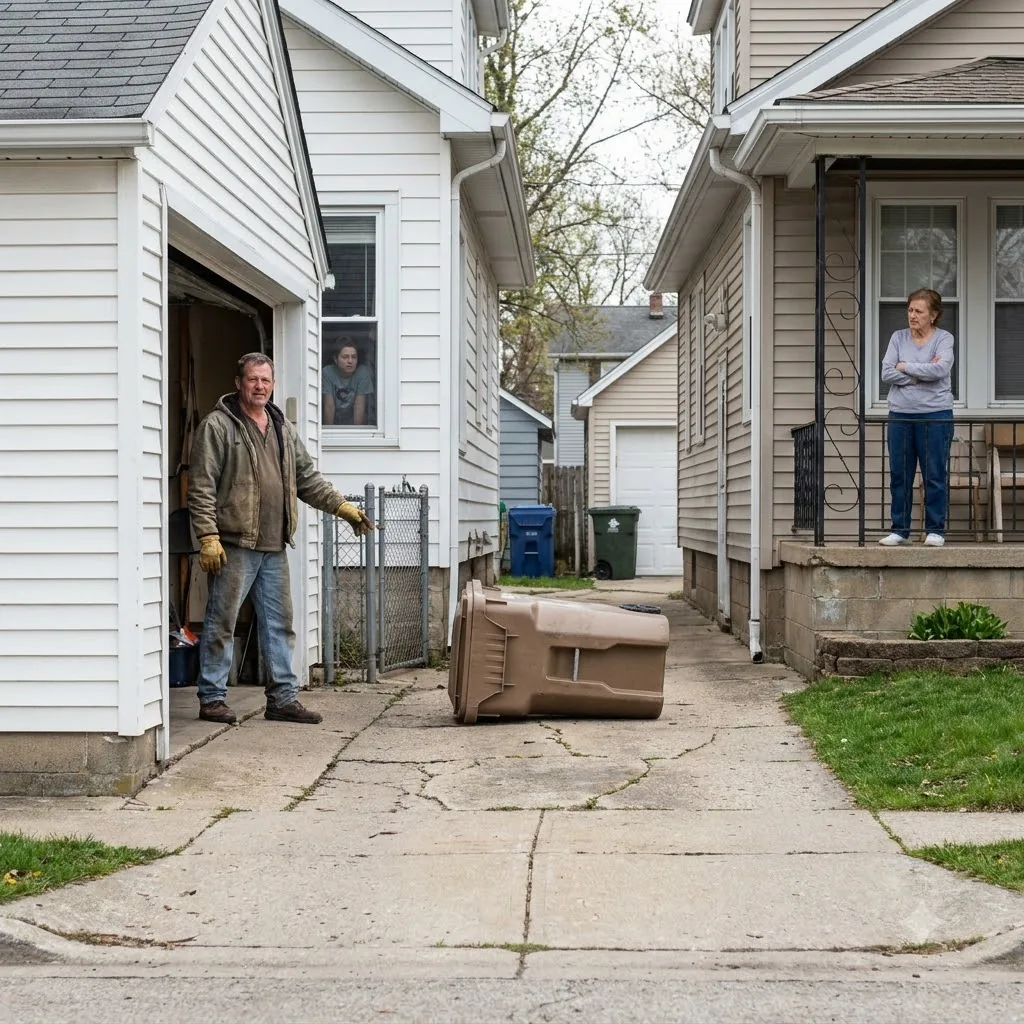
By Friday morning, the bins were still lined along the garage edge when I opened up to start work. That alone was unusual. Diane usually pulled hers out just far enough to create a problem before I had coffee finished. Luis was already there, tightening a clamp on the worktable. He looked past me at the driveway and said, “Leave ours where it belongs until the truck is close.” I nodded.
The plan was simple enough that it barely felt like a plan. We moved our trash bin to the curb early, before Diane came out, but left our recycling bin tucked back by the garage. That narrowed the passage without blocking it. There was still room to bring a bin through if you knew how to pivot it. If you did not, it looked annoying enough to complain about.
At seven twenty, Diane opened her side door and stepped out in slippers with her phone in one hand. She saw the setup and stopped. Her black trash bin was still in its storage spot, boxed in on one side by the wall and on the other by the angle our recycling bin created. Not trapped. Just waiting for the exact move she always acted like she could not do.
She set her phone on the porch rail and walked over. I stayed inside the garage opening with a box cutter in my hand. Luis kept working, or looked like he was. Nobody offered help.
Diane put both hands on the handle and gave the bin one short pull. The wheels bumped the seam. “Seriously?” she said, not to anyone in particular.
Luis said, “You can get it through. There’s enough room.”
She looked toward him. “Not with your bin there.”
“Our recycling goes after pickup,” he said. “Trash goes first.”
That left her with nothing to answer except the bin in front of her. She tugged again, weaker this time, then let it rock back into place. Usually that was the moment she looked at me and used my name. This time she didn’t. The truck could be heard two streets over, the hydraulic whine carrying between houses.
Diane shifted her feet and crouched a little to look at the wheels. “It’s catching,” she said.
Luis stepped to the slab edge and looked down without touching it. “Catching on what?”
She pointed once, vaguely, then straightened. “The edge. The concrete. I don’t know.”
I said, “If it’s the pivot, you know how to do that.”
She went still for a second. Then she gave a quick little laugh that did not go anywhere. “Mara, if I knew how to do it, I would’ve done it by now.”
The truck was loud enough now that you could tell it had turned onto our block. Diane looked toward the street, then back at the bin. Her hands went to the low part of the handle without her seeming to think about it. She planted one foot beside the right wheel, tipped the bin back just enough to clear the seam, and swung the front end through the narrow gap by the garage in one clean arc.
It was the same move I had seen before, only now there was no guest, no joke, no chance to turn it into luck. She corrected the angle halfway through, missed our recycling bin by an inch, rolled straight down the driveway, and set her trash at the curb with the lid facing the houses.
Everything about it was smooth. No dragging. No banging the wall. No weak tugs. No call for me.
Luis did not say anything right away. Neither did I. The truck stopped in front of the house. The mechanical arm came out, lifted our bin, then hers. Her trash emptied cleanly.
Diane stood with one hand still on the handle, looking at the curb. The silence there was heavier than any argument we could have had.
Then she started talking fast. “Well, it helps when there’s less in it. And when the ground is dry. And when I have time to look at it.” She glanced at me. “You act like this proves something, but the setup was different.”
Luis said, very plain, “Different how?”
She opened her mouth, closed it, and looked back at the driveway. The only thing on the concrete was the wheel track she had just made. A perfect curve through the spot where she always said the problem was.
I walked out far enough to point at it with the box cutter still closed in my hand. “That’s the move you’ve been saying you couldn’t do.”
Diane picked up her empty bin and started pulling it back before the truck had even reached the next house. She moved fast again, this time the same sure way, back through the narrow gap and into the storage edge. She set it down square against her side.
Then she said, without looking at either of us, “So what now?”
Luis answered before I did. “Now you keep handling your own bins. And ours stop touching yours.”
Diane’s hand stayed on the lid a second longer. She looked at the painted center line, then at the narrow strip beside the garage where our bins had always sat mixed together. I could see the next piece land before she said it.
“You want a divider,” she said.
I said, “By tonight.”