Story code: ST-000591
Part 3: I Finally Saw What He Needed From Me
Dale did not finish the sentence before I cut in.
“If this is about tomorrow,” I said, “email me a list of what you need and why.”
He went quiet for a beat. Then he said, slower, “Do not start sending estate material around until I review it.”
“Leah already told me what documents can be submitted directly.”
Another pause. Not long, but long enough for me to hear him breathing into the phone.
“So you did call someone,” he said.
“I handled estate business.”
His voice dropped flatter. “You are making this harder than it has to be. There are entries that need context. If the wrong people look at partial information, they can freeze things. Delay things. Demand explanations out of order.”
I looked down at my notes from the bank call. Prior submissions. Adjusted figures. Ledger-related entries.
“Then send me the full ledger pages so I have the context too,” I said.
“That is not how this works.”
There it was again. Not an answer. Just the rule, stated like weather.
I told him I was done for the night and hung up before he could keep steering the conversation in circles.
Then I sat at my home workspace with the checklist from Leah on one side and my own notes on the other and started writing out everything Dale had needed from me over the last month. My signature on estate forms. My ID for verification. My confirmation of addresses. My permission to speak to account departments. My copies of letters that came to Evan’s old mailing address. My availability for calls he said only I could join because I was family.
The list got longer than I expected.
That was the first time the shape of it became plain to me. Dale had records, passwords, and whatever sat inside that ledger, but he did not have the one thing he kept pretending was optional: me. He could delay me. He could embarrass me in his office. He could hold the ledger under his hand and act like every road ran through his desk. But every time an institution wanted identity confirmation, estate authority, or family-side approval, he had to reach back toward me.
I was not trapped because he had all the power. I was trapped because I had kept participating inside his version of the process.
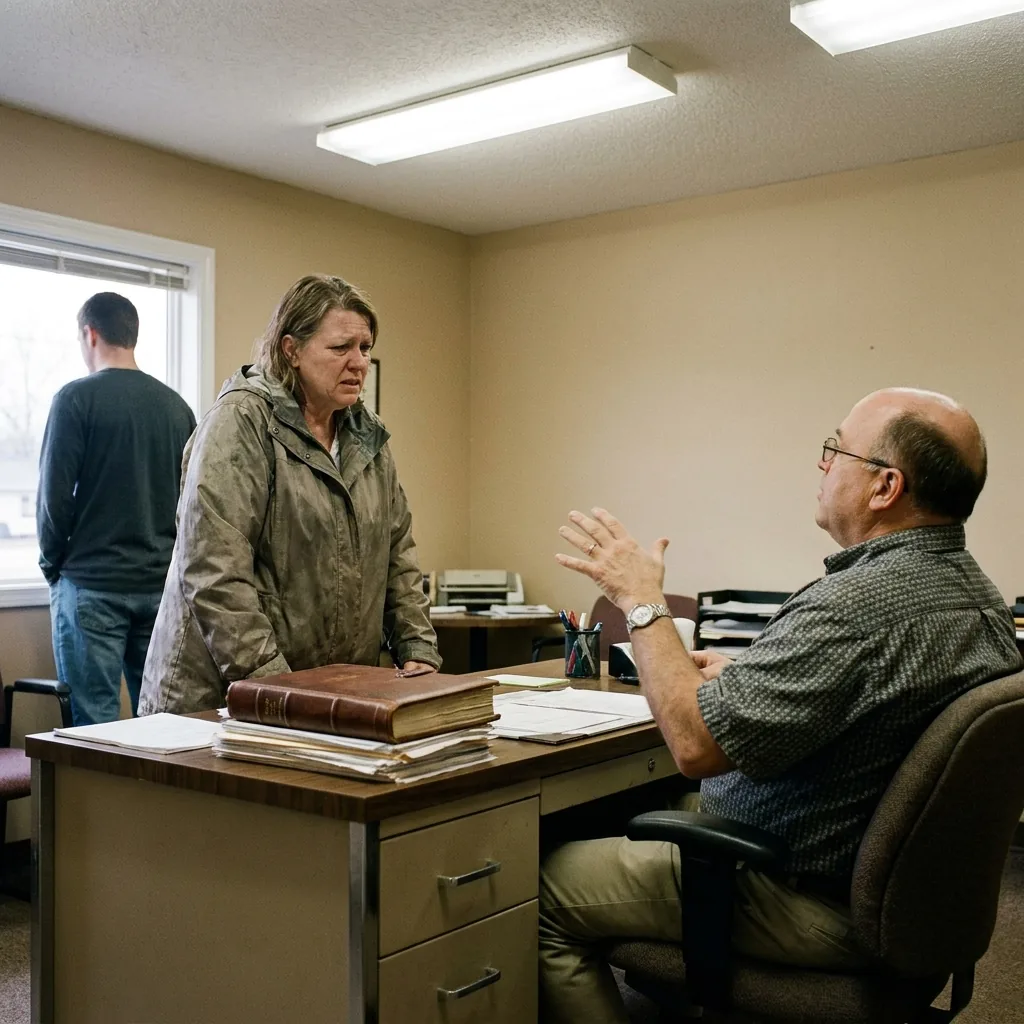
The next morning I went back to Dale Renshaw Tax Preparation with my folder, not because I planned to hand him everything, but because I wanted to see the ledger again now that I knew what to look for. The waiting area smelled like burnt coffee. The same plastic chairs sat under the laminated refund signs. A man near the front was filling out a client intake clipboard with a pen attached by string.
Dale met me at the half wall instead of inviting me straight back. “Come on,” he said.
At his inner desk area, the estate ledger was closed this time, with calculator tape laid across it like a marker. He did not offer me a seat until I asked for one.
“Before we go any further,” he said, “I need your full estate packet, your copies from the bank, and anything sent to you by outside administration contacts.”
“No,” I said.
He blinked once. “No?”
“You can tell me what specific item you need and why you need it. I’m not turning over everything first.”
He pressed his palm on the ledger cover. “That is exactly the kind of behavior creating these problems.”
“Then open the ledger.”
He looked at me for a second and then, maybe because refusing too directly would say too much, he flipped it open just a few inches. That was enough. I saw dated entries, small handwritten notes in the margin, and several lines where figures had been changed and initialed. One page had a column that matched the institutions I had listed from memory the night before. Another had a notation beside one adjusted amount that looked like pending family confirm.
He moved his hand over it almost immediately.
But I had already seen it.
Family confirm.
Not preparer confirm. Not office verify. Family confirm.
“What was that line?” I asked.
“Internal shorthand.”
“For what?”
“For things you do not need to manage.”
I held his gaze. “You told me yesterday I should not contact anyone without you. But your own ledger has entries waiting on family confirmation. That means you cannot finish parts of this without me.”
His jaw shifted. He picked up the calculator tape, set it down, then straightened a stack of folders that were already straight.
“Do not oversimplify what you are looking at,” he said.
“I’m not. I’m finally looking at it at all.”
He asked for my phone so he could “review” the email Leah had sent. I said no. He asked me to forward the checklist to him before I used it. I said no again. Then he changed tack and asked for the death certificate copy I had brought, saying he needed it for his file before anything else could move.
That was the moment it locked into place. Every route he wanted still looped back through documents, authority, and confirmations that belonged to me.
I stood up and put my folder under my arm.
“If you need something from me,” I said, “put it in writing. Item by item.”
His chair legs scraped back. “Hannah, sit down. If you walk out now, you are going to create a mess you can’t undo.”
I looked at the ledger one more time. The page with the adjusted figures was still open under his hand, and beside one amount, in the same narrow handwriting, was a note I had not noticed until then: hold pending heir packet.
He had not just been blocking me from the system.
Part of his system had been waiting on me the whole time.