Story code: ST-000192
Part 3: The Stream Keeps Rolling
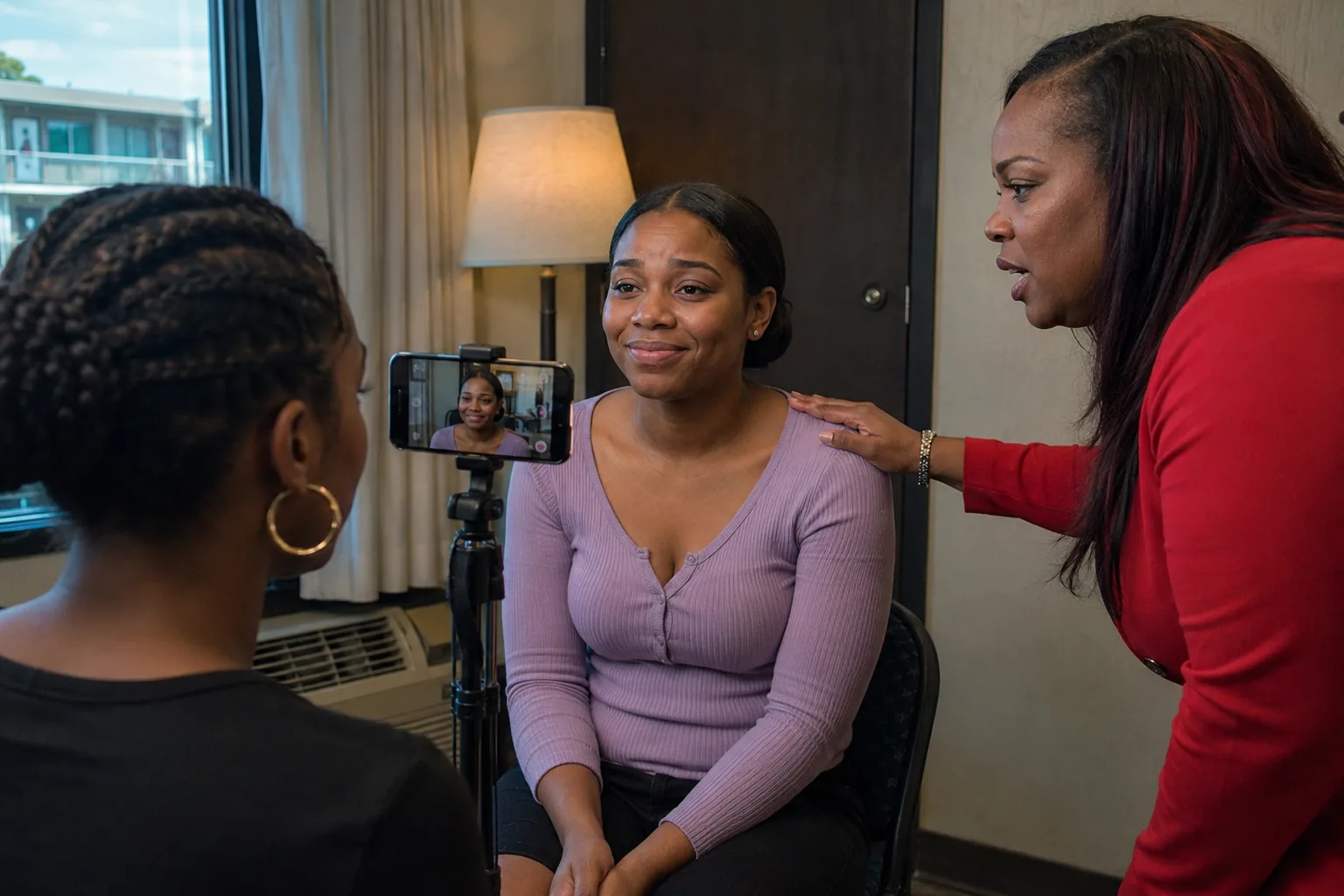
The woman in the doorway did not step back when the recruiter tried to talk over her. She stayed near the folding table, one hand still resting on the paper plate she had set down beside the pamphlets. The camera phone was still up, and now it was catching all of us at once: the recruiter with her bracelet turned out, the host with her mouth half open, me standing by the water case like I had been placed there and forgotten, and the wrong person looking straight at the bracelet instead of the sponsor banner.
The recruiter said, “This is getting misread,” and pointed at the phone like the glass itself could fix the room.
The host reached for the tripod-less stack of brochures under the phone and shifted them an inch, trying to steady the angle. Her hand shook just enough to make the screen wobble. The recruiter noticed and snapped, not loudly but fast, “Keep it on me.”
That was the first time she stopped pretending the room was a shared effort. She was looking at the camera, but she was speaking to the host. The woman in the doorway saw it too. She lifted her chin toward the bracelet and said, “You told somebody to wait until after the stream. I heard you.”
The recruiter answered, “You heard half of a conversation.”
The wrong person gave a short, dry laugh. It was not friendly. It sounded like somebody realizing the shape of a lie. She looked from the recruiter to me and back again, then said, “Then say the whole thing out loud.”
Nobody did. The host kept glancing at the hall, where another voice was moving back and forth outside the safe room. The line between private and public had already gone thin, and every time the recruiter tried to thicken it back up, she had to use more words. That only made the seams show.
She told the camera that the bracelet marked retreat work, that the night was about support, that people kept twisting normal things into accusations. She said the fundraiser was helping families. She said the room was calm until somebody decided to make trouble. Every sentence came with a small correction afterward, like she could hear herself slipping and was trying to catch up.
Then the woman in the doorway looked directly at me and asked, “Did they use you for this?”
I answered, “Yes.”
The recruiter turned her head so quickly that the bracelet flashed under the light. She stepped between me and the doorway, and for one second her body blocked the sponsor banner behind her. That made the background look wrong, like even the room had lost patience with the setup.
The host said, too quietly, “We need to keep this moving.”
But the movement had already changed. The wrong person had heard the offstage instruction and stayed. The host had heard it too. Now the recruiter had to explain why the thing she had said to one listener had reached another listener in front of a camera she wanted to control. She reached for the bracelet and turned it over, exposing the twisted weave and the little metal tag tucked inward. It was the first time I saw her handle it like something fragile instead of proof.
The woman in the doorway pointed at that tag and said, “Turn it around.”
The recruiter did not. She looked at the host instead, and I saw the host’s hand slide from the phone to the edge of the table, where the plate sat beside the pamphlets. A few crumbs had fallen onto the fundraiser sign.
The wrong person said, “If this is clean, why does everybody keep talking like the mic is off?”
No one answered. The room had gone past the point where a better sentence would save it. I could feel the pressure in the space between the phone and the doorway, in the way the host kept checking who was hearing what, in the way the recruiter kept lifting the bracelet and lowering it again. She had wanted the bracelet to mean trust. Now it only marked where she had tried to keep the story closed.
Then the host looked down at the screen and said, “We are not live anymore.”
She said it like a mistake had just been discovered in the middle of a receipt. The recruiter turned on her so fast the chair behind her scraped the floor. She lunged for the phone, but the wrong person had already seen the screen go dark and light again, dark and light again, as if the signal was trying to hold and failing.
That was the pressure point. The stream had not just faltered. Someone had reached in from outside the room and cut the clean edge off the performance. The recruiter still had the bracelet on her wrist, still had me in the frame of the room, but the audience was no longer guaranteed to see only the version she wanted.
Outside the door, the voice called again, louder this time, and the host flinched toward it. The recruiter looked from the dark phone screen to the doorway, then back to me, and for the first time she had nowhere left to hide the part where the story did not match what was being witnessed.