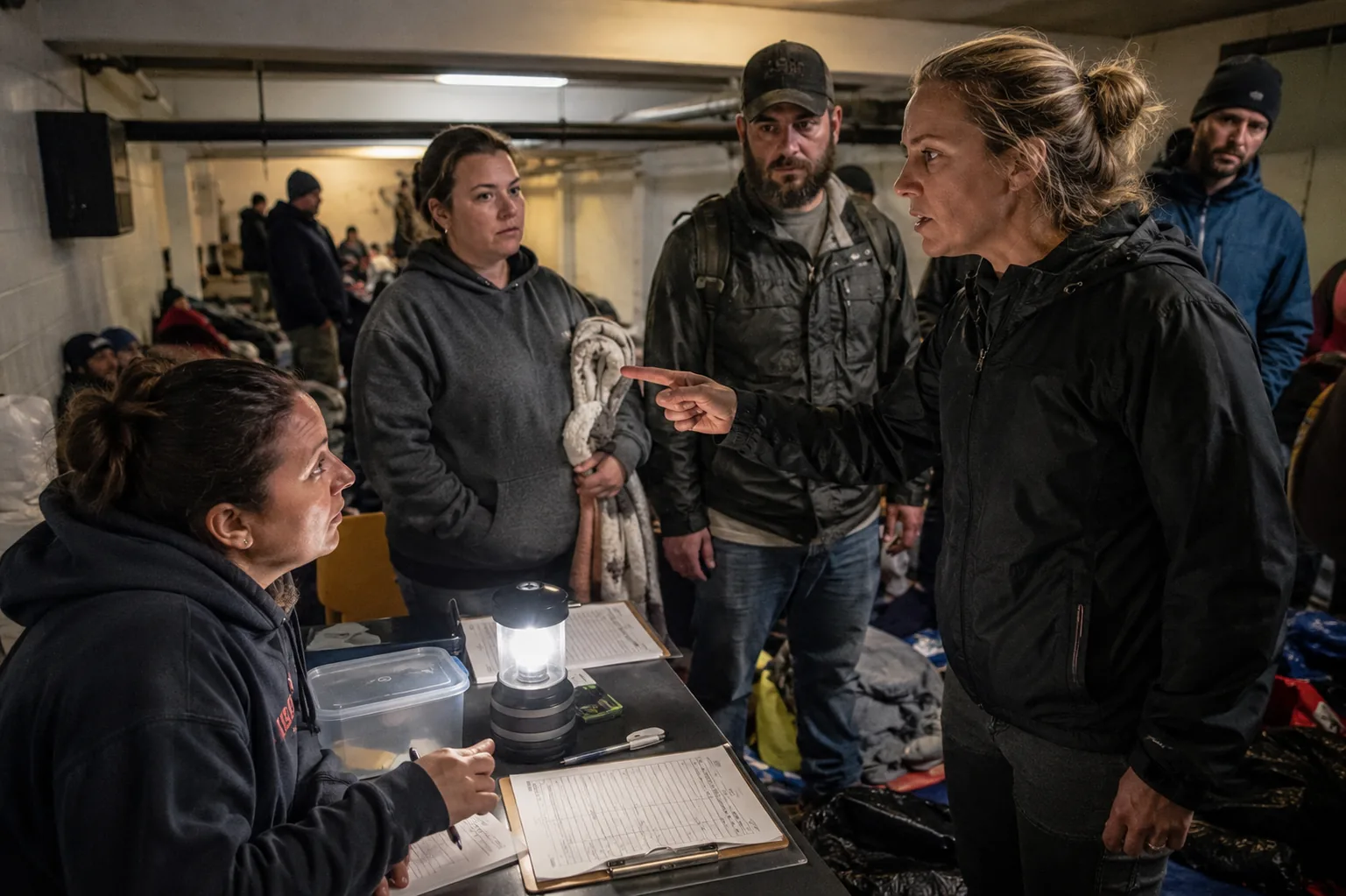
Story code: ST-000087
Part 2: The Clipboard Started Telling a Different Story
By the time Marisol pushed that injured man toward the chairs, Dana had half the room acting like my sister was cutting a private line through a public shelter. I was still holding the roster that showed otherwise, but Dana kept using my table as a stage, and the more she talked, the more people started repeating her version instead of looking at the names right in front of them.
“Name?” I asked the man with the sling.
He gave it to me through clenched teeth. Marisol added, “His wife and daughter are at the door. I told them to wait under the awning till I came back.”
Dana turned to the nearest cluster of cots and said, “This is what I mean. She decides who comes in, who waits, who gets grouped together. That is not how this works.”
Marisol looked at her once, quick. “He can’t stand out there long.”
“Neither can anybody else,” Dana shot back.
A woman in line nodded at that, not at Marisol. A teenager who had been helping sort blankets slowed down and watched. You could feel the room doing what crowded rooms do when one person sounds certain and another person is too busy moving to explain every decision.
I wrote the arrival time, marked the sling, and slid the clipboard under the lantern so I could see the earlier entries. The page was full enough now that a pattern was impossible to miss if anybody bothered to read it.
Nadine Walker, escorted by Marisol.
Joseph Benton and two minors, escorted by Marisol.
Ray Alvarez, escorted by Marisol.
Wheelchair request at entrance.
Cot for diabetic evacuee.
Return for mother and child.
None of it looked like favoritism. It looked like triage.
Dana leaned across the corner of my table and asked the room, not me, “Did anyone authorize her to keep leaving intake?”
That was the first moment I heard the gap in it. Dana kept saying authorize like she had somebody’s authority in her pocket. But Eli Benton wasn’t at the table yet, and nobody from county emergency management had been standing with us. Dana had just been here early, talking fast and pointing people around until others started letting her.
I said, “Eli handles final assignments when he gets back. I’m logging arrivals.”
Dana gave me a tight smile that didn’t reach her eyes. “Then log that we’ve had repeated delays because one volunteer won’t stay in her lane.”
“I’m logging who came in and what they needed,” I said.
A little girl near the chair row began coughing hard enough that her shoulders jumped. Her mother lifted a hand and called, “Can someone get water?”
Dana looked over, then back at Marisol. “Exactly. That child needs help too.”
Marisol was already moving toward the girl when another voice cut in.
“She helped me before she helped herself,” Nadine said from her cot.
It took her effort to get it out. She had one hand braced on the mattress and the other wrapped around that pill organizer. People nearby turned toward her because older voices in a room like that either vanish or stop everybody for a second.
Dana answered before Marisol could. “Nobody is saying she did nothing. I’m saying she made things harder by deciding whose emergency counted first.”
Nadine pointed straight at my clipboard. “Then read that paper.”
For a second, nobody moved. The lantern hummed faintly. Rain hit the metal siding. At the blanket stack, the teenager who had been sorting supplies stopped folding altogether.
I did not read it out loud. Not yet. The line was still moving, and people still needed cots more than a public showdown. But from then on I started asking every arrival one extra question in the same calm voice.
“Who brought you in?”
The answers stacked up.
“The woman in the red jacket.”
“Marisol, I think. She went back for my aunt.”
“The one who keeps going to the door.”
Each time, I wrote it down beside the names. Each time, Dana got a little sharper in how she spoke.
“We cannot have random volunteers freelancing medical decisions.”
“No one said he needed a cot there.”
“If people had listened earlier, this would be organized by now.”
But when the next real need hit, her voice was all she had.
A man came through carrying a boy of maybe seven whose foot was wrapped in a soaked towel. He set the boy down on a chair and asked, “Who knows where first aid is?”
Dana stepped forward right away, hand up like traffic control. “We need to keep the entrance clear. Put him by the wall and-”
“Where’s the kit?” the father asked again.
Dana looked toward the supply bins, then toward me, then toward the cots. She did not move.
Marisol was already crouching by the boy, not touching the towel yet, just asking, “Can you wiggle your toes for me?” Then she looked up at me. “Tess, can you get Eli or the first aid bin?”
I pointed to the cabinet behind the divider where Eli kept the medical tote. The teenager at the blankets ran for it before Dana did.
That was when the room changed a little. Not enough to fix it, but enough for people to start watching Dana differently. She had spent the last hour talking about responsibility. When somebody needed hands, she kept giving directions from three feet away.
Then Eli came back to the table carrying a stack of cot tags, took one look at the crowd around my station, and said, “Why is intake bottlenecked?”
Dana answered first. “Because one volunteer keeps abandoning post to run her own rescue priorities.”
Eli didn’t respond to her. He looked at me.
I set the clipboard flat under the lantern and turned it so he could read every time stamp, every escort note, every return entry in my handwriting.
And just before he lowered his eyes to the page, the mother of the coughing girl pointed across the room and said, clear enough for everyone to hear, “If that woman’s such a problem, why is she the only one who keeps coming back with people?”