Story code: ST-000587
Part 2: Everybody Saw Who Actually Did the Work
After Dahlia said I had delayed the ceremony, she started directing people around Leila like she was managing a stage scene instead of an older woman who needed a chair, water, and a clear path. The hall was filling fast by then. Ushers were seating cousins, the florist was carrying out the last two aisle pieces, and Nina kept checking the time and asking, “Are we lining up or not?”
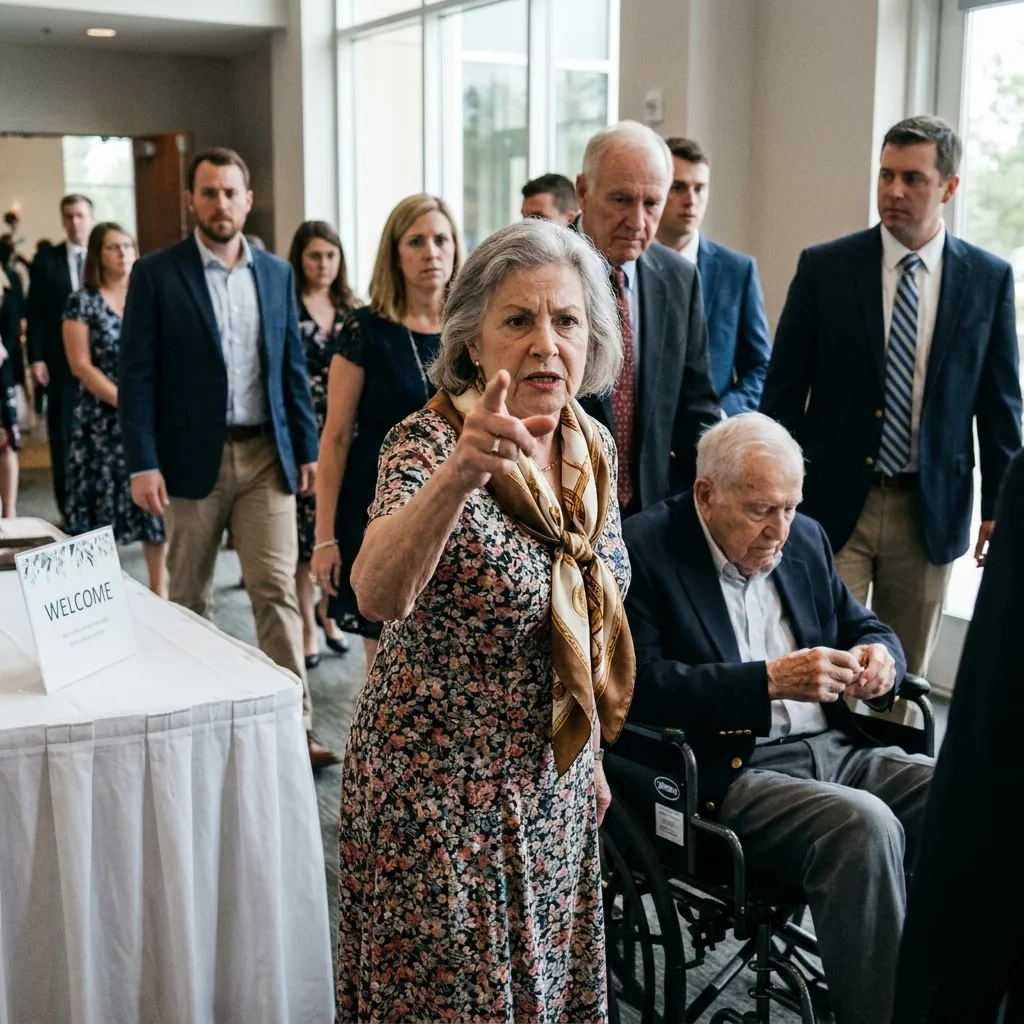
I stayed near the aisle entrance because that was my station, but I also stayed there because Leila was still in the chair I moved for her and the ceremony scarf was slipping a little more every time she shifted. The wrap had a slick underside, and without somebody settling it flat, it slid toward her elbow.
Dahlia noticed it too. She just handled it the same way she handled everything else that afternoon: with a loud correction and quick hands that let go before the job was done.
“Aunt Leila, sit up,” she said, reaching across the front of the chair. She lifted one end of the scarf, tucked it near the shoulder, and then turned immediately to call down the row, “Who moved these programs? And where is the processional order card?”
The scarf dropped again before she finished the sentence.
Leila made a small sound and pressed the water glass against her knee so she could use one hand to catch the fabric. I stepped forward because it was about to brush the floor again.
Dahlia snapped her fingers once in my direction. “Do not touch that scarf.”
I stopped with my hand in the air and said, “Then someone needs to hold it while she stands.”
“Family will do it,” Dahlia said.
Nobody moved.
One cousin was carrying two flower baskets. Another was trying to get three kids to stop stepping onto the runner. Nina came back from the prep hallway with one shoe on and one in her hand. “What now?” she asked.
Leila spoke softly from the chair. “I need a minute.”
Nina bent down to hear her and looked up at me. “Did she get water?”
Tessa was at the linen and water station again, replacing empty glasses on her tray. She answered without stepping into the family argument. “I brought it at 3:44. Mara asked for it when Ms. Leila sat down.”
Dahlia turned toward her. “Nobody asked for a time stamp.”
Tessa said, “You asked what happened. That’s what happened.”
It got quiet around us in that narrow way a room does when people are pretending they are still busy while listening hard. I could hear Ruben’s keys hit against his belt as he crossed the back of the hall. He didn’t come over yet. He only looked once toward the front, saw the aisle still partly blocked, and kept talking into his radio.
Nina put her shoe down and asked, “Who moved the chair?”
“I did,” I said.
Tessa added, “At 3:42. She brought it from the side wall because Ms. Leila asked not to walk all the way from the front row opening.”
Dahlia folded both arms, then unfolded them just to point again. “That is not the issue. The issue is respect. She touched a family item she did not understand.”
Leila was still seated right there with the scarf twisted under one arm. She lifted her chin a little and said, not much louder than before, “I asked her to help me.”
Dahlia answered over her. “You asked for a chair. That is different.”
I said nothing. I had already learned that if I used more than one sentence, Dahlia treated every extra word like proof she could climb onto. So I stayed with facts.
“The scarf was falling,” I said. “I kept it off the floor.”
Nina looked at the scarf, then at Leila’s hand still pinning one side in place. “Can somebody just fix it and get her up?”
Dahlia stepped in immediately like the answer had always been hers. “I will do it. Everyone else stop hovering.”
She set down the processional card she had been carrying, leaned over Leila, and tried to drape both ends evenly from the front. But Leila still had the water glass in one hand, and the chair was angled too tight to the aisle. Dahlia told her to stand. Leila tried, got halfway up, and the scarf slid forward again while the chair leg caught on the carpet edge.
Dahlia let go of the scarf to grab the chair back. The scarf dropped into Leila’s lap. The water tipped onto the silver trim. Nina took one step forward and stopped because a bridesmaid was calling her name from the hallway.
Without thinking, I caught the glass before it fell. Tessa caught the other end of the tray under Leila’s elbow. The three of us were suddenly doing the exact same work Dahlia had spent ten minutes saying I had no right to do.
Ruben reached us then. He looked at the chair angle, the wet scarf edge, and the line of guests now visible through the open doors.
“Aisle needs to clear in two minutes,” he said. Then he looked at me. “Mara, what do you need?”
Before I could answer, Dahlia said, “I need staff to stop interfering with family protocol.”
Ruben didn’t respond to that. He looked at Leila, who was still half-standing, one hand on the chair and one on the scarf, and then at Tessa holding the tray steady.
Tessa said, plain as anything, “Mara moved the chair, got the water, and kept the scarf off the floor twice.”
Ruben’s face didn’t change. He just glanced once toward the side prep room, then down at the key ring in his hand, like he had already decided where the next boundary in that hall was going to fall.