Story code: ST-000175
Part 2: She Kept Changing the Emergency
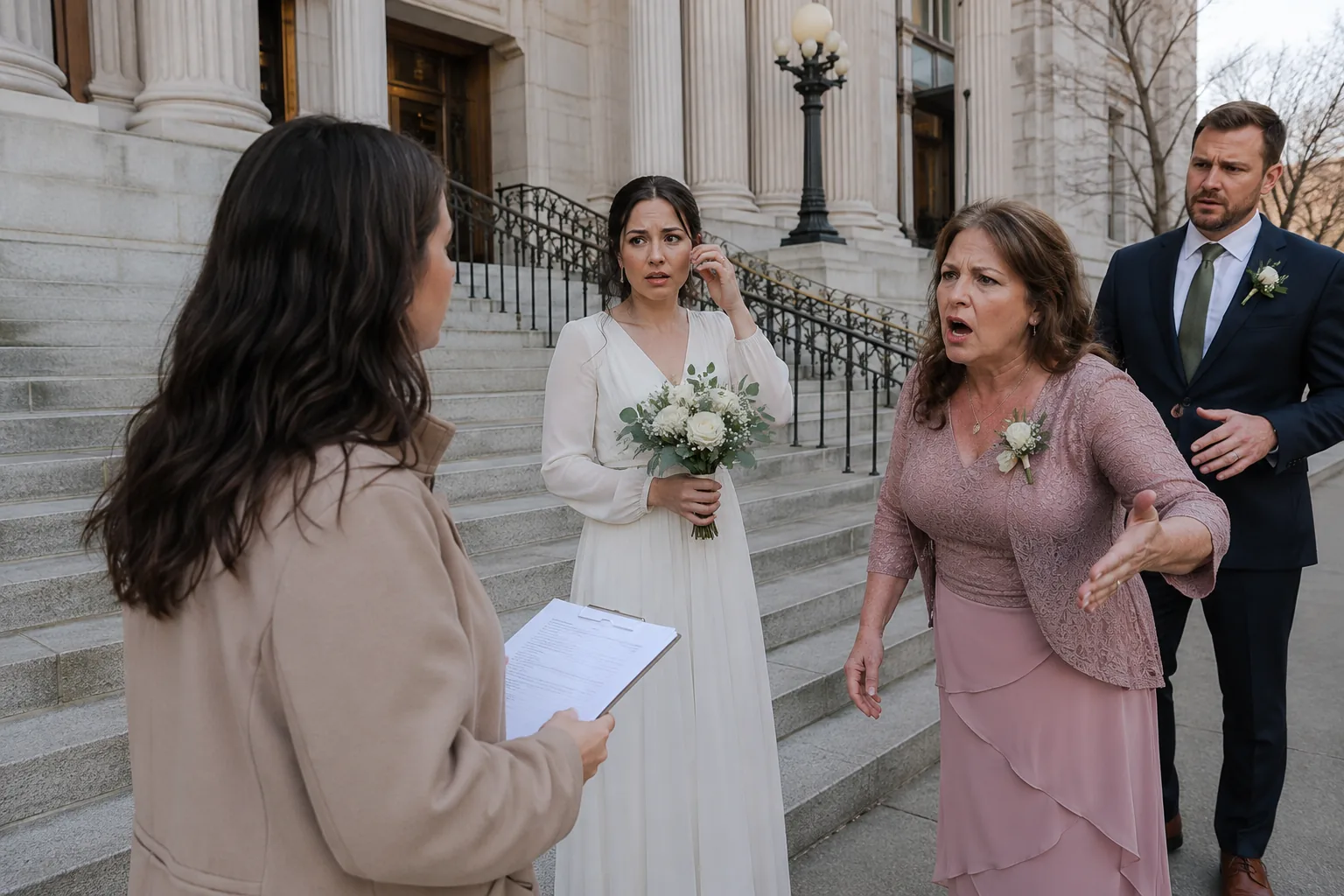
The second Denise grabbed Noah’s wrist, I called for Deputy Evan Cole. I did not raise my voice. I did not argue with her. I just used the radio clipped to my shoulder and said I needed a deputy on the front landing for a disturbance and a reported medical emergency. Those two details mattered together. If the emergency was real, we needed the right response. If it was not, the radio made the next part public. Denise let go of Noah as soon as she heard me say it. She took one step back and pointed at me like I had crossed a line. “You people are unbelievable,” she said. “I came here to get my daughter because there is a family crisis, and now you’re making a scene.” Noah rubbed his wrist once and held his phone lower, not away. “You made the scene.” Alyssa stayed where she was, shoulders tight, bouquet pressed against her middle. She looked from Denise to Noah to me and asked, “What hospital is he going to?” Denise answered too fast. “They haven’t decided.” That earned her a pause from everybody standing close enough to hear. Noah said, “You said he collapsed.” “I said he needs family there.” “You said he wasn’t breathing right.” “He isn’t well, Noah. Stop twisting words.” I have worked enough wedding windows to know how quickly a minute can turn into five when people start talking in circles. The courthouse doors kept opening behind me. Shoes clicked over the stone. Someone from records came out carrying a banker’s box, took one look at the landing, and stepped wide around us. I tucked the marriage license packet under my arm so nobody could snatch it in the confusion. It stayed in the center of everything even when no one named it. Alyssa’s eyes kept going back to it. So did Noah’s. Deputy Cole came through the security doors at an easy pace that usually means he has already decided not to match the loudest person in front of him. He was broad-shouldered, clean uniform, hand resting near his belt but not on anything. He looked first at me, because I had called, then at the space between Denise and the couple. “What do we have?” he asked. I said, “Reported medical emergency offsite, family dispute on the landing, and resistance when 911 was offered.” That was all I could say as fact. Denise jumped in before he could answer. “My brother is in distress. My daughter needs to come with me right now. They’re holding her here over a piece of paper.” Deputy Cole glanced at the packet under my arm, then at Alyssa. “Ma’am, is anyone here preventing you from leaving?” Alyssa shook her head once. “No.” “Do you want to leave?” Denise cut across him. “That’s not the issue.” He held up one finger without looking away from Alyssa. “I asked her.” Alyssa wet her lips and said, “I want to know what happened first.” That shifted the scene in a way even the people watching could feel. Denise stopped talking for one beat too long. Deputy Cole turned to her. “Who is the patient?” “My brother.” “Name?” “Why does that matter?” “So help can go to the right place.” “He’s with family.” “Address?” Denise crossed her arms. “I’m not giving out private family information on courthouse steps.” Noah gave a small disbelieving laugh through his nose, then caught himself. “But you want her to get in a car with you based on nothing.” Denise swung toward him again. “You don’t get to speak.” Deputy Cole stepped one pace between them, not touching anyone. “He can speak. You can answer. Address?” Denise looked at the people standing near the rail. She looked at the woman by the door, the family at the bottom of the steps, then back to the deputy. “It’s being handled.” He said, “By whom?” “My mother.” “With medical personnel?” “I didn’t say that.” “You said he was in distress.” “I said there is a crisis.” The word had changed. I heard it, and so did Noah, because he looked at me for half a second like he wanted someone else to mark it out loud. Deputy Cole did. “A minute ago you told staff there was a medical emergency. Now you’re saying crisis. Which is it?” Denise drew herself up and tried a different direction. “This is exactly why families stop trusting institutions. Everything becomes interrogation. My daughter is needed. That should be enough.” “It’s enough for her to choose,” he said. “It is not enough for you to shut down emergency response if you claim someone collapsed.” Noah lifted his phone again, slower this time, making no move toward Denise. “I can call and put it on speaker. If there’s really no ambulance there, we fix that now.” Denise’s voice sharpened instantly. “Don’t you dare.” Deputy Cole turned his head toward Noah. “Call if you have the number. If not, I’ll call county dispatch once she gives me an address.” Denise stepped sideways, blocking Alyssa’s view of Noah, then shifted again when the deputy mirrored her movement and reopened the line of sight. Alyssa said, very quietly but clearly, “Mom, what hospital?” Denise did not answer that question. She said, “If you marry him today after this, don’t expect me to clean up what comes next.” The landing went still around that sentence. It was the first thing she had said that had nothing to do with a collapsed relative and everything to do with the wedding itself. Deputy Cole looked at me. I looked at the packet under my arm. Noah looked straight at Denise and said, “So this was never about an emergency.” Denise opened her mouth, closed it, and then said the one thing that made me realize Part 3 was going to end in a public test instead of an argument. She pointed at my radio and said, “If anybody calls outside help, I will tell them there.