Story code: ST-000515
Part 2: The Screen Kept Better Time Than He Did
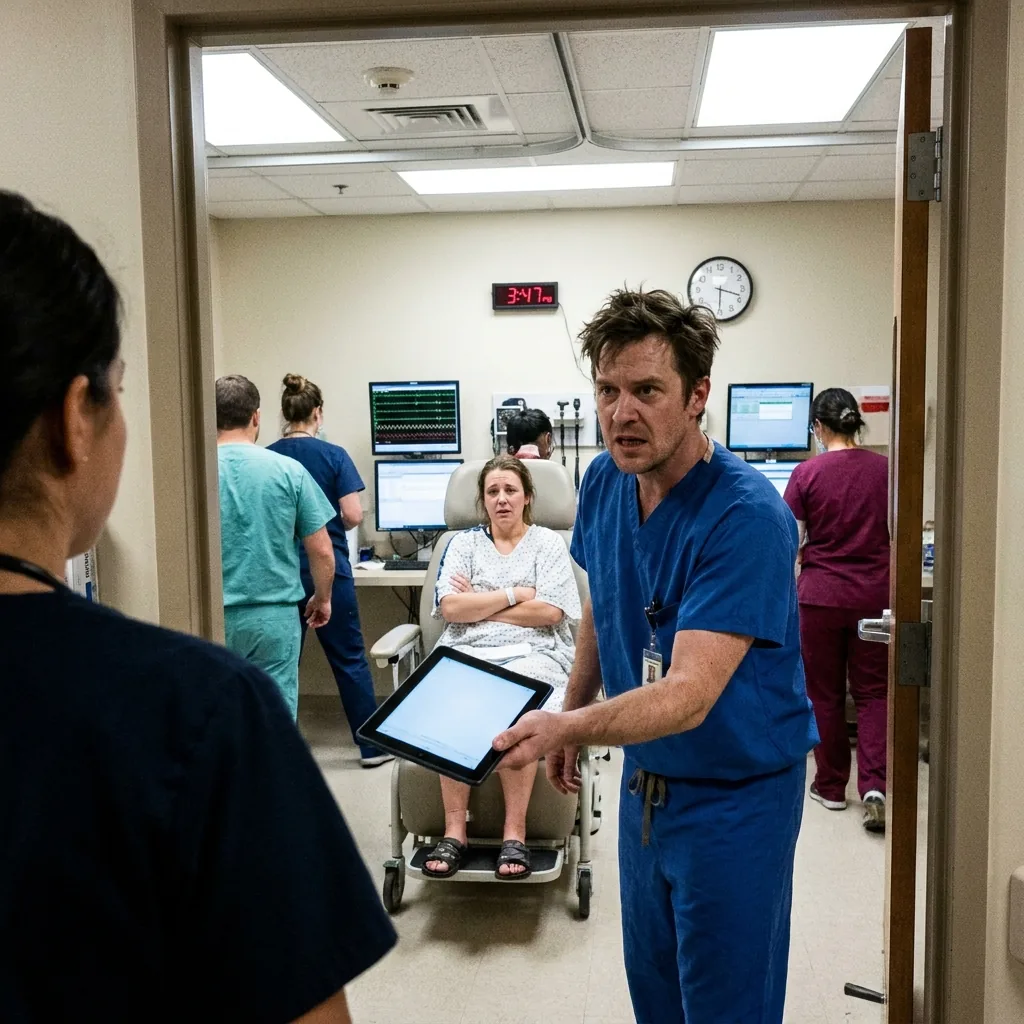
Owen did not lower his phone when Gavin told him not to call. He just looked past him at Leah and said, “You heard what he said.” Leah stayed in the prep chair with both hands together now, not touching the tablet at all, while the wall monitor over the nurse station kept cycling room assignments like nothing in our bay matched the language Gavin was using.
I paged Dr. Rina Cho anyway.
I did it through the bay phone in front of everybody, using the same short request we use when something needs a clinician in the room now but nobody is coding, nobody is crashing, and nobody needs a dramatic speech. The ordinary sound of that page mattered more to me than arguing with Gavin.
He heard it and turned on me. “I said don’t widen this.”
“I requested the supervising clinician,” I said. “That is not widening anything.”
At intake, a child started asking for crackers. Someone laughed softly near the check-in desk. A courier rolled a bin past the glass. The clinic still looked like a clinic, which made Gavin’s pacing and lowered voice stand out harder every second.
He pivoted back to Leah. “By the time she gets here, we may lose what this implant can preserve.”
Owen answered before Leah could. “You said minutes. Then you said procedural emergency. Which one is it?”
Gavin pointed at the tablet. “The point is consent.”
That was the cleanest thing he had said all morning.
Leah lifted her chin a little. “Then why do you keep saying emergency instead of just telling me what’s on the screen?”
He brought the tablet closer again. “Because your delay affects outcome.”
“Show me where it says that,” she said.
For the first time, he did not immediately angle the screen toward her. He kept it partly turned toward himself and started talking instead of showing. I stepped around the supply cart so I had a straight sightline to the tablet.
“Let me see the timestamp,” I said.
“It’s not relevant,” Gavin said.
“It’s on the consent screen,” I said. “So it’s relevant.”
He gave me a look but did not move the tablet. Owen saw that too.
“If this is so urgent,” Owen said, “why are you arguing about the screen instead of getting the doctor?”
Gavin’s answer changed shape again. “Because the doctor cannot authorize patient choice for her.”
“Nobody asked her to authorize it,” I said. “We asked for her to be here if you’re claiming an override-level urgency.”
Leah spoke without raising her voice. “Am I allowed to wait until she gets here?”
“You can wait,” I said.
Gavin cut over me. “You can, but I strongly advise against it.”
That was different from minutes. Different from intervention window. Different from can’t guarantee the outcome. The room had heard all three versions now.
Dr. Cho arrived from the hall in her white coat with her badge half tucked under the lapel. She did not rush in dramatically. She stepped into the bay, looked at Leah first, then at the tablet, then at me.
“What claim is being made?” she asked.
I answered with what I had heard, nothing more. “Gavin told Ms. Bennett she had minutes to consent because of a narrowing emergency window. When her husband offered to call outside help and I paged up, he objected to both. Consent has not been completed.”
Dr. Cho held out her hand. “Tablet.”
Gavin didn’t give it to her right away. It was only a pause of maybe two seconds, but in a clinic bay two seconds can sound loud. Then he passed it over.
She repositioned it so all of us could see the screen. The consent prompts were still open. The timestamp in the corner showed when the form had first been pulled up. Another smaller line showed inactivity and re-entry after timeout warning.
Dr. Cho read without comment for a few beats. “What emergency protocol term did you use with the patient?”
“Implant instability risk,” Gavin said.
“That is not a protocol term,” she said. “What exact event occurred?”
He started explaining in wider circles. “There was concern about preserving continuity if we lost the slot and if her tolerance window shifted and if-”
Dr. Cho lifted one finger and he stopped.
“Did a medical event occur in this room requiring emergency deviation from normal consent pace?”
Gavin looked at Leah, then at the wall monitor, then back to Dr. Cho. “Not a medical event in that sense.”
Nobody in the bay said anything after that. The front desk printer started again. Somewhere behind us, a drawer shut.
Dr. Cho tapped the top of the tablet screen once. “This form was opened before the first emergency wording was used, and it remained unsigned through repeated prompts. Why was the patient being told she had minutes?”
Gavin opened his mouth, closed it, and then tried a smaller version of the story. “I was emphasizing same-day decision pressure.”
Owen gave one short laugh with no humor in it. “You said emergency. Twice.”
Dr. Cho did not look at him. She kept her eyes on the screen. “Nina, note the current room time. Ms. Bennett, you are not under emergency consent conditions. You may pause this process.”
Leah’s shoulders dropped away from the tablet for the first time since Gavin walked in. She set both hands on the sides of the chair and said, very clearly, “Then I am pausing.”
Dr. Cho turned the tablet so the timestamp faced outward, not toward Gavin anymore. “Stay here,” she said to him. “Do not reopen this form.”
Then she looked at me and said, “I want the event log and the access sequence pulled before anyone touches this device again.”
That was when the tablet stopped looking like sales pressure and started looking like evidence, and Gavin finally stopped talking.