Story code: ST-001055
Part 4: The Audit Trail
The system log printer emitted a sharp, rhythmic clicking sound as it output the data lines. The paper curled into the plastic bin, the black ink still faint as the thermal head pressed against the sheet.
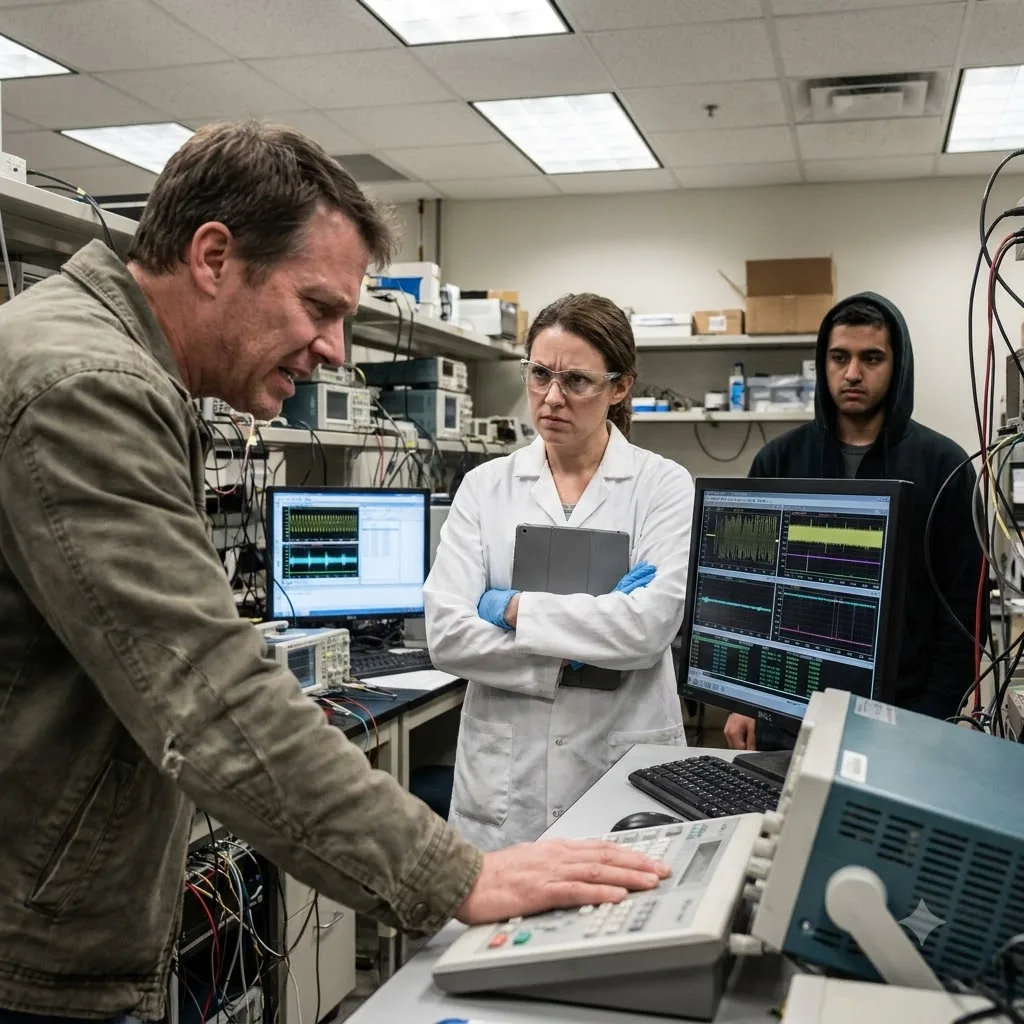
Leo stood by the junction box, his arms crossed over his chest. He did not look at the printer or at the monitors. His gaze was fixed on the concrete floor between his boots.
Sarah pulled the printed paper from the tray, tearing it along the serrated edge. She laid the sheet flat on the console desk, smoothing it with the palm of her hand. I leaned over to read the printed registry lines alongside her.
“`
[SYSTEM TEST SUMMARY: ARRAY ALPHA]
TIMESTAMP: 21:19:15
COHERENCE RATE: 99.84% (STABLE)
AMBIENT FIELD: 1.02 T (BASELINE)
ACTIVE SIMULATION INJECTION: DETECTED
INJECTION SOURCE: LOCAL TERMINAL B
INJECTION TIMESTAMP: 21:05:12
AUTHENTICATION CREDENTIAL: OPERATOR_L_OCTAVE
“`
Sarah read the lines slowly, her finger moving down the page until she reached the authentication credential. “Operator L Octave. That is your local login, Leo.”
Leo did not move from the wall. “The simulator tool is used for training exercises. I must have left the process running in the background during the afternoon shift.”
“The injection occurred at 21:05,” I said, pointing to the digital clock on the master console, which now read 21:20. “That was fifteen minutes ago. You logged into terminal B ten minutes before you claimed the system was collapsing.”
“It was a calibration check,” Leo said, his voice dropping to a low, quiet tone. He did not look up. “I wanted to see how the system handled emergency telemetry under load. I was going to cancel it before the log cycle.”
“You demanded I sign a manual override bypass,” Sarah said. She did not raise her voice, but her speech was measured, each syllable distinct in the quiet room. “If I had signed it, the registry would have recorded a manual bypass on a stable system, and the override would have covered up the simulation run. It would have looked like we had an actual system event that we resolved without reporting it.”
Leo reached into his pocket and pulled out his keys. “It was a mistake in the sequence. I misread the active process flags on my terminal.”
“The live query has already uploaded the results to the campus safety server,” I said.
A soft chime sounded from my terminal. The screen flashed a blue notification window, replacing the diagnostic interface with the official university safety board registry lock. A text box displayed the administrative response: *Manual override access suspended for Operator ID: L_OCTAVE pending administrative review. Facility access credentials updated.*
Leo walked to the coat rack near the entrance. He took his jacket off the hook and slid his arms into the sleeves. He did not pick up his notebook or his coffee mug from the desk.
“We will have to explain this to the department chair tomorrow,” Sarah said, her voice remaining steady as she folded the printed diagnostic report in half and placed it inside the lab’s physical logbook.
“Yes,” Leo said. He reached for the door handle, turned it, and stepped out into the brightly lit hallway. The heavy laboratory door swung shut behind him, the magnetic lock clicking into place with a dry, metallic snap.
I sat back in my chair, pulled the logbook toward me, and entered the final timestamp for the shift run: 21:22. The system monitors returned to their quiet blue standby screens, the cooling pumps continuing their steady, uninterrupted hum.