Story code: ST-001058
Part 1: The Vocabulary of Authority
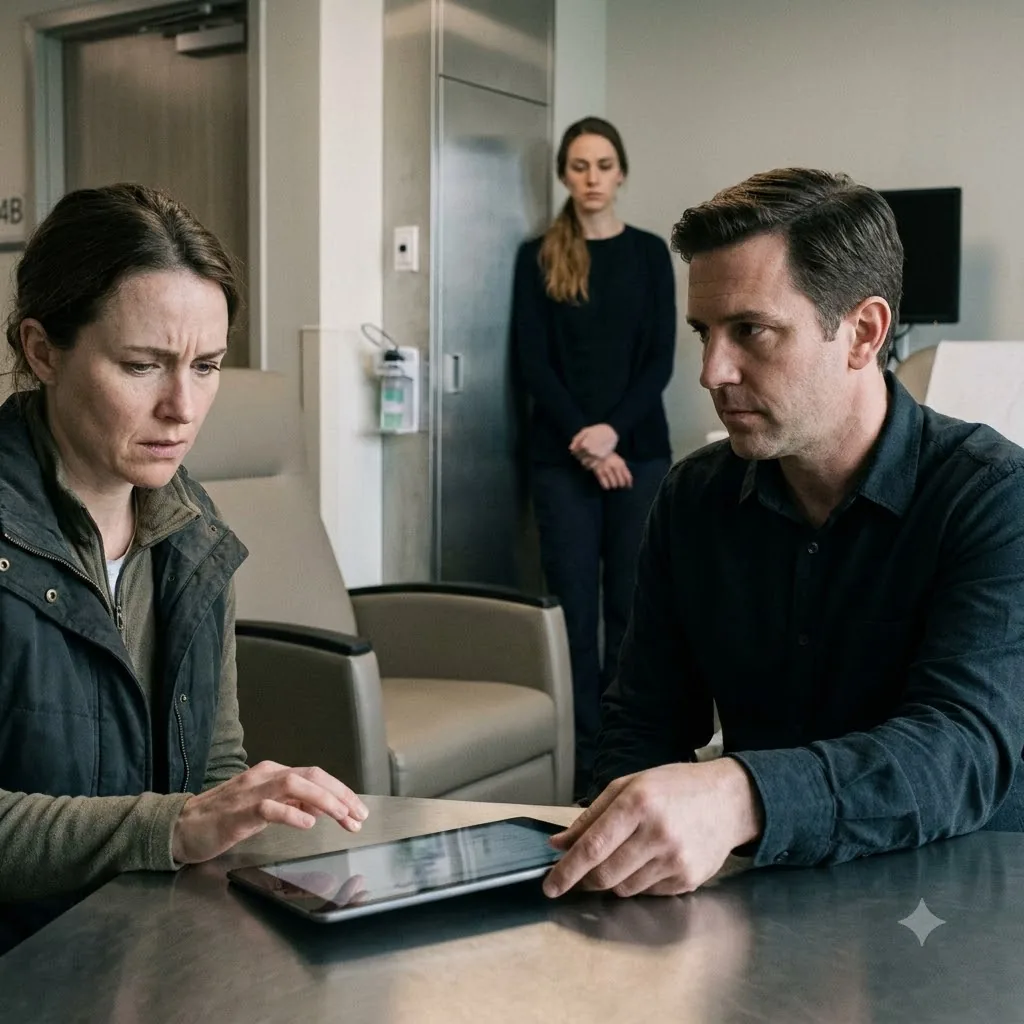
Inside Room 4B of the Veritas Neuro-Clinic, our lead memory technician Harrison slid a glass-backed implant consent tablet toward Clara, using dense, fabricated medical jargon to shame her as too ignorant to object to the procedure. When she hesitated, wringing her hands over the screen, Harrison smoothed his clinical coat and adjusted the collar, his voice dropping into a patronizing register that filled the quiet specialist room. I stood in the corner of the room by the equipment cart, adjusting my safety glasses and holding the calibration stylus tightly as I watched the scene unfold.
‘The interface requires a biometric signature to proceed, Clara,’ Harrison said, tapping his fingers rhythmically on the tablet’s metallic frame. ‘Your concerns about post-operative memory loss are entirely moot. The implant employs a localized gradient matrix with active synaptic shielding. If you had a basic certification in neural-bypass architecture, you would know that lateral memory sectors are structurally isolated.’
Clara hunched her shoulders, her eyes fixed on the glowing blue border of the digital prompt. ‘I only wanted to know if I will still remember my sister’s face. She passed away last year. The nurse outside said there were risks of lateral erasure.’
‘The nurse is a triage coordinator, not a lead technician,’ Harrison replied, his rapid-fire cadence cutting her off. ‘To suggest that standard synaptic shielding could interfere with deep-cortex autobiographical files is an unscientific leap. We are here to stabilize your cognitive baseline, not debate the physics of neural integration with laypeople. If you refuse to sign the prompt because of terminology you do not grasp, we will have to forfeit your slot. There are twelve patients waiting in the lobby who understand the value of this technology.’
Across the table, Dr. Aris, Clara’s family physician, did not look up from his small physical notepad. He wore a simple wool coat over clinical scrubs and wrote slow, deliberate notes with a mechanical pencil. ‘Harrison,’ Dr. Aris said, his voice flat, ‘Clara is asking a straightforward question. She wants to ensure her personal recollections remain intact.’
‘And I have answered it using the precise clinical language of our licensing board,’ Harrison said, gesturing toward the diagnostic monitor on my cart. ‘My assistant, Julian, can pull up the schematics, but unless you possess a specialization in neuro-dynamics, the math will simply look like Greek to you. We do not have the time to conduct a remedial class today.’
Clara pulled her hands back, pressing them against her lap. ‘I do not understand what a localized gradient is. I just want to be sure.’
‘If you were sure, you wouldn’t be delaying the queue,’ Harrison said. He reached over and tapped the screen, activating the biometric sensor.
Dr. Aris stopped writing. He tapped the end of his pencil against the paper. ‘Harrison, if the shielding is as robust as you claim, then how does this specific model handle retrograde synaptic feedback loops during the initial synchronization phase?’
I kept my eyes on the diagnostic panel. Having prepared these units for two years, I knew the Veritas technical manuals cover to cover. The term ‘retrograde synaptic feedback loop’ did not exist in any manual. It was a completely fabricated term, a snare.
Harrison did not blink. He smiled, leaning forward on his elbows and smoothing the front of his coat. ‘Ah, the retrograde loop. A common concern for general practitioners who rely on older literature. In this particular model, the feedback loop is routed directly through the secondary bypass gate, which dampens the signal to a negligible sub-hertz frequency before it can reach the cortex. It is a proprietary protocol designed precisely to prevent any lateral memory bleed during activation. We run it routinely.’
Dr. Aris recorded the response in his pad, his pencil scratching against the paper in the quiet room.
Inside Room 4B of the Veritas Neuro-Clinic, our lead memory technician Harrison slid a glass-backed implant consent tablet toward Clara, using dense, fabricated medical jargon to shame her as too ignorant to object to the procedure. When she hesitated, wringing her hands over the screen, Harrison smoothed his clinical coat and adjusted the collar, his voice dropping into a patronizing register that filled the quiet specialist room. I stood in the corner of the room by the equipment cart, adjusting my safety glasses and holding the calibration stylus tightly as I watched the scene unfold.
‘The interface requires a biometric signature to proceed, Clara,’ Harrison said, tapping his fingers rhythmically on the tablet’s metallic frame. ‘Your concerns about post-operative memory loss are entirely moot. The implant employs a localized gradient matrix with active synaptic shielding. If you had a basic certification in neural-bypass architecture, you would know that lateral memory sectors are structurally isolated.’
Clara hunched her shoulders, her eyes fixed on the glowing blue border of the digital prompt. ‘I only wanted to know if I will still remember my sister’s face. She passed away last year. The nurse outside said there were risks of lateral erasure.’
‘The nurse is a triage coordinator, not a lead technician,’ Harrison replied, his rapid-fire cadence cutting her off. ‘To suggest that standard synaptic shielding could interfere with deep-cortex autobiographical files is an unscientific leap. We are here to stabilize your cognitive baseline, not debate the physics of neural integration with laypeople. If you refuse to sign the prompt because of terminology you do not grasp, we will have to forfeit your slot. There are twelve patients waiting in the lobby who understand the value of this technology.’
Across the table, Dr. Aris, Clara’s family physician, did not look up from his small physical notepad. He wore a simple wool coat over clinical scrubs and wrote slow, deliberate notes with a mechanical pencil. ‘Harrison,’ Dr. Aris said, his voice flat, ‘Clara is asking a straightforward question. She wants to ensure her personal recollections remain intact.’
‘And I have answered it using the precise clinical language of our licensing board,’ Harrison said, gesturing toward the diagnostic monitor on my cart. ‘My assistant, Julian, can pull up the schematics, but unless you possess a specialization in neuro-dynamics, the math will simply look like Greek to you. We do not have the time to conduct a remedial class today.’
Clara pulled her hands back, pressing them against her lap. ‘I do not understand what a localized gradient is. I just want to be sure.’
‘If you were sure, you wouldn’t be delaying the queue,’ Harrison said. He reached over and tapped the screen, activating the biometric sensor.
Dr. Aris stopped writing. He tapped the end of his pencil against the paper. ‘Harrison, if the shielding is as robust as you claim, then how does this specific model handle retrograde synaptic feedback loops during the initial synchronization phase?’
I kept my eyes on the diagnostic panel. Having prepared these units for two years, I knew the Veritas technical manuals cover to cover. The term ‘retrograde synaptic feedback loop’ did not exist in any manual. It was a completely fabricated term, a snare.
Harrison did not blink. He smiled, leaning forward on his elbows and smoothing the front of his coat. ‘Ah, the retrograde loop. A common concern for general practitioners who rely on older literature. In this particular model, the feedback loop is routed directly through the secondary bypass gate, which dampens the signal to a negligible sub-hertz frequency before it can reach the cortex. It is a proprietary protocol designed precisely to prevent any lateral memory bleed during activation. We run it routinely.’
Dr. Aris recorded the response in his pad, his pencil scratching against the paper in the quiet room.