Story code: ST-000366
Part 1: Out of Sequence
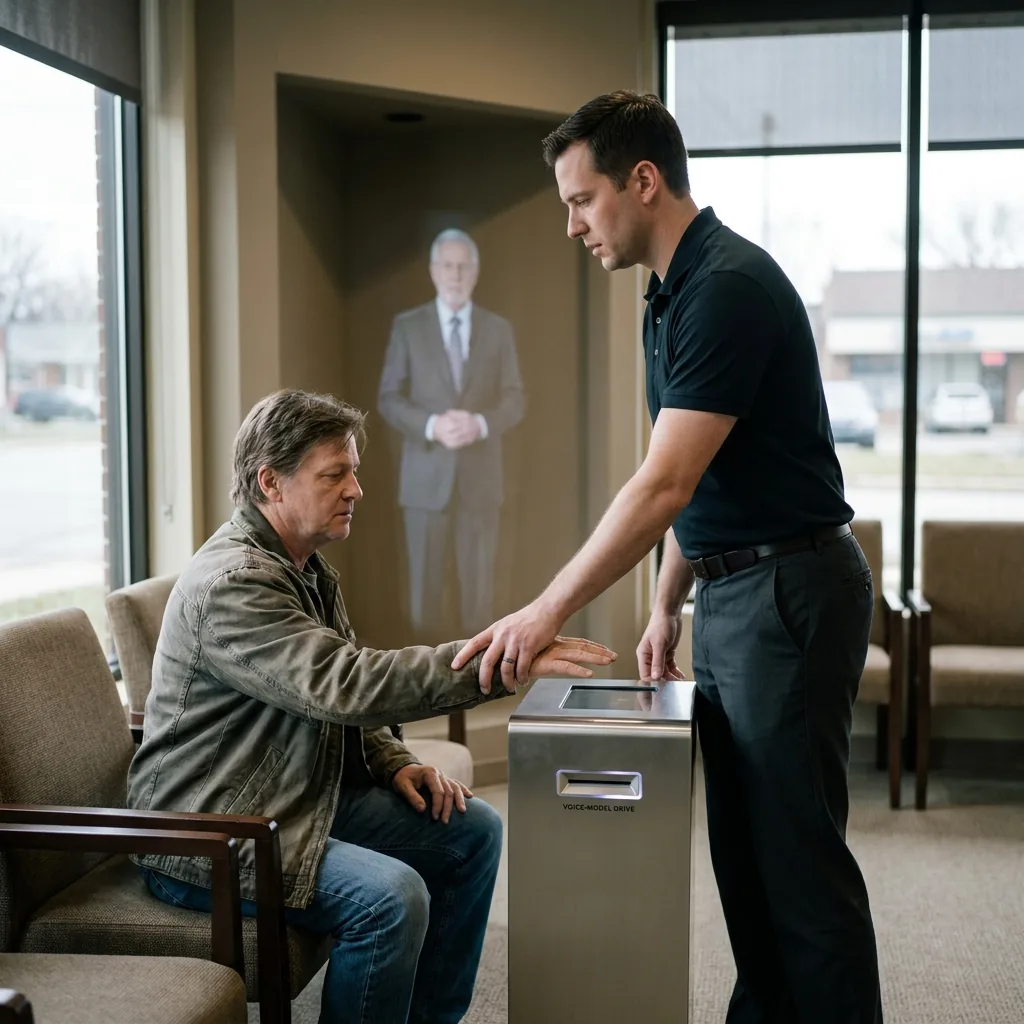
Grant Voss stopped my hand before I could touch Eli Moran’s voice-model drive. I was at the front authority desk inside Lumen Passage Memorial Showroom, right under the session sequence screen, and he used the same calm tone you hear in a bank to tell me my request was out of sequence. Behind him, the demo corridor booths kept running memorial voices to other families, soft and ordinary, while he kept one hand on the console and the other over my brother’s drive like it belonged to him.
“You can’t jump to that clip,” he said. “The sequence has to preserve narrative integrity.”
I looked at the drive in the tray. Eli’s name was etched on the edge label in tiny silver letters. The metadata panel was already live on the screen beside it, and the timestamps were plain enough for me to read without leaning in: 7:14 p.m., 7:18 p.m., 6:52 p.m. Not the order Grant was feeding me. Not the last day I remembered. Not even close.
I kept my voice level. “That isn’t chronological.”
Grant’s fingers moved fast across the touchscreen. The session sequence screen shifted, and the highlighted clip path snapped back to the first approved segment, the one with Eli saying my name in that warm teasing voice from the recordings they sold to families. “It is in the approved playback order,” he said. “That is the order attached to the memorial package.”
“I didn’t ask for approved. I asked for the clip from the last afternoon.” I pointed at the timestamps. “These don’t match.”
He didn’t look at the drive. He looked at me like I was the problem the room had to accommodate. “Memorial playback is not a free-form search. The order protects continuity. If you start in the middle, you can damage the experience.”
The word experience landed wrong in my chest. Eli was not an experience. Eli had called me from his car with road noise behind his voice. Eli had texted me from the parking lot. Eli had been real in the messy order real life happens, not neat enough for a showroom script.
I reached past the edge of the counter for the customer release tablet. Grant slid it away without raising his voice. The motion was so smooth it almost looked polite. “I can’t authorize open access,” he said. “Not without manager verification.”
That was the first visible harm. Not the death. Not the hologram. The harm was smaller and meaner: he blocked me from the only memory path that could tell me whether the showroom’s version of my brother matched the day I lived through.
A family in the demo corridor laughed at something their memorial said. The sound came through the glass wall in little bursts, then faded under the low hum of the playback system. I heard my own breathing in the silence around Grant’s desk.
“Show me the full list,” I said.
He tapped twice. The panel widened, but only for a second. A line of clip names appeared with the timestamps beside them, and the order still made no sense. The 7:14 clip came after the 7:18 clip, and the 6:52 clip sat below both of them, like the drive had been arranged by someone who had never seen a clock.
I read them out loud. Grant’s jaw tightened by a fraction.
“Those are internal stamps,” he said. “They don’t change the official sequence.”
“Then what do they mean?”
He answered too quickly. “They mean the system is protecting the intended presentation.”
Intended for who?
I didn’t say it yet. I was still staring at the timestamps, trying to line them up with the day Eli died, with the coffee stain on his shirt, with the text he sent me after he left my apartment, with the fact that I had been in the same city and had heard his voice alive after the time Grant was showing me. If the drive was real, one of those times had to be wrong. If the times were right, then the showroom was showing me a story that could not have happened.
Grant rested two fingers on the console as if he could hold the whole truth in place by touch alone. “We can continue in proper sequence,” he said. “Or we can pause and wait for Monica Hale.”
I looked back at the screen. The timestamps were still there, and now one detail I hadn’t noticed before was sitting underneath them in a tiny system note: clip import completed after session lock.
That didn’t fit either.
Grant Voss stopped my hand before I could touch Eli Moran’s voice-model drive. I was at the front authority desk inside Lumen Passage Memorial Showroom, right under the session sequence screen, and he used the same calm tone you hear in a bank to tell me my request was out of sequence. Behind him, the demo corridor booths kept running memorial voices to other families, soft and ordinary, while he kept one hand on the console and the other over my brother’s drive like it belonged to him.
“You can’t jump to that clip,” he said. “The sequence has to preserve narrative integrity.”
I looked at the drive in the tray. Eli’s name was etched on the edge label in tiny silver letters. The metadata panel was already live on the screen beside it, and the timestamps were plain enough for me to read without leaning in: 7:14 p.m., 7:18 p.m., 6:52 p.m. Not the order Grant was feeding me. Not the last day I remembered. Not even close.
I kept my voice level. “That isn’t chronological.”
Grant’s fingers moved fast across the touchscreen. The session sequence screen shifted, and the highlighted clip path snapped back to the first approved segment, the one with Eli saying my name in that warm teasing voice from the recordings they sold to families. “It is in the approved playback order,” he said. “That is the order attached to the memorial package.”
“I didn’t ask for approved. I asked for the clip from the last afternoon.” I pointed at the timestamps. “These don’t match.”
He didn’t look at the drive. He looked at me like I was the problem the room had to accommodate. “Memorial playback is not a free-form search. The order protects continuity. If you start in the middle, you can damage the experience.”
The word experience landed wrong in my chest. Eli was not an experience. Eli had called me from his car with road noise behind his voice. Eli had texted me from the parking lot. Eli had been real in the messy order real life happens, not neat enough for a showroom script.
I reached past the edge of the counter for the customer release tablet. Grant slid it away without raising his voice. The motion was so smooth it almost looked polite. “I can’t authorize open access,” he said. “Not without manager verification.”
That was the first visible harm. Not the death. Not the hologram. The harm was smaller and meaner: he blocked me from the only memory path that could tell me whether the showroom’s version of my brother matched the day I lived through.
A family in the demo corridor laughed at something their memorial said. The sound came through the glass wall in little bursts, then faded under the low hum of the playback system. I heard my own breathing in the silence around Grant’s desk.
“Show me the full list,” I said.
He tapped twice. The panel widened, but only for a second. A line of clip names appeared with the timestamps beside them, and the order still made no sense. The 7:14 clip came after the 7:18 clip, and the 6:52 clip sat below both of them, like the drive had been arranged by someone who had never seen a clock.
I read them out loud. Grant’s jaw tightened by a fraction.
“Those are internal stamps,” he said. “They don’t change the official sequence.”
“Then what do they mean?”
He answered too quickly. “They mean the system is protecting the intended presentation.”
Intended for who?
I didn’t say it yet. I was still staring at the timestamps, trying to line them up with the day Eli died, with the coffee stain on his shirt, with the text he sent me after he left my apartment, with the fact that I had been in the same city and had heard his voice alive after the time Grant was showing me. If the drive was real, one of those times had to be wrong. If the times were right, then the showroom was showing me a story that could not have happened.
Grant rested two fingers on the console as if he could hold the whole truth in place by touch alone. “We can continue in proper sequence,” he said. “Or we can pause and wait for Monica Hale.”
I looked back at the screen. The timestamps were still there, and now one detail I hadn’t noticed before was sitting underneath them in a tiny system note: clip import completed after session lock.
That didn’t fit either.