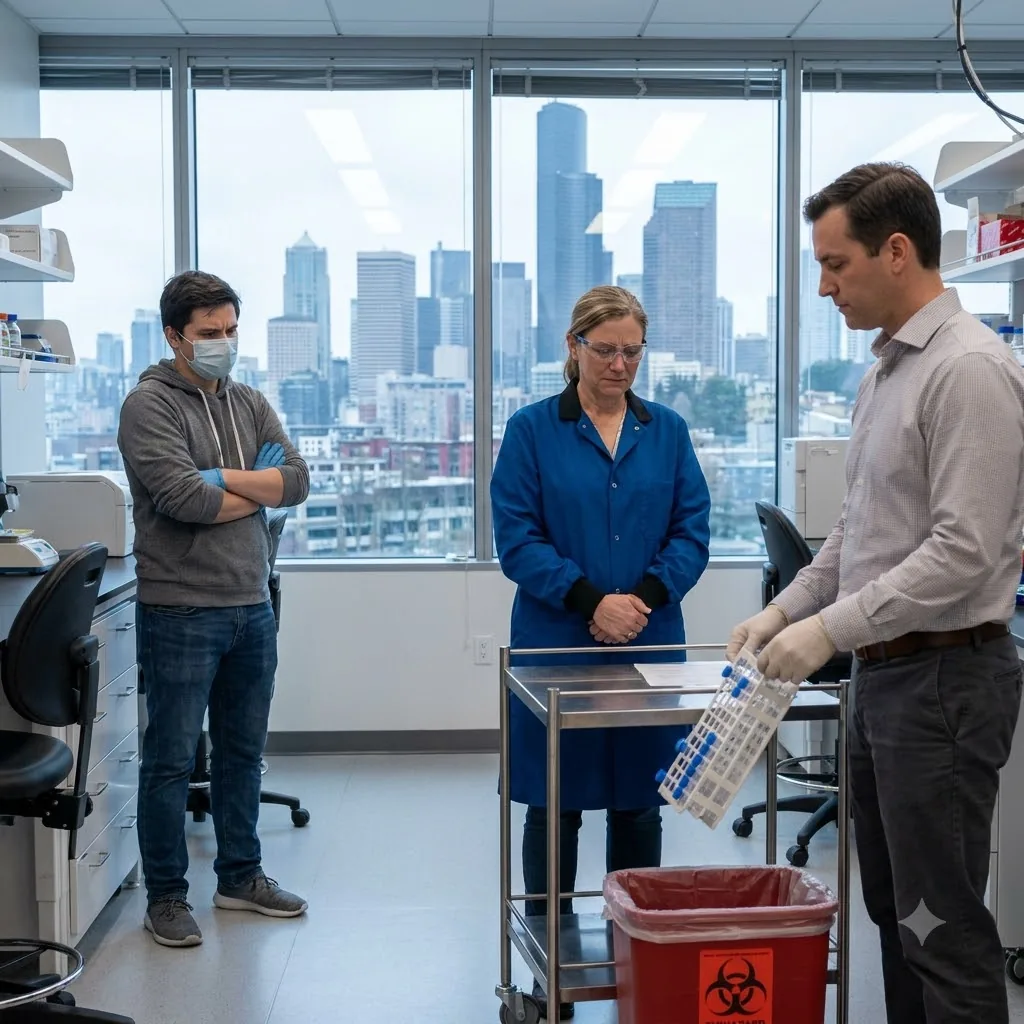
Story code: ST-001076
Part 3: The Locked Interface
I spent the afternoon running calibration sweeps on CRISPR Sequencer Unit 4, my fingers running along the edges of the physical blue ledger. Across the room, Elena Vance was bent over her desk, her hand resting against her temple as she stared at the flashing red warning on her monitor. The screen displayed the initial analysis of Lab Report #882-G. The system flagged her baseline control samples as contaminated, a result that would trigger a mandatory federal inquiry into her research integrity. I wrote the serial number of the sequencer into the blue ledger, my pen scratching loudly in the quiet room. Elena’s coffee had gone cold, a thin film forming over the dark liquid. She rubbed her temples, the pale light of the screen reflecting off her tired eyes.
Julian Miller stood nearby, holding an empty pipette tip box. He was slowly, deliberately trying to fit a tip into the wrong size rack, his brow furrowed in mock concentration. “I think I messed up the layout again, Elena,” he muttered, dropping a plastic tip onto the clean tile floor. “The calibration looks weird. Should I just press delete and start over?”
Elena did not look up from her screen. “Don’t touch the interface, Julian,” she said, her voice dry and flat.
From my desk, I adjusted my safety goggles and opened the system’s background terminal. While Julian stood fumbling with the plastic box, I pulled up the system log history for the night before. The audit trail was clear. At 11:43 PM, Julian’s unique credential ID-JM-9921-had accessed the calibration values for the control samples. The logs showed he had manually entered the commands to adjust the baseline values, artificially raising the threshold to make Elena’s clean samples appear contaminated. He had done it with surgical precision. There were no retries, no syntax errors. The sequence of commands had been executed in a single three-minute block.
I glanced at Julian. He was now typing on his keyboard with his two index fingers, hitting the backspace key three times for every word as he drafted a message on his screen.
“Marcus wants the final report submitted before the five o’clock archive sweep,” Julian said, his tone casual. He pointed a single finger at the screen. “It says it needs a supervisor sign-off to go to the federal portal. I can enter it for you if you’re busy.”
“Leave it,” Elena said.
I stood up, carrying the blue ledger, and walked over to the shared terminal. I clicked on the active log interface, pulling up the metadata panel for Lab Report #882-G. I did not close the window. Instead, I split the display screen, pinning the raw access logs-complete with Julian’s ID, the exact timestamps, and the flawless command inputs-directly next to the final submission form. Julian shifted his weight, his eyes darting to the screen. His hand stayed hovering near his pocket.
“The system has locked the file for pre-submission review,” I said, pointing to the blinking indicator on the monitor. “Any attempt to modify or delete the report now will automatically route the entire change history directly to the federal audit board.”
Julian’s shoulders went rigid. He stared at the screen, where his login ID was displayed in bright green characters next to the altered calibration code. He could no longer delete the evidence of his late-night work without alerting the entire network.