Story code: ST-000650
Part 3: What The Log Actually Showed
Dr. Alvarez did not let the room drift back into interpretation. She kept the wall display on the station console and pulled up the session verification panel that sat behind the review interface. It was plain, gray, and harder to turn into gossip than Ethan’s clip. That alone changed the temperature around the optics bench row.
The verification log listed every screen-state change in order: review mode opened, panel expanded, station tag opened, scrubber moved backward, bookmark created, recording initiated from a phone camera angle, then clip playback in chat less than two minutes later. The sequence appeared one line at a time with machine timestamps down to the second.
Noah leaned closer without raising his phone. “So the graph wasn’t caught live,” he said.
“No,” Dr. Alvarez said. “The recording was made during review navigation.”
She clicked again and brought up the bracelet session map tied to my ID. The graph spike Ethan had posted still sat there. Nobody disputed that. But now it appeared beside the rest of the session context: bench check-in, idle interval, review access, and a short annotation marker from the system showing biometric response during a display event. The marker did not label misconduct. It did not place me where Ethan’s caption had placed me. It just recorded that my bracelet registered a stress spike while the review system was being used.
Ethan spoke into the gap before anyone else could. “A spike is still a spike.”
Dr. Alvarez did not look at him. She traced the time bar with one finger near the screen. “The spike aligns with the moment the display station loaded her bracelet panel into review. Not with a live location transition.”
That sentence stripped the clip down to its frame. The thing everyone had been treating as a caught lie was now just a bracelet reaction attached to a review event on a screen.
Someone behind Noah said, “So he posted her reaction data and called it proof.”
Nobody answered that right away.
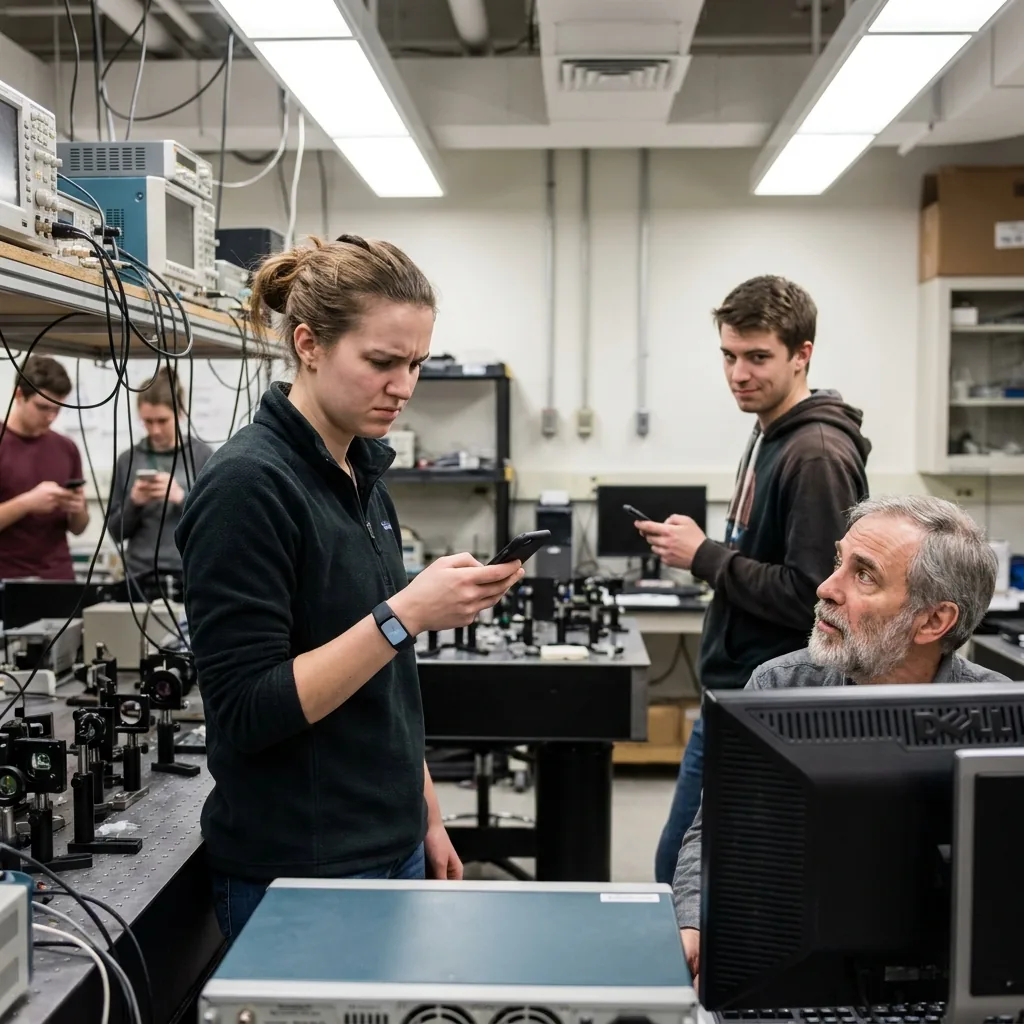
Dr. Alvarez opened one more pane. The station camera feed was not a dramatic video wall, just the routine overhead lab record used to confirm equipment access. The image showed the wall display station from above and behind. Timestamp in the corner. No sound. People crossing through. My figure visible only in angles and partial turns.
She dragged to the minute Ethan had centered in his clip.
The overhead footage showed the wall display active. It showed Ethan at the station. It showed his phone lifted toward the screen. It showed me several feet away near the optics bench row, one hand braced on the edge of the cart while I looked toward the monitor after the panel had already been opened.
Noah said, very flat, “She’s not even at the station when he records it.”
“Correct,” Dr. Alvarez said.
Ethan shifted his grip on the stool and said, “That doesn’t mean she didn’t lie earlier.”
“Then produce a record for that claim,” Dr. Alvarez said. “What you posted does not do it.”
The overhead feed rolled on for another few seconds. It showed Ethan turning the phone, likely framing the display more tightly. It showed me step closer only after that. Then Dr. Alvarez stopped the footage.
The room stayed still in that particular way people do when the process gets too clear to interrupt.
I could have asked her to keep going. The overhead system would have shown more of the same room and maybe more of Ethan handling his phone. It might also have pulled more of my private bracelet review onto a bigger screen for a longer time. The proof lane had already narrowed where it needed to narrow.
“That’s enough,” I said.
Dr. Alvarez turned from the monitor to me. “You don’t want the rest displayed?”
“No. The point is already there.”
That was the first choice in the room that did not feed the spectacle. Noah looked from me to the screen, then lowered his eyes and locked his phone. A researcher near the fiber spool cart did the same.
Dr. Alvarez nodded once and closed the overhead panel. Then she looked at Ethan.
“You posted non-consensual bracelet-linked review material to the lab chat,” she said. “You framed it as proof before verification. You also recorded at the station during a review sequence. Those are recordable issues.”
Ethan started with, “I was trying to show-”
She cut across him with the same even voice. “You can explain in writing after I finish the verification note.”
She opened a fresh entry in the lab system. The header appeared on the monitor where everyone could see it: Unauthorized capture and distribution during device review. Under it, she entered the station number, my bracelet ID, the verification timestamp chain, and Ethan’s user handle from the chat attachment.
Then the final irreversible line appeared.
Pending review, Ethan’s access to bracelet-session review panels and wall-display export functions was suspended effective immediately.