Story code: ST-000816
Part 2: Everything Stalled Around That Tag
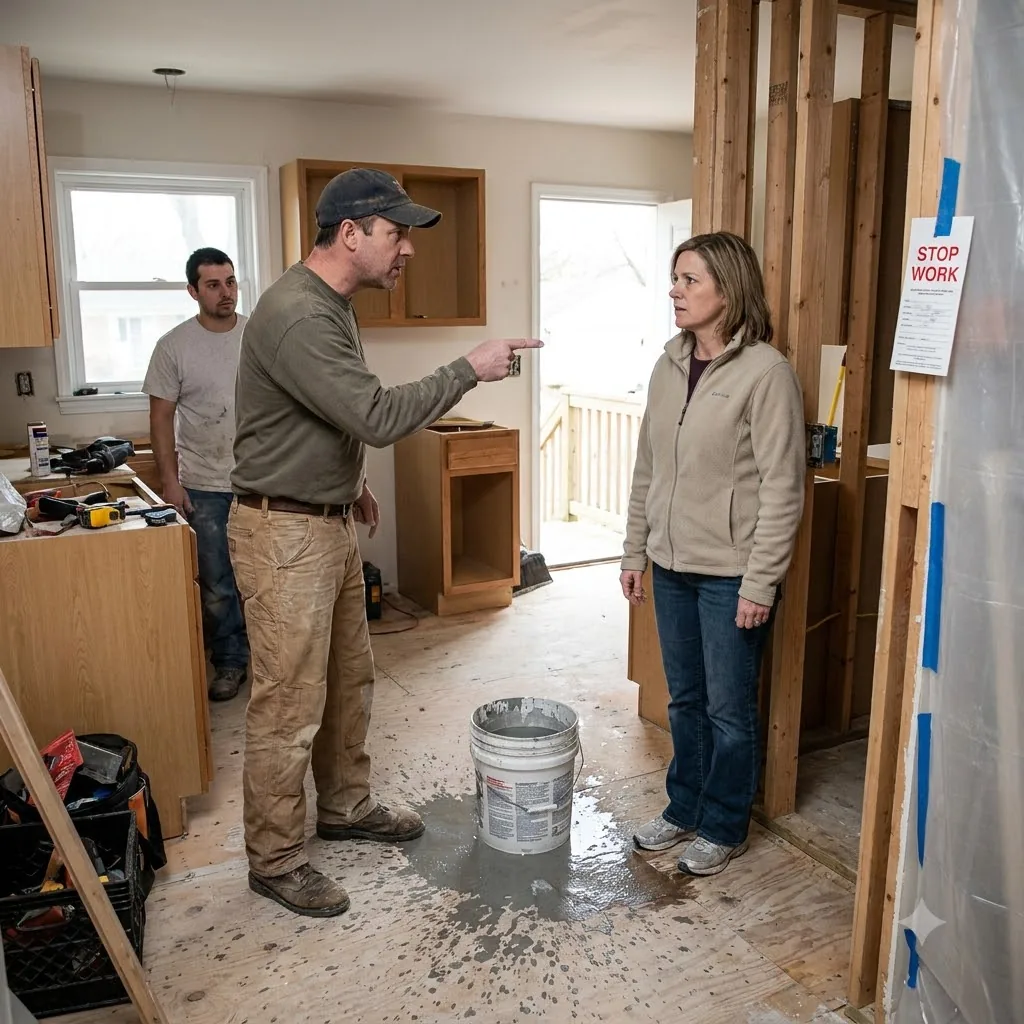
By lunch the trash bag was full of ruined backing board, wet cardboard, and the tape Derek had ripped off labels Nina had already made. He kept turning simple choices into emergencies only he could solve, and every time the room stalled, somebody’s eyes went to the permit tag by the doorway. It was the only thing in that kitchen that looked settled. Nina had wiped the floor, restacked the hardware, and lined the boxed fixture up under the sink wall exactly where Derek said he wanted it. He still moved from problem to problem like each one had appeared on its own. “The brace is wrong now,” he said, tapping it with two fingers. “It’s the same brace,” Nina said. “It’s wrong for the height we’re at now.” “We’re at the same height we were an hour ago.” Derek gave a laugh with no smile in it and crouched at the cabinet run. “This is why jobs go sideways with homeowners in the room. Nothing stays consistent.” I was scraping thinset ridges off a scrap board near the island. He had not touched the boxed fixture. He had not opened the code sheet clipped behind the permit tag. He had not cleared the sink wall enough to start the permit-tagged step. Still, he kept saying he was trying to move the job forward. Nina took a small notebook from the counter and flipped it open. She didn’t wave it around. She just read from it. “At nine-ten you said don’t unbox the fixture until you’re ready. At ten-fifteen you said not to mount the brace until the cabinet feet were dry. At eleven you said the feet were wet because I was slowing you down by asking questions.” He stared at her for one beat too long. “You keeping a case file now?” “I’m keeping track of what gets said in my kitchen.” The plastic at the doorway snapped once from the air. The permit tag swung out and back. Derek looked at it, then away. He pointed to the breaker panel hall. “Did you even check whether the dedicated line is labeled? Because if that’s not right, none of this matters.” Nina answered right away. “You checked it yesterday.” “Maybe I shouldn’t have trusted my own notes in a house where people keep moving things.” Nobody had moved the breaker panel. I rinsed my putty knife in the small bucket I kept by my knee and said, before I could stop myself, “The blue tape label is still on the breaker number you marked.” He turned toward me. “You want to run this job?” “No,” I said. “I’m looking at the label.” He held my stare for a second, then shifted back to Nina as if I had stopped existing. “This is what I mean. Too many voices. If everybody would stay out of my way, I could finish.” Nina folded the notebook closed. “Finish what, exactly?” He spread both hands toward the sink wall and the boxed fixture. “The next stage.” “Then do the next stage.” “Not with this setup.” “What setup?” He opened his mouth, shut it, then reached for a tape measure and snapped it out harder than he needed to. He measured from the cabinet face to the wall, wrote nothing down, retracted it, then measured the same span again. A truck door slammed outside. Derek stopped with the tape half reeled in. Nina’s chin lifted toward the doorway. I heard boots on the porch and then on the subfloor paper in the hall. Mr. Boone stepped through the plastic with a clipboard tucked under one arm. He touched the permit tag before he said anything, the way some people touch a door frame entering a room. His eyes moved across the sink wall, the boxed fixture, the open cabinet, the brace, then finally Derek. “Afternoon,” he said. “I was nearby. Figured I’d check whether the rough-in correction was ready for the completion step.” Nobody answered for a second. Derek recovered first. “We’re still staging.” Mr. Boone nodded once and waited. Nina asked, “What has to happen before you can sign off the next stage?” Mr. Boone kept his eyes on the work area, not the conversation. “Whoever’s doing the permit-tagged install needs to set the fixture, tie the connection, and show clean support and access. I don’t need a speech. I need to see the hands that can do it.” The room got very still after that. Even Derek’s tape measure stayed quiet in his fist. He gave a short laugh. “Well, not in the middle of debris and confusion.” Mr. Boone touched the tag again with one finger. “I can come back. But next time, don’t have the box still sealed if you’re telling people the delay is everybody else.” Nina looked at the fixture box. So did I. The packing tape across the top was still smooth except for one corner Derek had picked at and left curled. Derek set the tape measure down. “That’s not the issue.” Mr. Boone’s voice stayed flat. “Good. Then when I return, open path, open box, right person at the wall.” He turned to leave, and Elena, who had been quiet by the tile saw cart most of the morning, spoke without raising her voice. “He grabbed the correct driver bit without looking earlier,” she said, still sorting spacers into neat stacks. “Before that, he said he couldn’t tell which screw packet was which.” Nobody moved. Mr. Boone paused at the plastic and looked back, not at Derek’s face but at his tool belt. Derek’s hand covered the bit slot on reflex, quick as a blink. Then he said, too carefully, “We’re not doing commentary now.” Mr. Boone left without another word. The permit tag tapped the doorway once after him. Nina rested her fingertips on the sealed fixture box and looked at Derek’s hands instead of his face. That was the first time in that kitchen the question stopped being whether he could do.