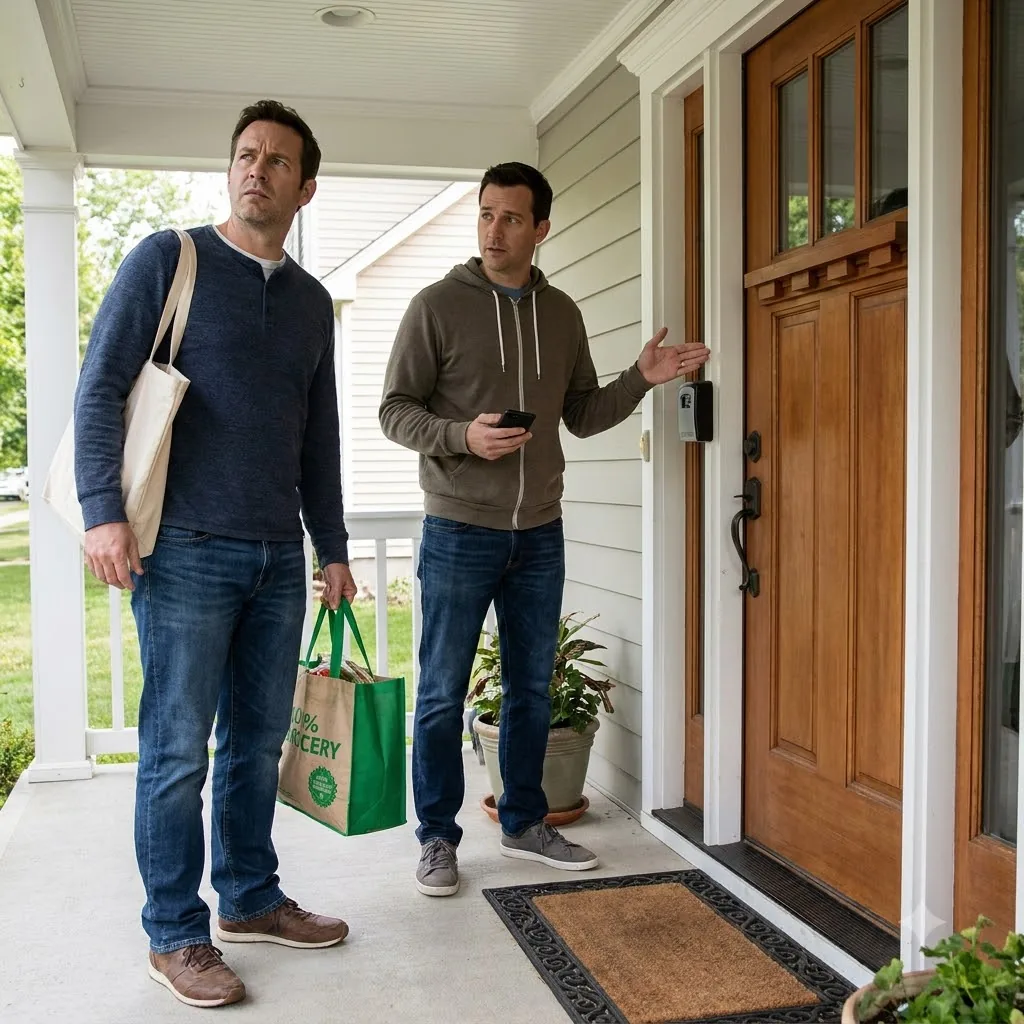
Story code: ST-000997
Part 3: The Message on the Same Screen
Rosa’s question stayed in the kitchen for a full beat. Derek did not answer it directly. He reached toward Maya’s phone again and said he needed to read the entire thread, not just one line pulled out of context.
Maya did not hand him the phone. She set it flat on the island instead, screen up, and scrolled slowly with one finger while the rest of us watched. That mattered more than any speech. Nobody was relying on memory now. The support, whatever it was, had to sit there in plain view.
The thread showed the usual pre-arrival items first: parking side, trash day, quiet hours after ten. Then the line she had already read aloud appeared again, attached to the same message bubble.
Lockbox code is for easy entry if members of your group arrive separately.
Under that, in the same message, was a second line none of us had mentioned yet because Maya had not reached it before.
Please return the key to the box so everyone in your group can access the house without coordinating each trip.
Rosa leaned forward enough to read it for herself. “Without coordinating each trip,” she repeated.
No one had to interpret that sentence. It answered the exact arrangement Derek had been imposing all afternoon.
He said, “That still doesn’t mean guests are supposed to handle it freely.”
I asked, “Compared to what? The message says everyone in the group can access the house that way.”
He tapped the island once with two fingers. “Hosts send canned instructions. Policy can still override a template.”
That was narrower than before and weaker too, but it was still the same move: push the source somewhere farther away the second a visible source appeared.
So Maya opened the general help pages she had been searching and held the phone so all three of us could see. She typed lockbox, then guest access, then self check-in. We stood there in the kitchen under the too-bright ceiling light and read little chunks of platform language out loud like people assembling furniture with the wrong instruction sheet.
What came up was the opposite of what Derek had said. Self check-in. Keypad. Lockbox. Smartlock. Guests can access the place through a secure method arranged by the host. There were safety reminders about not sharing codes outside the reservation. There was language about accurate check-in instructions. There was nothing saying booked guests were prohibited from touching a lockbox the host had assigned to them.
Maya stopped scrolling and said, very carefully, “I’m not seeing your rule.”
Derek answered fast. “Search liability. Search external device access.”
She did. We all watched the screen change. There were pages about damage protection, cancellations, identity checks, prohibited surveillance devices. Still nothing matching his wording from the door.
I said, “Can you show the article title at least?”
He said, “I don’t remember the exact article title.”
“Then where did the rule come from?” Rosa asked.
“From common sense,” he said, and that was the first fully visible break.
Not because common sense is a bad phrase, but because it was not what he had claimed. He had started with Airbnb policy, then compliance, then liability, then host entry tools, and now, with the phone open in front of him, he had landed on common sense.
Maya looked at him for a long second and then scrolled back to the host message. She enlarged the text with two fingers so the line about everyone in the group filled most of the screen.
“Derek,” she said, “you told Lauren this was an Airbnb rule. Did you actually see that anywhere, yes or no?”
He did not answer yes or no. He said, “I was trying to keep control of the house.”
That sentence did not explain everything, but it removed the official mask from the argument. No one in the room had to guess after that. We had the host’s written check-in message, the help pages on the screen, and Derek’s own shift away from policy language.
I said, “Then say it as your preference next time, not as platform policy.”
He pushed back from the island. “Fine. Then my preference is nobody uses the box unless I say so.”
Maya picked up the phone and shook her head once. “It isn’t your call that way. The reservation is in my name, and the host instructions are right here.”
He said, “So now we’re doing this in front of everybody?”
Rosa answered before I could. “You started that at the front door.”
Maya’s thumb moved again. She opened the message field in the reservation thread. I could see the blinking cursor appear under the host’s earlier instructions. She said, “I’m not arguing this by translation anymore. I’m asking the host one plain question in writing.”
Then she read the draft out loud before sending it: Hi, your pre-arrival message says our group can use the lockbox for separate entry. Can all booked guests use the lockbox code during the stay, or is there any rule against that?
Derek said, “Don’t send that.”
Maya looked at the screen, not at him. “Why not?”
He did not answer.
She hit send.
That was the pressure point Part 3 ended on for me: the lockbox, the host’s own written instruction, the help pages saying self check-in was normal, and Derek standing three feet away while a direct written question went to the only source left that could settle it without interpretation.