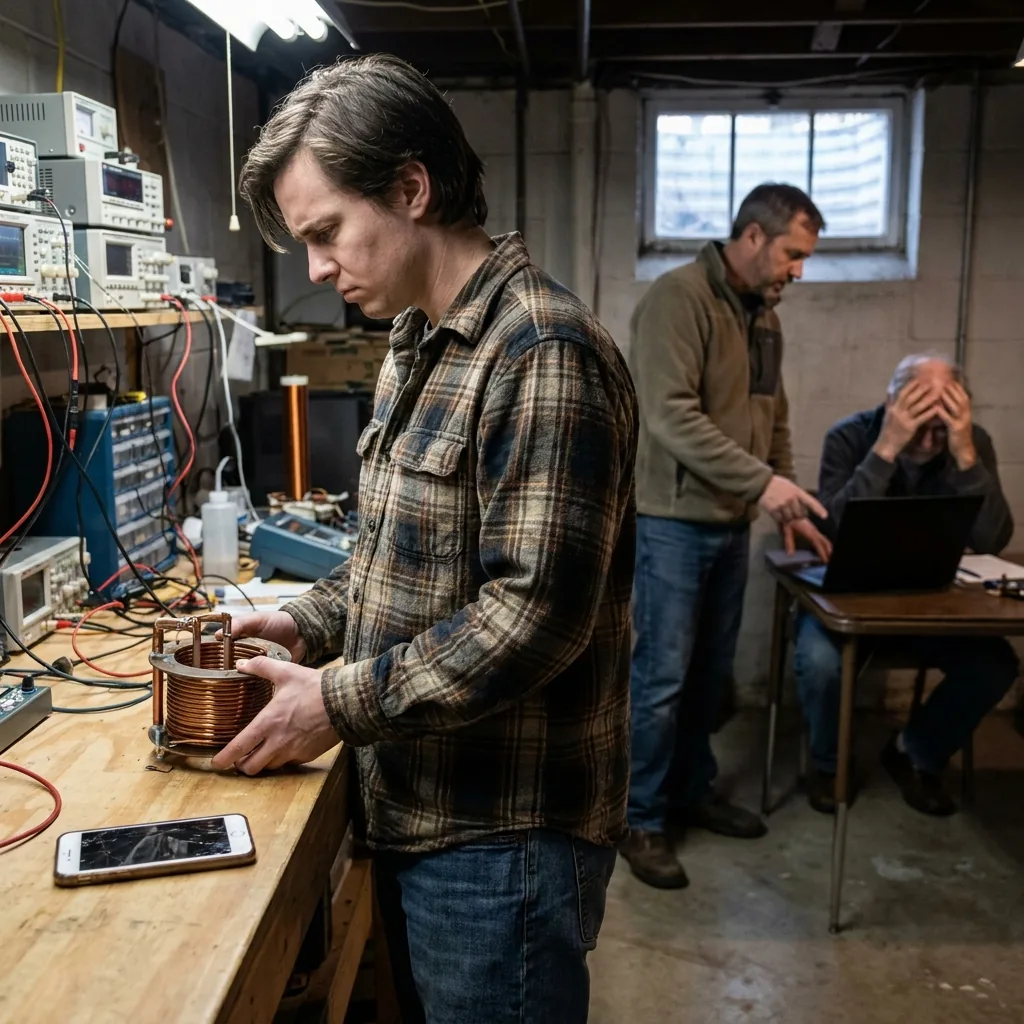
Story code: ST-000524
Part 2: The Postcard Knew What He Still Needed
By that night, Noah had my funding transfer in his folder, my result in his mouth, and my aunt upstairs telling people we were having a family misunderstanding. The only thing I had that he did not control fit in my back pocket, and it was a postcard from next year warning me not to let him set the phase angle alone. I waited until Diane went back upstairs before I read it again under the bench light. Do not let him set the phase angle alone. Keep the card. Routine will matter more than proof. That was all. No dramatic reveal. No explanation. Just two instructions written in block print that looked close enough to mine to make my throat tighten, but not close enough for me to claim anything out loud. The postmark still sat there like a splinter in the eye. Mara had not left with Noah. She stayed by the counter, flipping through my calibration notebook page by page, not riffling, not snooping, just reading the dates and the little corrections in the margins. “These are your entries?” she asked. “Every one of them.” She touched a page where I’d drawn the coil response by hand after the printer jammed a month ago. “He said the successful sequence only came together this week.” “I’ve had partial containment for months,” I said. “The problem was not getting a flare. The problem was bringing it back down without shredding the signal.” She looked toward the apparatus. “And he can’t do that part.” I put the postcard back in my pocket. “You saw him.” Mara gave one small nod. “I saw a hesitation. That’s not the same as proving ownership.” “I know.” She closed the notebook but kept a finger in it to hold her page. “If he’s already pushed a funding change through, somebody heard a version of this before today.” That was the part I couldn’t map. I knew what I had seen. Noah walked into my basement speaking in past tense about work I had not shown anybody outside a narrow circle. He had a transfer email timed to land while he was standing beside me. He watched that postcard like it had teeth. But none of that explained itself cleanly enough to anybody who wasn’t there. Noah came back down twenty minutes later carrying the printout like a trophy he was trying not to show off. Diane followed him halfway and stopped on the stairs. “Keep it civil,” she said. Then she looked at Mara. “You staying for dinner?” “Not yet,” Mara said. Noah set the printout on the counter. “I don’t want this to get theatrical. We need to act like adults. The oversight shift is administrative. The work is still in the family.” “The work isn’t a casserole dish,” I said. Diane exhaled through her nose like she was tired already. “Evan.” Noah ignored her tone and leaned on the counter. “Look, if this keeps moving, everybody wins. You’re good at the bench work. I’m good at getting things into the world. That’s not theft. That’s structure.” Mara said, “Then walk me through the return sequence again.” Noah didn’t look at her right away. He looked at me. It was brief, but there it was. Not panic. Not apology. Just calculation in the time it took him to decide whether to answer from memory or make me do it for him. He turned back to Mara. “We don’t need a full rerun tonight.” “I didn’t ask for a rerun,” she said. “I asked for the sequence.” He started talking. He got the first three steps right because anybody could memorize them from hearing me say them enough times. Then he switched the order of the phase correction and the dampening drop. I said nothing. Mara looked at me once, then back to him. “Why that order?” “Because it preserves the window,” Noah said. “No,” I said. “It spikes the feedback and forces a manual catch.” Noah gave me an annoyed half smile. “Only if your coil seating is off.” I pulled the coil assembly free, turned it so the underside faced them, and pointed to the tiny shim I’d filed myself and taped in place with heat-resistant cloth. “My coil seating is not off. This is how I stopped the lateral chatter six weeks ago.” Mara bent closer. “You told me on Tuesday you solved it with software compensation.” Noah’s jaw moved once before he spoke. “Software plus hardware adjustment.” “Which hardware adjustment?” she asked. He glanced at the assembly and named the wrong side. Nobody raised their voice. That was the worst part. The room just got quieter, and every quiet second made the lie less stable. Diane shifted on the steps. “I don’t understand half of what you’re saying.” “You don’t need to,” Mara said without taking her eyes off the bench. “He claimed sole control over a sequence he can’t accurately describe.” Noah straightened. “I never said sole.” He had. Maybe not that exact word, but close enough in every way that mattered. I did not argue the wording. I was watching his hands. He kept folding and unfolding the funding printout until the corners softened. After a moment he said, more carefully, “Fine. Evan knows some bench specifics. That’s why I was trying to bring him with me instead of leaving him down here forever.” He said it like a favor. Mara held out her hand. “Show me the email chain that moved the funding.” Noah didn’t give it to her. “It’s not final-final.” That phrase stuck harder than anything else he had said. Not final-final. Administrative people don’t write like that. Family does. People filling gaps do. People trying to bridge from one version of events to another do. When he went upstairs with Diane a few minutes later, he took the printout but left the corner of another page under the notebook. I slid it free after their steps faded. It was a draft message addressed to.