Story code: ST-001339
Part 3: The Contamination Confirmed
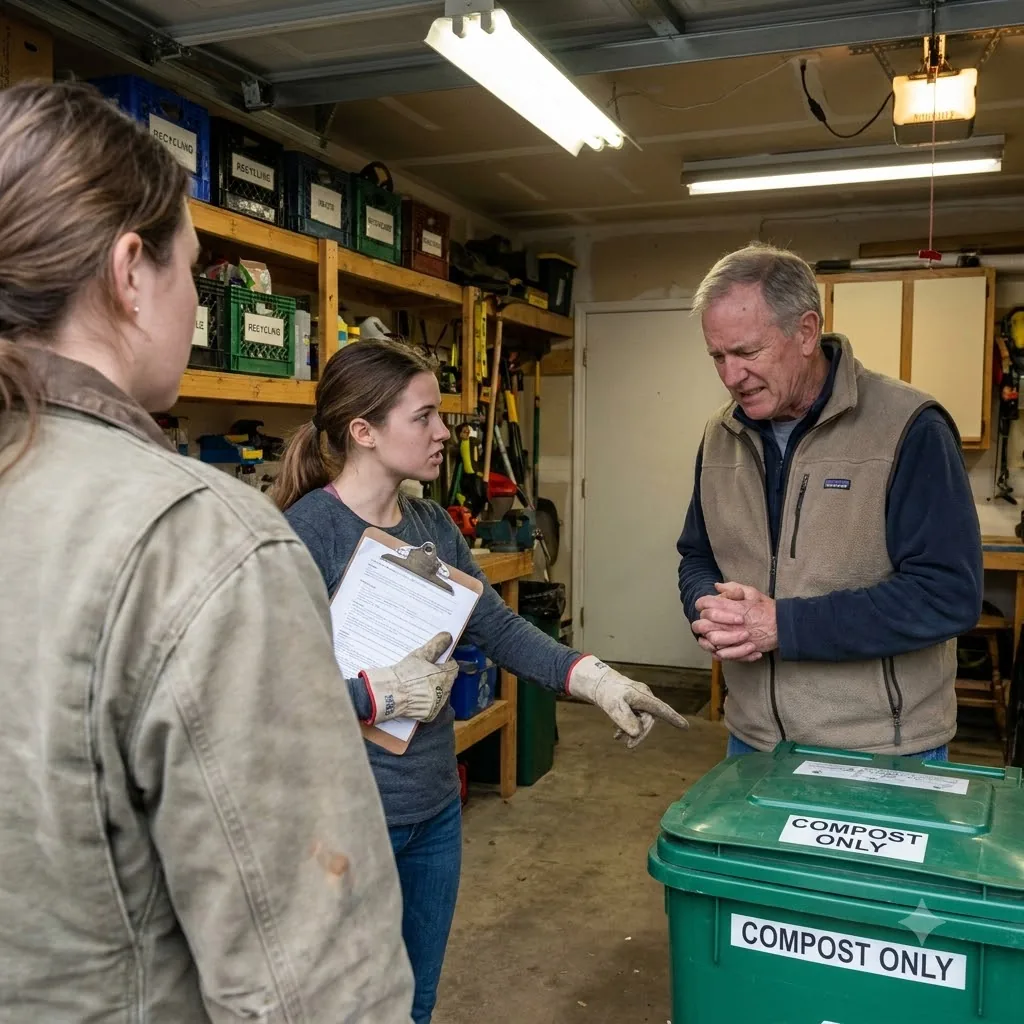
Sarah kept her eyes on the paper slip clinging to the greasy plastic lid. Under the bright overhead fluorescent tube, the name “Chloe” was clearly printed in bold black ink next to the order number and a date stamp from three days prior.
Richard leaned over, his hands resting on his knees. “That is your name, isn’t it, Chloe?”
Chloe did not move. Her gloved hand remained clamped around the handle of the hand rake. A piece of wet lettuce leaf clung to her canvas cuff. She stared at the receipt, her chin slightly lowered. “The restaurant’s website stated all takeout containers were made of plant-based, compostable PLA,” she said. Her voice was flat, devoid of its earlier academic cadence.
“It has a recycling triangle with a number five on the bottom,” Richard said. He reached down, picked up one of the empty containers with two fingers, and turned it over. The clean white plastic caught the light. “Number five is polypropylene. We can’t even recycle it in this county, let alone compost it. You know that. It’s on page two of your orientation binder.”
Sarah picked up another brass screw from the bench. She rolled it between her thumb and forefinger, watching the reflection of the two figures against the grey garage wall.
Chloe set the rake down on the blue tarp. “The packaging was mislabeled by the vendor. It is a supply-chain issue, not a household compliance failure.”
“You hid them at the very bottom, Chloe,” Richard said softly. “Under the grass clippings from last week. If it was just a vendor mistake, why didn’t you put them in the landfill bin?”
Chloe looked toward the garage door, then back at the green compost bin. Her chest rose and fell in a slow, measured rhythm. “I intended to return them to the restaurant for reuse. Storing them in the compost bin temporarily prevented them from cluttering the dry recycling stacks.”
Richard walked over to the laminated board hanging on the wall. He tapped a finger against the section labeled “Class I Violations: Deliberate Misdirection of Waste.”
“You wrote this paragraph last winter,” Richard said, his voice level. “If a resident intentionally conceals non-compostable materials inside the organic waste stream to avoid household sorting quotas, the penalty is an automatic suspension of waste-monitoring privileges and a one-hundred-dollar fine.”
Chloe’s gaze snapped to the board. The laminated sheet reflected the white glare of the fluorescent light, obscuring the text slightly, but the neat, hand-printed letters were unmistakable.
“I was acting as the environmental coordinator,” Chloe said.
“The protocol applies to all residents,” Richard said. He reached for the laminated clipboard on the workbench, picking it up and holding it out toward Chloe. “Section one, paragraph A. No exemptions.”
Sarah watched Chloe’s shoulders stiffen. A light breeze from the driveway blew a dry leaf across the garage floor, where it scraped against the edge of the blue tarp. Chloe did not reach for the clipboard. She took a step back, her canvas boots squeaking on the concrete.
“We need to verify the rest of the pile,” Chloe said, her voice remaining low. “If there are other contaminants, the entire batch must be logged as landfill waste.”
“Then keep digging,” Richard said, gesturing to the remaining pile of compost on the tarp.
Chloe knelt on the edge of the blue plastic sheet. She began to sort through the damp vegetable scraps, her movements slower now. Sarah watched her pull out two more white plastic containers, each bearing the same red logo, each tucked beneath a layer of decomposed fruit peels.