Story code: ST-000537
Part 3: The Chip Record Narrowed Everything
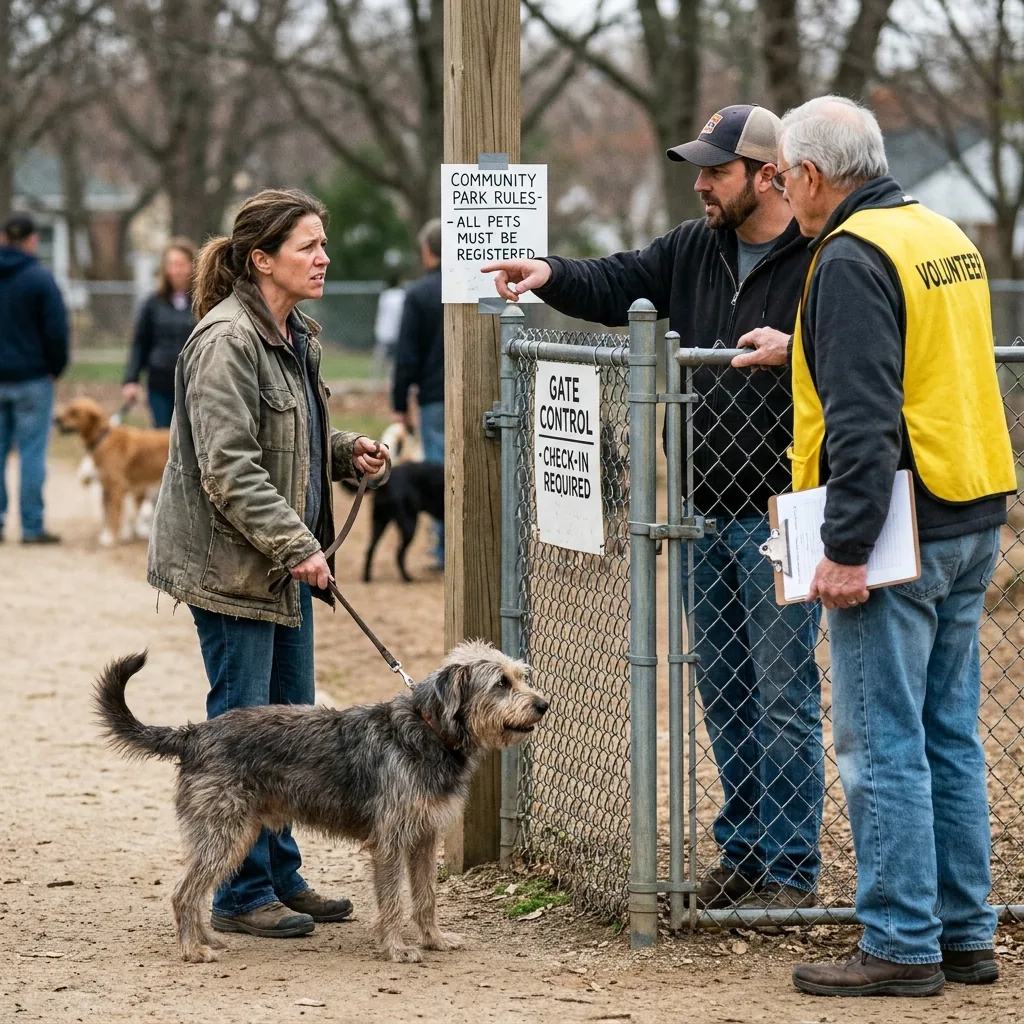
Once Monica said Derek had to participate, the whole scene tightened around procedure instead of volume. Nobody had to argue about our history anymore. Tasha from the vet office had already reduced it to the one thing the gate had been pretending to use all morning: a record tied to the dog.
Derek put one hand on the edge of the folding table and said, “I’m not giving private account information to a speakerphone at a dog park.”
Tasha answered before I could. “You do not need to give private payment information. I need identifying details connected to the microchip record and account contacts. If you are challenging current handling, this is the verification step.”
That wording mattered. Verification step. Not debate. Not opinion.
Monica turned the roster toward herself and clicked her pen. “Go ahead,” she said.
Tasha asked for the dog’s microchip number again. Monica read back the digits she had written in the margin. Tasha repeated them, then asked for the dog’s color, approximate weight, and the name used on recent visits. I answered first. Monica looked down at the collar, then at the dog, then nodded once as each detail matched what was in front of her.
Then Tasha asked for the primary contact listed on the account.
She did not blurt it out. She handled it the way offices do when they are trying to confirm, not lead.
“Mr. Lawson,” she said through the phone, “if you are disputing current handling, tell me the first and last name of the primary contact you believe is on the record.”
Derek said my name after a beat too long to miss.
A couple people in line glanced at each other.
Tasha said, “And the listed secondary contact?”
He gave his own.
“Thank you,” she said. “That matches the contact order on file for this microchip-linked account.”
The line at the gate did not erupt. It just changed shape. Derek had spent the morning speaking as if the existence of a dispute was enough to freeze me out. The first clean record anybody could tie to the dog put me first and him second.
Monica’s pen stopped moving.
Tasha kept going in the same flat office voice. “For routine identity confirmation, the dog is linked in our system to the primary contact as Erin Maddox. Secondary contact Derek Lawson is listed for pickup and communication. No note in this record authorizes excluding the primary contact from handling.”
Luis let out a low whistle through his teeth.
Derek lifted his chin toward the phone. “That doesn’t settle park restrictions.”
It was weaker than what he had been saying before, mostly because now there was something on the table besides him.
Monica asked the question she should have asked at the start. “Is there any notation in the vet-linked record that access should be frozen if two contacts disagree?”
“No,” Tasha said. “We do not create recreational access holds. We maintain record identity, contacts, and medical notes. If a park is using the record for check-in, the relevant part is the linked identity and listed contacts.”
There it was. The claimed policy had nowhere to anchor.
Luis shifted his shepherd’s leash and said, “So the only actual record we can verify says she’s the primary contact, and the park rule about custody holds is still invisible.”
Nobody corrected him.
Monica looked at the posted board, then the binder, then back at Derek. It was a small movement, but it read like someone checking every place a rule should have existed and finding empty space. She asked Tasha one more question, careful now.
“If both contacts are present and one is challenging the other’s handling, what is the routine step on your end?”
“We document who requested clarification and advise that non-medical access disputes are not controlled by our office,” Tasha said. “If a third party is relying on our record, they should not invert primary and secondary contacts without another verifiable source.”
Monica wrote that down word for word.
Derek tapped the table once. “This is getting turned into something it isn’t.”
“It already was,” the woman with the beagle said from the line. “That’s why we’re still standing here.”
Monica did not wave me through yet. That would have been too loose after all the noise. Instead she shifted into the colder lane the whole morning had been avoiding.
“Mr. Lawson,” she said, “because you initiated the hold request, I need you to state for the roster whether you have any posted park rule, board instruction, or written gate procedure that authorizes denying entry to a listed primary contact based only on your objection.”
He stared at the binder.
“Do you have one?” she asked again.
“It’s been enforced before,” he said.
“That is not what I asked.”
He did not put a page on the table. He did not point to the board. He did not give a number to call.
Monica drew a line through the blank space she had left for policy source. Then she said, still looking at the roster, “If you want this objection to stay attached to today’s entry record, I need your full statement and signature under false reporting language.”
That landed harder than any speech could have. For the first time all morning, the process was asking something of him that would remain after the gate opened.