Story code: ST-001343
Part 1: The Coached Script
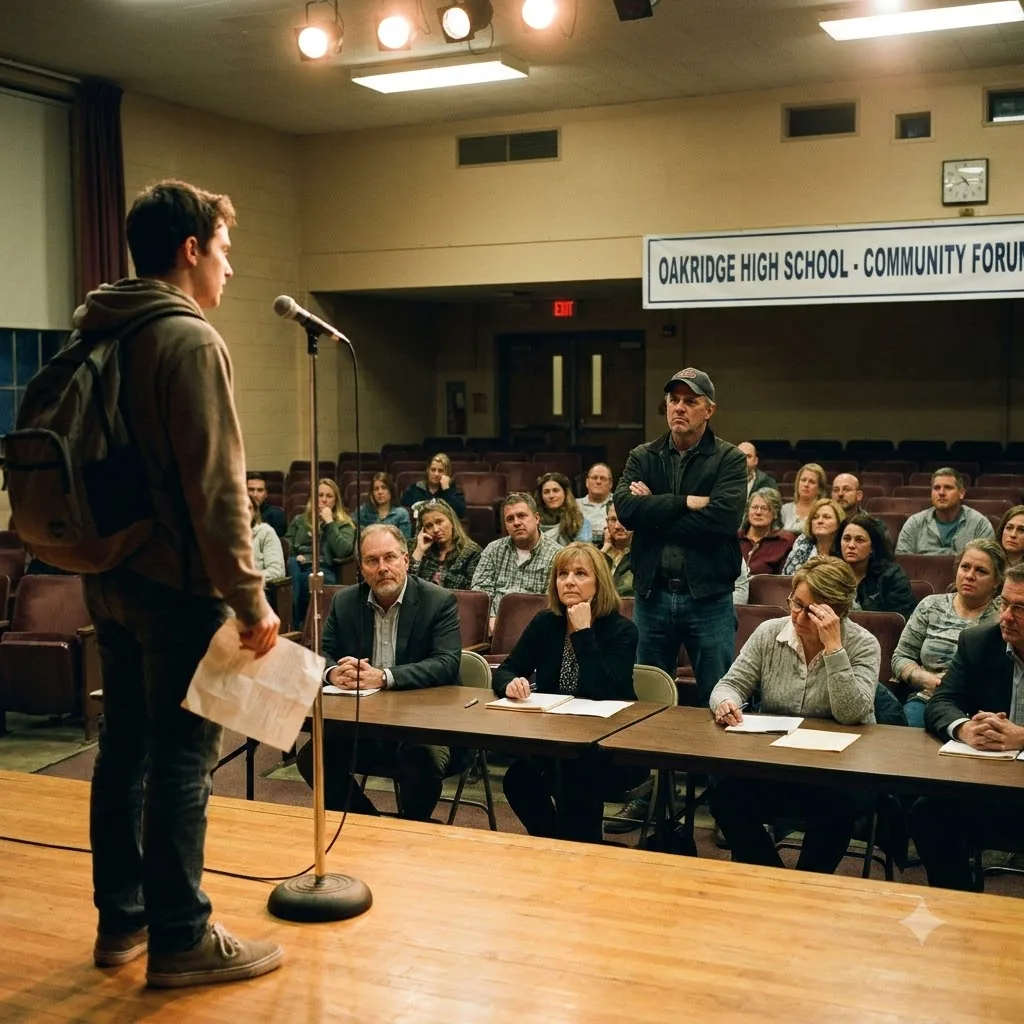
My father, Marcus, stood at the back of the Oakridge High School Auditorium, watching me walk up to the stage with a coached script that I didn’t realize was rigged to fail. The school board members sat under the harsh fluorescent lights, their papers rustling as the hum of the school AV system filled the tense room. I gripped the paper he had handed me just before the doors opened, my hands shaking as I reached the microphone to deliver his bitter protest against the school’s past safety mandates.
Behind me, the double doors of the auditorium were propped open with heavy rubber wedges, letting in a cool draft from the hallway. My father stood near the exit sign, his arms crossed over his chest, his eyes locked on me. He had spent three hours at the kitchen table coaching me on exactly how to read this statement, telling me it was the only way to make the board listen to the community. The school board members sat at a long table draped in blue cloth. Mrs. Gable, the board representative running the public comment session, adjusted her microphone, the feedback whining briefly through the speakers before settling into a low hiss.
I cleared my throat, adjusting the metal stand. I could hear the quiet murmur of the crowd in the plastic folding chairs behind me, neighbors and teachers who had watched me grow up. My father had insisted that a student’s voice carried more weight, that they wouldn’t dare cut off a high school senior during the public forum.
“My name is Leo,” I began, my voice echoing off the high, paneled ceiling. “I am a senior here, and I am speaking tonight to address the long-term impact of the administrative decisions made during the lockdown period.”
I looked down at the typed sheet of paper. My father’s handwriting crossed out several of the printed lines I had originally drafted, replacing them with block letters in red ink. He had told me to read those parts exactly as written, emphasizing the final sentences to make the point clear to the local news reporter sitting in the front row.
“We were kept out of classrooms based on guidelines that did not reflect the needs of the student body,” I read, trying to maintain the steady, measured tone my father had practiced with me. “The board continues to refuse transparency, hiding behind administrative procedures to avoid accountability for the damage done to our education.”
Mrs. Gable leaned forward, her hands resting flat on her papers. She didn’t look at the other board members; her eyes were fixed on me, waiting.
I turned the page, reaching the climax of the coached speech. My father had told me this was the crucial phrase that would force them to respond. I started reading the line. “The continuation of these policies, without community consent, represents a deliberate act of…”
I stopped. The next word on the page was not ‘negligence,’ which we had practiced at home. It was ‘treason.’
My father had scribbled over the word ‘negligence’ with thick black ink, writing ‘treason’ in its place. The pressure of the room pressed in on me. I looked at the word, my mind racing. If I paused too long, Mrs. Gable would cut me off for exceeding my time limit. If I changed it back, my father would know I had backed down.
I repeated the coached phrase, the wrong word slipping past my lips. “The continuation of these policies represents a deliberate act of treason by this administration.”
The entire auditorium went dead silent. The whispers in the back stopped instantly. Mrs. Gable’s pen froze mid-air, her expression hardening as she stared at me.
My father, Marcus, stood at the back of the Oakridge High School Auditorium, watching me walk up to the stage with a coached script that I didn’t realize was rigged to fail. The school board members sat under the harsh fluorescent lights, their papers rustling as the hum of the school AV system filled the tense room. I gripped the paper he had handed me just before the doors opened, my hands shaking as I reached the microphone to deliver his bitter protest against the school’s past safety mandates.
Behind me, the double doors of the auditorium were propped open with heavy rubber wedges, letting in a cool draft from the hallway. My father stood near the exit sign, his arms crossed over his chest, his eyes locked on me. He had spent three hours at the kitchen table coaching me on exactly how to read this statement, telling me it was the only way to make the board listen to the community. The school board members sat at a long table draped in blue cloth. Mrs. Gable, the board representative running the public comment session, adjusted her microphone, the feedback whining briefly through the speakers before settling into a low hiss.
I cleared my throat, adjusting the metal stand. I could hear the quiet murmur of the crowd in the plastic folding chairs behind me, neighbors and teachers who had watched me grow up. My father had insisted that a student’s voice carried more weight, that they wouldn’t dare cut off a high school senior during the public forum.
“My name is Leo,” I began, my voice echoing off the high, paneled ceiling. “I am a senior here, and I am speaking tonight to address the long-term impact of the administrative decisions made during the lockdown period.”
I looked down at the typed sheet of paper. My father’s handwriting crossed out several of the printed lines I had originally drafted, replacing them with block letters in red ink. He had told me to read those parts exactly as written, emphasizing the final sentences to make the point clear to the local news reporter sitting in the front row.
“We were kept out of classrooms based on guidelines that did not reflect the needs of the student body,” I read, trying to maintain the steady, measured tone my father had practiced with me. “The board continues to refuse transparency, hiding behind administrative procedures to avoid accountability for the damage done to our education.”
Mrs. Gable leaned forward, her hands resting flat on her papers. She didn’t look at the other board members; her eyes were fixed on me, waiting.
I turned the page, reaching the climax of the coached speech. My father had told me this was the crucial phrase that would force them to respond. I started reading the line. “The continuation of these policies, without community consent, represents a deliberate act of…”
I stopped. The next word on the page was not ‘negligence,’ which we had practiced at home. It was ‘treason.’
My father had scribbled over the word ‘negligence’ with thick black ink, writing ‘treason’ in its place. The pressure of the room pressed in on me. I looked at the word, my mind racing. If I paused too long, Mrs. Gable would cut me off for exceeding my time limit. If I changed it back, my father would know I had backed down.
I repeated the coached phrase, the wrong word slipping past my lips. “The continuation of these policies represents a deliberate act of treason by this administration.”
The entire auditorium went dead silent. The whispers in the back stopped instantly. Mrs. Gable’s pen froze mid-air, her expression hardening as she stared at me.