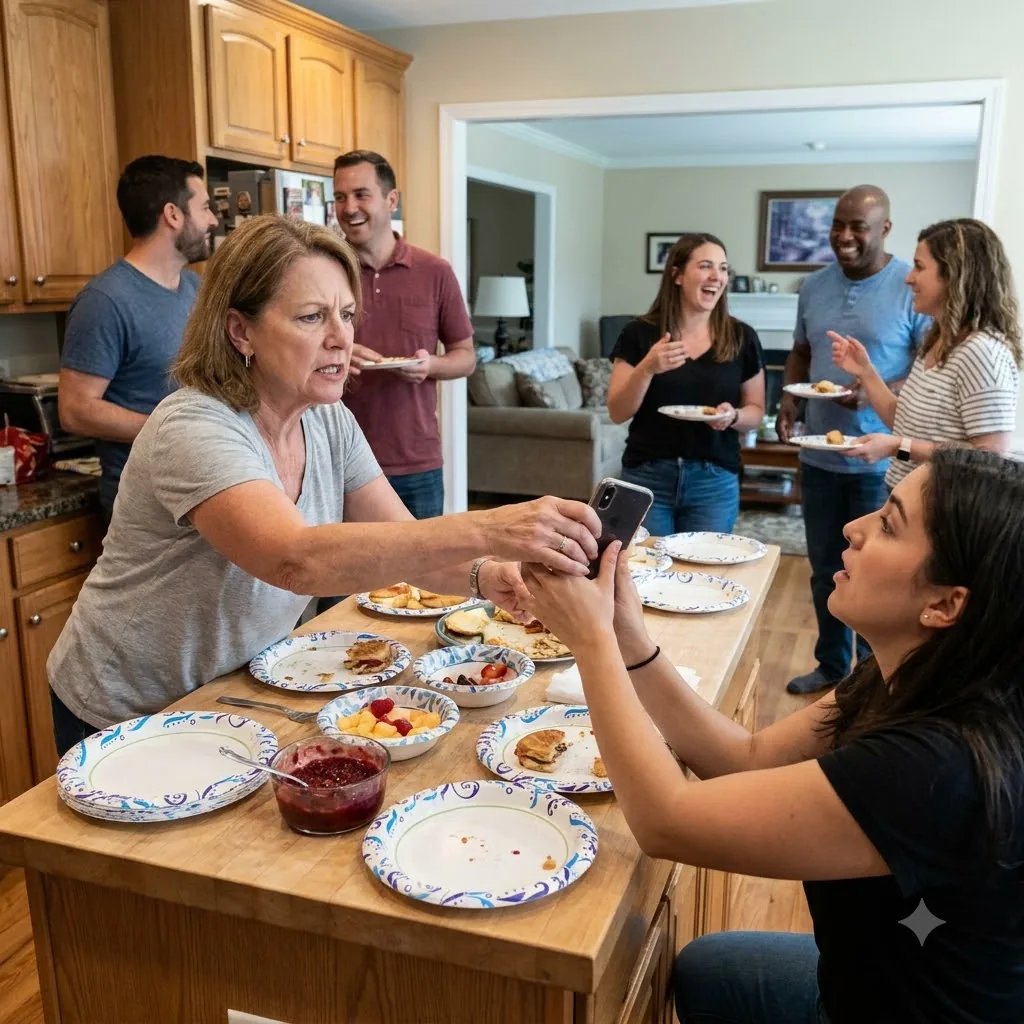
Story code: ST-001002
Part 2: She Denied the Part Nobody Said Out Loud
Nina did not raise her voice after that. She did something that made Elaine look worse: she started asking small, practical questions in the same tone people used for asking where the extra forks were. From the hallway threshold, with her phone in one hand and her tote tucked under the other arm, she said, “Who had my laptop last Thanksgiving?” and the room got even quieter than it had in the kitchen.
Tessa stayed near the opening between the living room and hall, close enough to hear and far enough that nobody could act like she was joining in. Cal was still by the couch with one paper plate hanging loose from his fingers. Elaine remained at the edge of the island, shoulders square, smile gone now, but her voice was still trying to sound normal.
“What does that have to do with anything?” Elaine asked.
Nina looked at her phone screen for a second, thumb moving once, then once again. “Who had it?”
Cal cleared his throat. “We all passed things around that weekend. You wanted to print recipes.”
Nina kept her eyes on him. “Who logged me out?”
“I don’t know.”
Elaine jumped in before he finished the last word. “Nobody logged you out. Why are you doing this?”
Again, it was the speed of the answer that changed the air. Nina looked up slowly. Tessa could see the line of the unlocked phone reflected faintly in the dark hall mirror, though not the words. Nina did not wave it around. She kept it close, as if the object itself had become the line she was no longer letting anyone cross.
“I asked Cal,” Nina said.
Elaine folded a dish towel that had already been folded. “Because you’re trying to turn a family party into some kind of interrogation over an email alert.”
“An email alert you reached for before I touched my own phone.”
“It was on the screen.”
“You’ve said that.” Nina shifted her tote higher on her shoulder. “You also said you didn’t open anything before I ever said the word open.”
No one moved to smooth that over this time. The TV fire flickered silently in the next room. A couple near the dining table gathered their coats without commenting, doing it slowly enough that it looked like politeness instead of escape.
Tessa watched Cal’s face when Nina asked the next question.
“Did my old tablet ever stay here after Christmas?”
Cal’s mouth opened, then he glanced at Elaine before answering. “Maybe for a day or two.”
“How many days?”
“I don’t know. A couple.”
Elaine snapped the dish towel flatter against the counter. “This is ridiculous.”
Nina’s voice stayed controlled. “Then answer something simple. How did you know it was a match email?”
Elaine took one step forward. Nina took one back, putting her shoulder against the wall again and angling the phone away. It was a small movement, but everybody saw it. Elaine stopped there.
“I did not know,” she said. “I saw a notification and reached out. Mothers do that. I was helping.”
Tessa had known Elaine for years. She had seen her redirect holiday arguments, move people out of kitchens, assign chairs, and settle menu disputes before they started. This was the first time Tessa had watched her miss the easiest escape. If all Elaine had done was snatch at a buzzing screen, she could have kept the whole thing vague. Instead she kept denying details that Nina had not supplied yet.
Nina glanced down at the phone again. “Interesting.”
Elaine’s chin lifted. “What is that supposed to mean?”
“It means the service sends different subjects for different alerts.” Nina looked back up. “You called it a match before I said match.”
That landed harder than shouting would have. Cal’s plate finally slipped from his hand and bent on the carpeted edge by the living room. Nobody reacted to the food sliding off it.
Elaine said, “Everybody here knew what tonight was about.”
“Everybody here knew ethnicity estimates were coming,” Nina said. “Not that this specific email was sitting in my inbox right then.”
Tessa saw one of the older relatives turn fully toward the hall for the first time. No one spoke for Elaine now. The room had reached the point where even people trying not to involve themselves could hear the strain in what she was saying.
Cal rubbed his palm over the back of his neck. “Nina, maybe do this later.”
Nina gave him a look that was not dramatic, just direct. “Later is what got me here.”
That sentence hung there with no explanation attached, and Tessa noted the way Cal stopped moving after it, like he had walked into a word he recognized and did not want to touch.
Nina tapped her screen, then her face changed only in the visible ways Tessa could measure: her mouth tightened, and she shifted her grip on the phone as if the weight of it had changed. She reached into her tote, pulled out a small zip pouch, and checked for something inside.
Elaine saw that and moved half a step again. “What are you doing?”
“Making sure I still have everything.”
“For what?”
Nina zipped the pouch shut. “For when I change every password you’ve ever told me not to bother changing.”
Elaine’s answer came out sharp enough to cut through the room. “I never said that.”
But Cal did the worst possible thing for her then. He looked straight at the tote, then at the old family desktop tucked in the corner of the den doorway, and said, too quickly, “She means because we all used the same recovery email for a while.”
Nobody had mentioned a recovery email before that.