Story code: ST-001224
Part 3: The Maker’s Mark
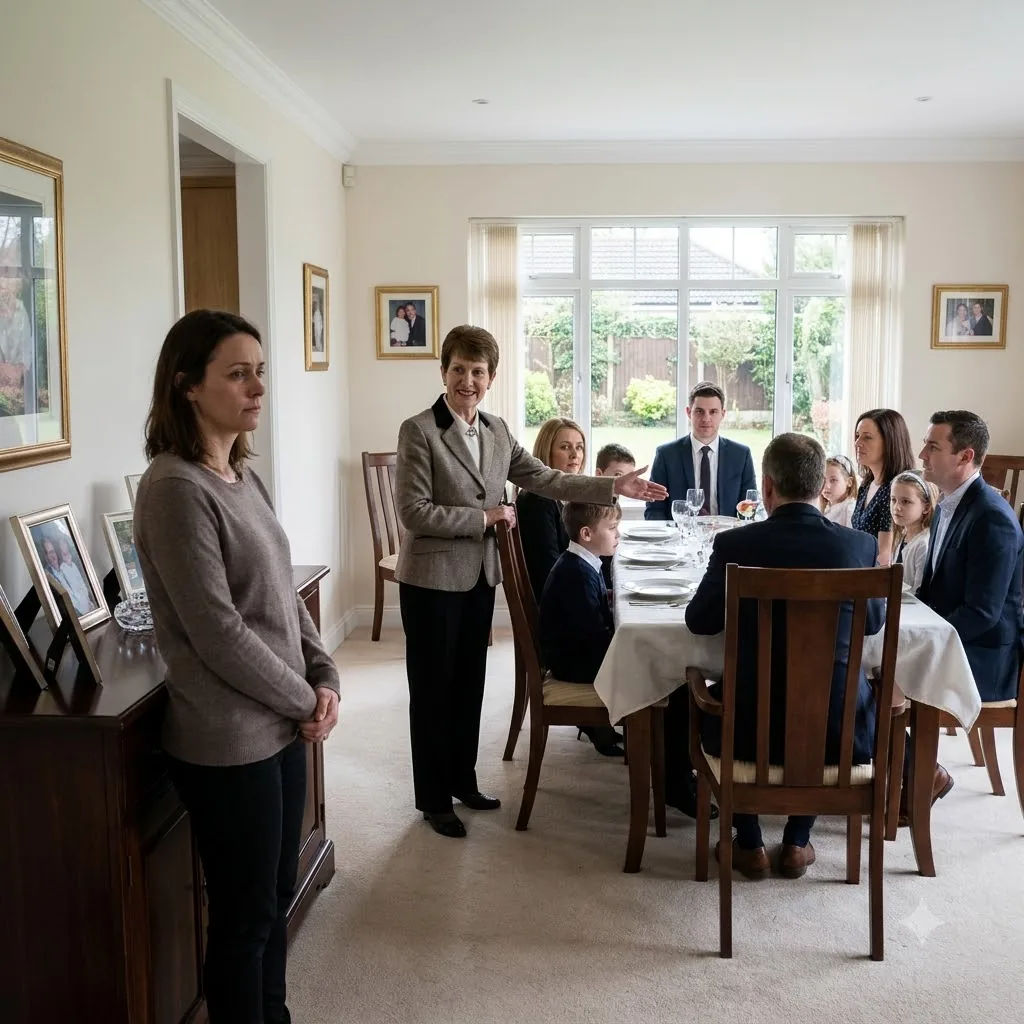
Mara saw Helen’s fingers tighten against the silver tongs as Uncle Charles reached for the edge of the ceramic plate. Helen shifted her weight, leaning slightly over the table to block Uncle Charles’s view, her movements unusually hurried.
“We don’t need to turn it over,” Helen said, her voice dry and slightly strained. “The glaze is old and could scratch against the table linen. Let’s just proceed with serving the meat.”
Uncle Charles paused, his hand hovering near the rim. He looked at Helen, then down at the complex geometric patterns. “Helen, if we don’t align the salt and grain correctly, we violate the entire purpose of the regional presentation. If this is the valley plate, the signature on the base will clarify the placement. It takes only a second to check the stamp.”
Mara observed Maya, who sat perfectly still across from them. Maya’s wine glass was back on the table, her hands folded neatly in her lap. Her expression remained neutral, showing no visible sign of anger or distress, but she spoke in a clear, carrying voice that silenced the rest of the table.
“The three interlocking triangles near the base represent the convergence of the three local clay bodies used to throw the plate,” Maya said.
The table fell silent. Helen’s head snapped toward Maya, her eyes narrowing.
“The wave pattern,” Maya continued, pointing toward the rim without touching the plate itself, “is designed to guide the oil away from the central well. If you place the grain on the wave, the oil from the roast will soak the bread. The salt must be placed in the star-shaped crest to the right of the signature triangles to prevent moisture from reaching the grains.”
Uncle Charles looked from Maya to the plate, then back to Maya, his brow furrowed. “How do you know the oil drainage path of this specific design?”
“Because the valley studio that produces this specific formulation of turquoise slip glaze only opened three years ago,” Maya said. She pointed to a tiny, stylized leaf pattern near the handle. “And that leaf motif is a custom maker’s mark. It is registered to a private studio in the city.”
Helen’s face flushed a deep red under the dining room lights. She gripped the edge of the table, her posture stiffening. “Many studios copy traditional patterns, Maya. This plate was given to me by my cousin as a piece from our family’s ancestral village. You are simply confusing it with modern reproductions you’ve seen online.”
“The ancestral village didn’t use electric kilns, Mother,” Leo said, his voice flat. He pointed to the uniform vitrification on the rim. “Or commercial slip glazes.”
“Your cousin gave this to me,” Helen insisted, her voice rising slightly. “It is a family piece. Maya is mistaken.”
Uncle Charles looked at Helen’s rigid posture, then at the plate. He slowly slid his fingers under the ceramic rim, lifting it slightly from the table. Helen did not move to help him, nor did she let go of her fork, which clattered against her wine glass. The pressure in the room was palpable as Uncle Charles prepared to flip the plate to resolve the dispute.