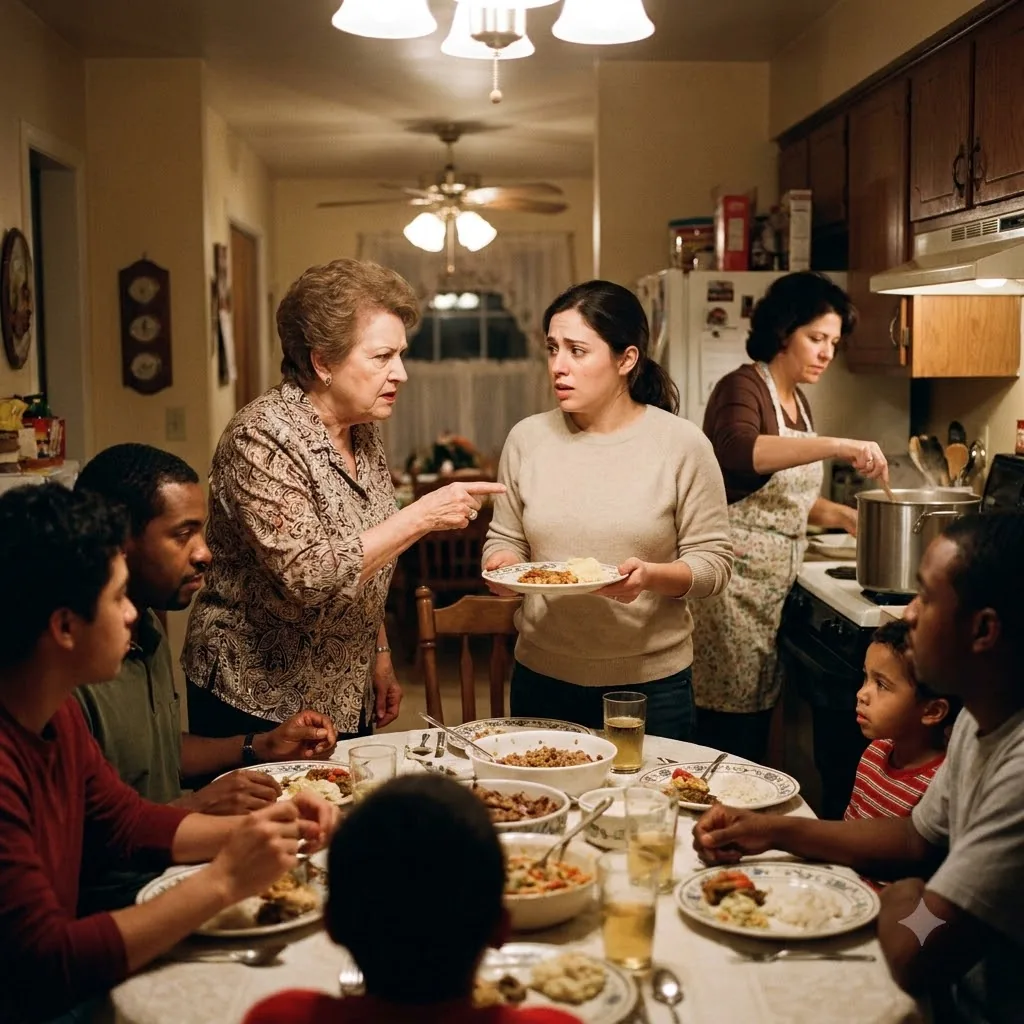
Story code: ST-000956
Part 4: The Plate Went Out in Her Hands
Diane carried the ceremony plate into the dining room without a wobble.
I could see her through the threshold between the shoulders of the guests nearest the end of the table. She slowed at the exact spot where the sideboard rug changed to hardwood. She lifted the tray a little to clear a chair arm. She lowered it to the center of the table and turned the plate so the border pattern faced outward.
Then she stepped back.
There was no speech. No gasp. No grand scene.
One of the older uncles looked from the plate to Diane and then toward the kitchen. A cousin reached for her water glass and stopped halfway. Omar came through the doorway behind Diane and stood still with his hands empty.
Diane said, “Dinner’s ready,” in the same voice people use when they want the room to move past something.
Nobody answered for a beat too long.
Then chairs shifted. Someone asked for the rice. The dinner resumed around the plate she had just proved she could handle from start to finish.
Back in the kitchen pass, Nadia untied her apron with both hands. She did it carefully, not in a dramatic yank, just one knot, then the second. She folded the apron once and laid it on the sideboard beside the backup dishes.
Omar came in after a minute. “Nadia,” he said.
She held up one hand and kept her voice level. “After service, you can explain to the guests why your mother can present the ceremony dish but I still get blamed for it. Right now I’m done rebuilding anything she touches.”
He glanced toward the dining room. “Can we not do this here?”
Aunt Marisol answered before Nadia did. “This is here. It has been here all evening.”
Diane appeared in the doorway then, empty-handed. Her face looked fixed, neat, and harder around the mouth than before.
“Are you really going to sulk because I stepped in once?” she said.
Nadia picked up her phone from beside the warming drawer. Then she picked up her keys from under the folded napkins where she had dropped them at the start of service.
The key ring made a bright sound against the counter.
“Not once,” she said.
Diane opened her mouth again, but Omar finally spoke over her.
“Mom, stop.”
That stopped more than the sentence. Diane did not look at him right away. When she did, he was already reaching into the junk bowl near the fridge where the spare house key had been tossed with coupons and loose batteries.
He found it, lifted it out, and set it on the counter in front of Diane.
It was such a plain object that for a second it took me longer to understand than the plate had.
Then he said, without raising his voice, “Give me yours too. Tonight.”
Diane stared at him. “Excuse me?”
“You don’t get to come over early and run this kitchen anymore,” he said. His voice shook once on the last word, then steadied. “Not without us asking. Not without Nadia here. And not with a key.”
The room stayed very still.
That was the visible cost. Not a speech. Not a public banishment. One small metal answer to a whole evening of taking over the house and calling it tradition.
Diane’s fingers tightened around nothing. Then she reached into her purse, pulled out a single brass key on a paper pharmacy tag, and placed it beside the spare.
The keys touched with a dry click.
Nadia looked at them, then at Omar, then at the doorway to the dining room where the guests were starting to call for serving spoons. She slipped her own phone into her bag and put the strap over her shoulder.
“I am leaving after dessert goes out,” she said. “I’m not coming early for these dinners anymore. If you want the ceremony plate, the person who knows how to do it can do it.”
Diane said, “You would walk out over a misunderstanding?”
Nadia turned to her. “You carried it to the table.”
That was all.
No one in that kitchen could honestly call it misunderstanding after that.
Aunt Marisol picked up the dessert tray list and handed it to me. “We’ll finish the last course,” she said. Then she looked at Nadia. “You go wash your face first.”
Nadia nodded once and went down the hall with her bag still on her shoulder.
Diane remained by the counter, close to the two keys and not touching them. Omar took the dessert bowls from the shelf himself. He did not hand either key back.
We served the rest of the meal. The guests got their sweets. The table talk rose and fell in careful little waves, as if everyone had agreed to keep the china intact by not naming what they had seen. Diane stayed out of the kitchen pass after that. She sat in the dining room with a straight back and her napkin folded small in her lap.
When I carried the last empty bowls in, Nadia was at the front door in her coat. Her apron was folded over one arm. Omar stood a step behind her holding the returned casserole dish she had brought earlier. Aunt Marisol was beside the console table, watching without crowding.
Nadia took the dish, shifted her bag higher, and left with the apron still visible against her coat sleeve.
That was the bitter part of the freedom. She was right, and she still walked out carrying her own things, her extra labor showing on the fabric crease, while the house behind her stayed lit for a family dinner she had helped save.
On the hall table, the two house keys remained by Omar’s hand.
The ceremony plate had made it to the table at last, but it did not belong to Diane’s story anymore.