Story code: ST-001086
Part 3: The Network Lock
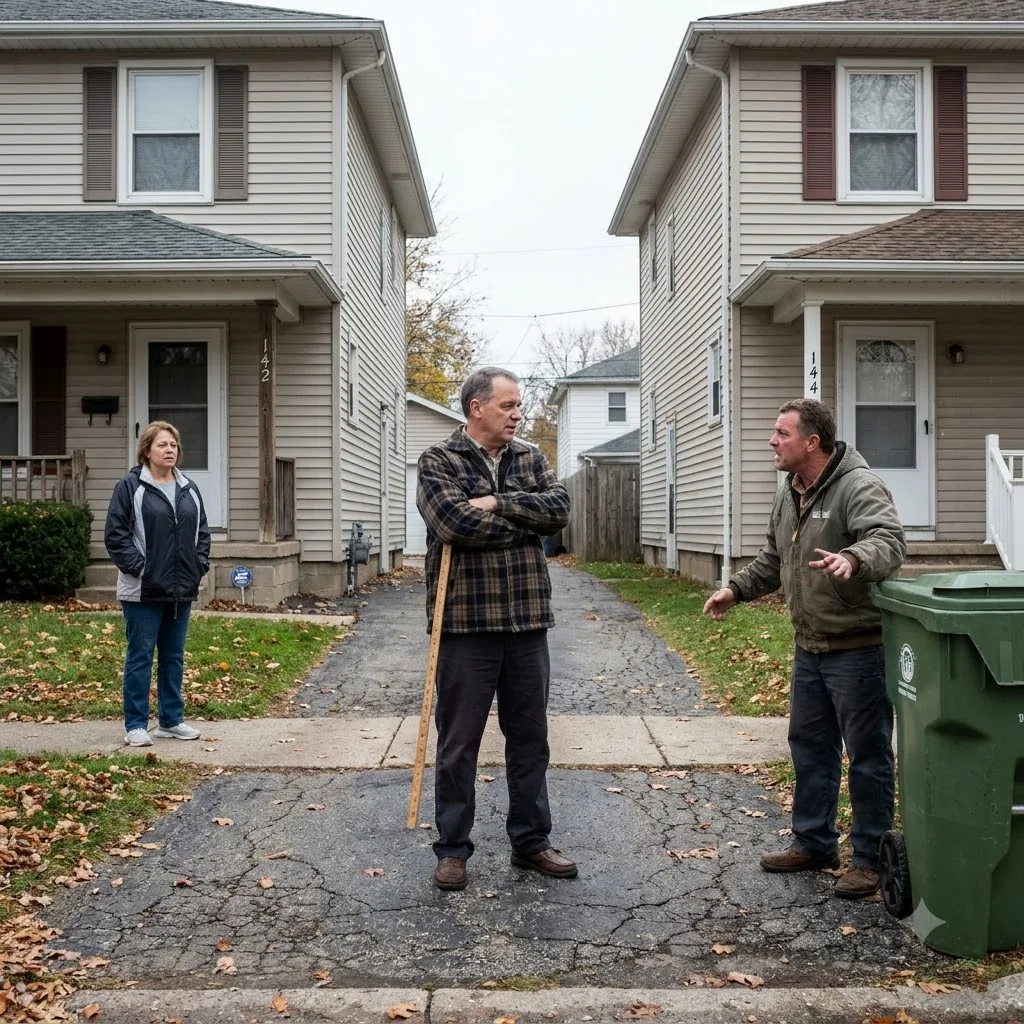
At 5:45 PM, a white municipal SUV with the words “Code Enforcement” printed on the side pulled up to the curb of 142 Oak Street. Inspector Vance, a man in a gray uniform carrying a ruggedized department tablet, stepped out. Mark walked down from his porch, clipboard in hand, while Sarah remained by her driver’s side door. Harold emerged from his garage, still carrying his wooden yardstick, though he held it low against his leg.
“I received a formal dispute regarding Citation 8849-B,” Vance said, his voice flat. He stopped at the edge of the shared driveway and looked at the blue plastic trash bin still sitting in the easement.
“The vehicle was obstructing the easement during a reported violation window,” Harold said, pointing his yardstick at the blue bin. “The digital report I submitted contains the required photographic proof. The ticket was issued based on that filing.”
Mark tapped his tablet. “Inspector, the citation lists the violation at two-fifteen Monday afternoon. According to the municipal sanitation schedule, the easement restriction only applies during the active collection window, which does not begin until six o’clock on Monday evening. Furthermore, look at the municipal database submission log.”
Mark turned his tablet toward the inspector. The screen displayed the public-access ledger for the city’s code enforcement portal. “The digital report shows an upload timestamp of two-twenty Monday afternoon. But the municipal sanitation truck’s automated GPS log shows the entire Oak Street route was cleared and marked inactive until Tuesday morning. A violation cannot exist in a window that has not yet opened.”
Inspector Vance looked at Mark’s tablet, then opened a screen on his own handheld device. He tapped several keys, his face remaining expressionless. “The system shows the digital photo submitted with the report was logged as taken at two-fifteen. However, the server’s master network clock recorded the actual data transfer from the sender’s IP address at five-twenty.”
Harold cleared his throat, his posture stiffening. “The transmission delay is a network issue. The time on the image is what the portal accepted.”
“The portal accepted it because the camera’s internal clock was set manually,” Vance said, looking up from his screen. He looked at the blue bin, then at the dry, clear asphalt around it. “But the sanitation database shows the GPS log for this route. At two-fifteen, no collection window was active. More importantly, the system’s database logs show that the digital signature on the submission token was generated by a server handshake that only occurs after five o’clock. The timestamp on the submission is mathematically impossible when compared to the active network logs.”
Harold did not move. He stood with his arms crossed, his eyes fixed on the inspector’s terminal.
“To resolve a metadata conflict of this nature,” Inspector Vance said, “the system requires a physical verification during the actual active window. The collection window opens in exactly ten minutes, at six o’clock. I will remain here to log the physical placement of the bin.”
Harold’s grip tightened on his yardstick. The silence stretched across the driveway.