Story code: ST-000690
Part 3: The Longer Version Stops Being Optional
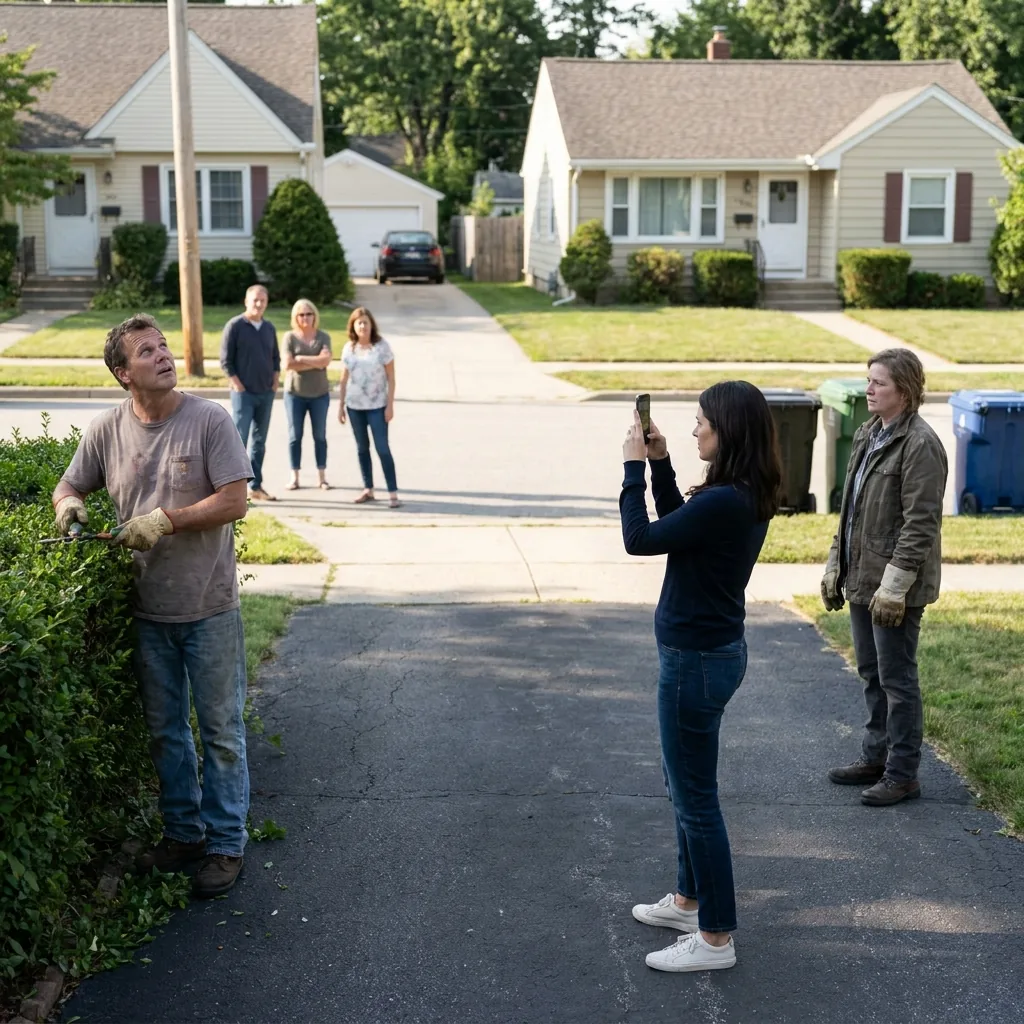
The message alerts kept going off in staggered bursts up and down the curb, each chime pulling another set of eyes down to a screen and then back up at Tessa. Eli had seen neighborhood arguments fizzle once people got bored. This one did the opposite. The more the longer video spread, the tighter the half-circle around the driveway became.
Marisol kept her phone out where the nearest people could see it. She replayed the first seconds twice without hurrying: the scrape, the wheels shifting sideways, Tessa’s voice close to the microphone, then Nora walking up with the tied white bag. Every replay made the same point harder to dodge. The clip that had been passed around all morning did not start where the incident started.
Doug took one step farther off the curb and held his phone up beside Marisol’s. “Mine starts here,” he said, tapping his screen. On his version, Nora was already between the cans. On Marisol’s, the setup was visible first.
“That’s not a trim for time,” the woman with the thirty-two-second clip said. “That’s the whole meaning changing.”
Tessa answered quickly, but she did not answer that sentence directly. “People clip lives all the time. It doesn’t make the point false.”
“It makes your caption false,” Marisol said.
A man near the back asked to hear the audio again. Marisol replayed it, louder this time. Eli watched faces more than phones. Two neighbors who had shown up smiling at the spectacle now stood with their mouths set flat. Doug kept glancing at Tessa, as if waiting for a simpler explanation that never arrived.
Nora stayed close to the bins, one hand resting on the closed lid. “Play the part after I move it,” she said.
Marisol let the video run. The screen was small from where Eli stood, but the sequence carried even at a distance. Nora set the white bag down. She tugged the angled can a few inches, enough to free the jammed lid. Then Tessa’s voice sharpened, louder than before, and the framing tightened in exactly the place the neighborhood clip began.
“There,” Doug said. “That’s the start of the version everybody got. Right after the drag marks.”
Nobody contradicted him.
Tessa lifted her chin toward the crowd. “You still can’t prove I moved that bin.”
Eli heard the opening before he saw it. A teenager near the sidewalk said, “You can hear her say hold on before the scrape.” Then an older man beside him added, “And the phone points down like she’s setting it up.”
That was the first moment the crowd stopped acting like an audience and started acting like witnesses. People were no longer reacting to a story Tessa gave them. They were comparing screens, matching audio to concrete, matching the drag marks to the beginning of the saved live.
Nora pointed once to Tessa’s raised phone. “You filmed my driveway while I was handling my own trash, then cut out the part that showed why I touched the bin at all.”
Tessa started speaking over her. “Shared driveway. Shared space.”
“Not shared camera rights,” Marisol said.
That line moved through the group in a visible way. A few heads turned. Someone near the curb repeated it more quietly, almost to himself. Eli noticed one woman lower her phone entirely and tuck it into her back pocket, like the scene had stopped being entertainment and become something less comfortable to hold.
Doug looked at his own screen again, thumb moving through comments. “People are still piling on in the chat,” he said. “They’re repeating your caption like it’s fact.”
“Then correct it,” Nora said, without looking away from Tessa.
Tessa’s mouth opened, then closed. She shifted her weight back again toward her side of the porch walk.
“Correct it how?” the woman with the short clip asked. “By saying you left out the setup?”
No one filled that pause for Tessa.
Then the new pressure point arrived from the same place the first one had: a phone screen. A younger neighbor pushed forward from the edge of the group with his arm out. “It’s not just in the chat,” he said. “Your live is still mirrored on the neighborhood page because Doug shared it from the group before you cut it down.”
Doug looked up sharply. “I shared what you posted.”
The younger neighbor turned his screen so the closest people could see. Even Eli could make out the frozen frame: Nora by the bins, the driveway seam, the red live badge, and Tessa’s caption underneath. The comments stacked below it were still visible.
“You can edit your post,” the younger neighbor said. “You can’t edit everybody else’s share.”
Tessa reached toward the phone without touching it. “Take that down.”
“You first,” Nora said.
The crowd tightened another step, and for the first time Eli saw several people looking not at Nora, but directly at Tessa’s screen, waiting to see what she would do in front of them all.