Story code: ST-000784
Part 2: The Room Started Tracking The Gaps
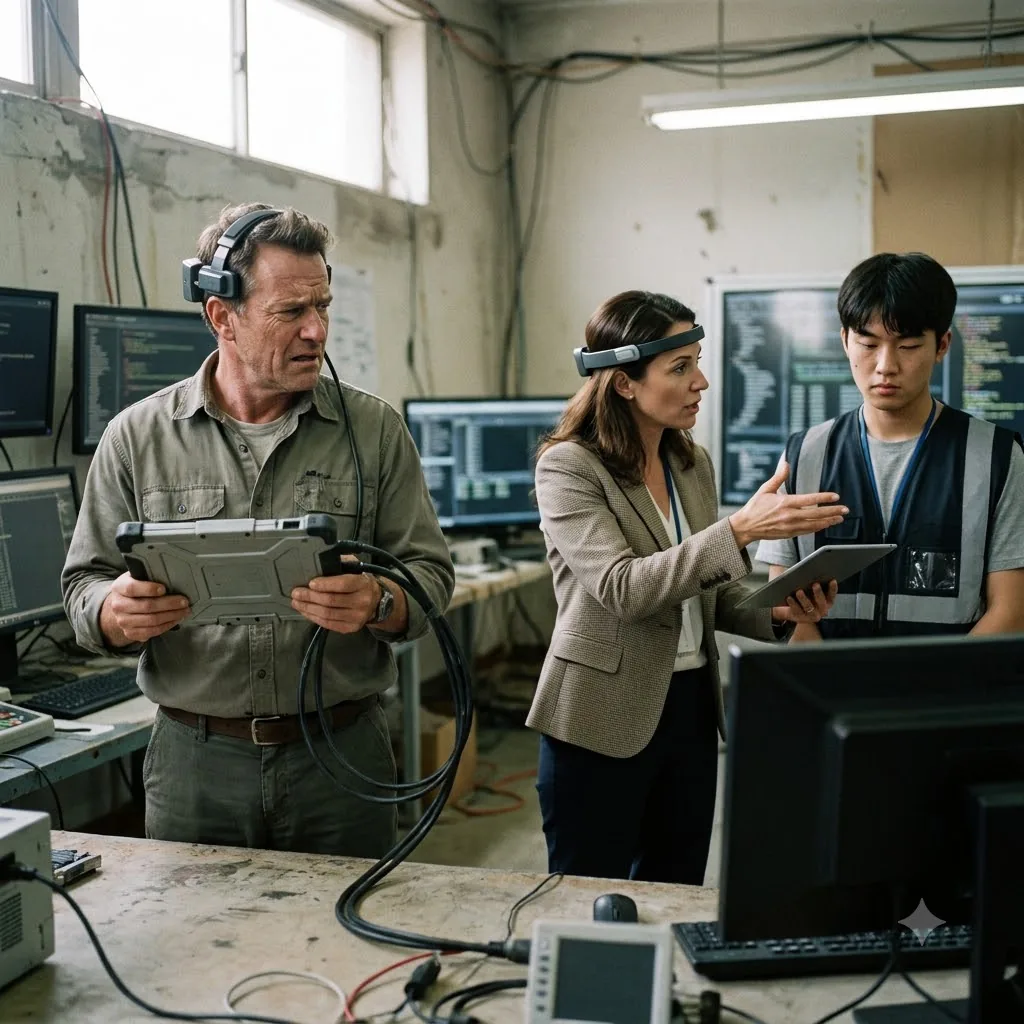
Leah kept her smile in place, but the demo stalled on a prompt simple enough that no one in that room could pretend not to see it. The sync band was seated, the live session was open, and the tablet was waiting for the calibration order she had just implied was hers. She did not touch the screen until Evan repeated himself.
“Proceed with the calibration order on the tablet,” he said.
Same volume. Same wording. He was giving the room a clean second chance.
Leah tapped one icon, then another, then stopped before confirming either. “We usually explain what the family will feel at this point,” she said, turning slightly toward Nina instead of the tablet. “The technical side is there to support the human side.”
Nina did not nod along. She looked at the tablet. “Is that the first step?”
Leah gave a short laugh that did not move anything forward. “It depends on the user profile.”
Evan checked the console again. “This session is loaded to a single saved profile. Current pairing source is already confirmed. Next step is tolerance alignment or fallback threshold, depending on workflow design.”
Depending on workflow design.
That was as close as he was going to come, in that moment, to saying the room could tell whether someone actually knew what had been built.
Leah rested two fingers on the edge of the tablet without pressing anything. Her voice stayed smooth. “Right. We front-load comfort.”
I answered because the device was still live and I was not going to let the session fail just to make a point. “Fallback threshold first on this profile. Then tolerance alignment.”
Leah hit the threshold screen as soon as I said it, fast enough to make it look like timing instead of dependence if you weren’t paying attention.
Nina was paying attention.
She asked, “If you built it, why did she answer that?”
No one rushed to fill the silence after that. The band indicator line kept pulsing. Evan’s eyes moved from the console to the tablet and back.
Leah said, “Because Mara handles some technical support when I present.”
The wording had shifted again. I had gone from helper to technical support.
I kept my voice flat. “Load the threshold at point eight six before alignment, or the response check will read too clean and then drift.”
Evan looked at the console. “That matches prior room notes.”
He said it to the room, not to me.
That small sentence changed the air more than anything dramatic could have. Up to then, Leah still had the advantage of posture, family familiarity, and the fact that the demo had not yet broken. But once Evan tied my instruction to prior room notes, it stopped being my word against hers. It became visible process.
Leah pressed the threshold value. Correct. Then she moved to the alignment screen and paused again.
There are pauses that come from caution and pauses that come from searching. This one was long enough for Nina to close her notebook.
Evan said, “Run live tolerance alignment.”
Leah asked, “Do you want the short pass or full pass for this room?”
He answered immediately. “Whichever your workflow requires.”
Not whichever we recommend. Not whichever I prefer. Your workflow.
That was another clean opening, and she still did not take it.
Her hand stayed over the tablet. She glanced toward the work counter where I had left the spare strap clip and access badge. Then she said, “Mara, pull up the response behavior for her.”
For her.
Like I was an assistant she had assigned in front of witnesses.
I did not move to the tablet. “Full pass after threshold,” I said. “Short pass only if the baseline check throws asymmetry.”
Evan looked at the console and said, “Baseline check is clean.”
Nina leaned one forearm on the counter. “So she just told you which pass to use too.”
Leah straightened and shifted back to presentation mode. “The important thing for families is that our process is collaborative.”
That line might have held if the demo had continued without another hitch. Instead, the wall display flashed the next prompt: RESPONSE WINDOW CALIBRATION.
That step was where the workflow stopped rewarding broad language. The band had to be calibrated to the response window in the right sequence or the live check became meaningless. Not dangerous. Not dramatic. Just useless. And useless is deadly in a demo room because everyone can keep smiling while the record quietly turns against you.
Evan’s tone stayed neutral. “Set the response window.”
Leah touched the lower range field, withdrew her hand, then said, “Can we speak to outcomes while the system catches up?”
“System is waiting on input,” Evan said.
Again, he checked the console before speaking. Again, he left no extra language around it.
I had stopped correcting every small claim by then. There was no need. The room was collecting its own version.
Nina looked from Leah to me and asked the question that split presentation from ownership.
“Who decided that response window in the first place?”
Leah answered first. “I shaped the user experience.”
I said, “The response window sits on the tolerance behavior I tuned during live drift testing.”
Evan turned the monitor slightly so the session log was visible from the counter side. On the edge of the screen sat the profile history, the calibration prompts, and the last saved adjustment path. He did not read it aloud. He just said, “Before we continue, I need the person who set the live drift parameters to confirm the response range.”
Leah’s hand stayed suspended over the tablet.
Nobody in that room needed a speech after that. We needed one answer, and only one of us could give it.