Story code: ST-001009
Part 2: The Story Started Breaking at the Buffet Table
Once Daniel named the apron, the barbecue kept moving in the way public scenes do when people want to pretend they did not just hear the sentence that mattered most. Kids still ran through the side gate. Someone at the grill flipped patties too hard and sent sparks up. Linda passed out plates. But the wording around Daniel started catching on itself.
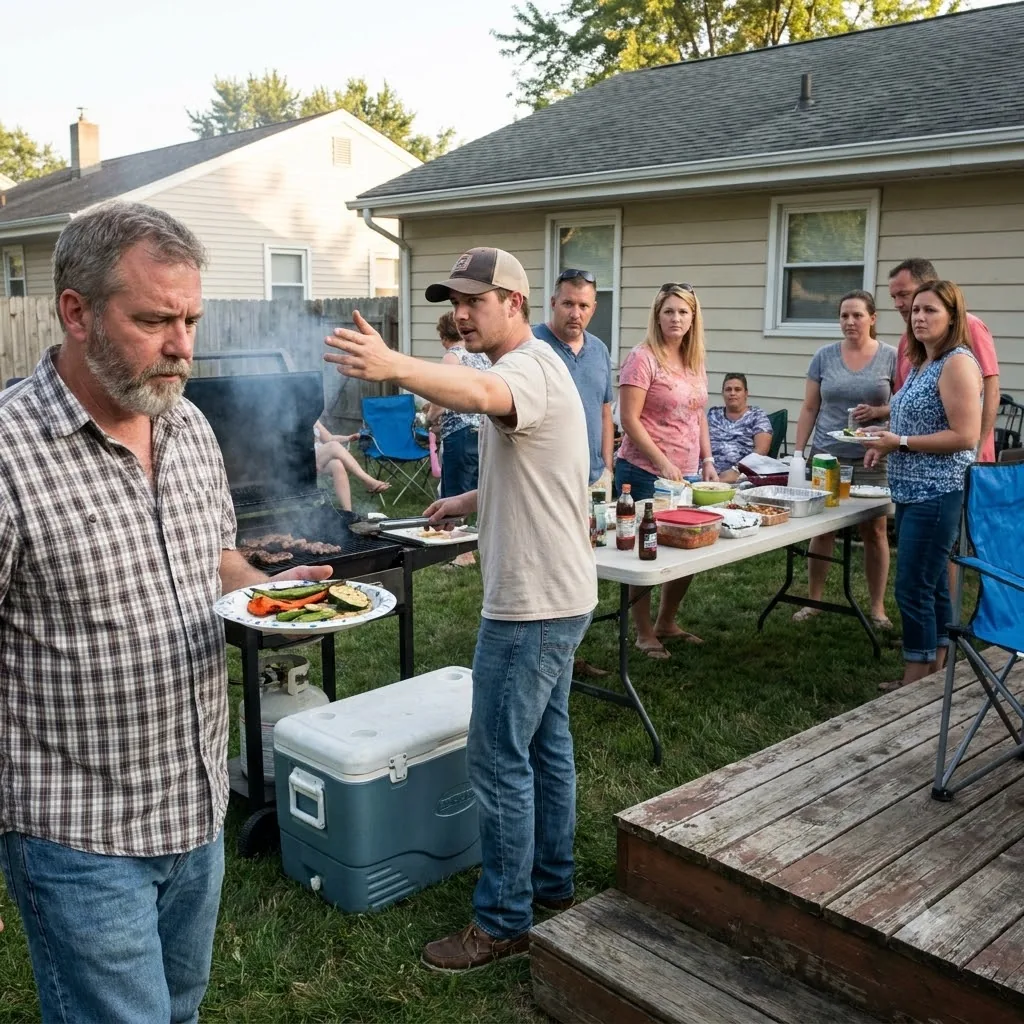
Evan stayed planted by the buffet table like a guard posted beside evidence. Every new arrival got sorted with quick labels. “That’s Aunt Cheryl.” “That’s Tessa’s friend.” “Put the drinks over there.” When Ray Bishop reached for a paper plate, Evan said, “Neighbor plates are on the far end,” and gave a short tap to the stack near the fruit bowl, as if the yard now had categories for who belonged where.
Daniel did not leave. He stood by the end of the table near the meatless platter, one hand resting on the tongs, and answered people when they spoke to him. He did not ask anyone to defend him. That made the silence around him louder.
Tessa set cups beside the drink tub and started doing the thing observant relatives do when a family story stops matching the room. She asked small direct questions in ordinary tones.
“Who’s doing the toast this year?”
Linda, carrying a bowl of sliced onions, said, “We’ll see.”
Tessa nodded toward Daniel. “Didn’t he always do the thank-you before people ate?”
Linda put the bowl down. “Let’s not make everything a thing.”
But it already was one. A man from Linda’s church walked up to Daniel and said, “Good to see you back on grill duty,” while holding out a hand for the tongs. Daniel did not take the bait or the compliment. He just said, “Evan’s handling the grill.” The man blinked, looked between them, and withdrew his hand.
That happened three more times in different forms. A cousin asked Daniel where the extra chairs were stored. A neighbor asked whether he still did the corn in foil packets. An older woman near the patio door said, “You always remember the mustard nobody else buys,” and then went quiet after seeing Evan’s face.
Each little exchange did the same work. Evan kept saying Daniel did not count. The yard kept supplying routines that said otherwise.
I watched Evan begin checking the crowd before every correction. It happened when Tessa picked up one of the blank index cards and, without asking, wrote VEGETABLE KABOBS on it in thick black marker. She slid it in front of Daniel’s platter and squared it with the edge of the table.
Evan reached over and turned the card facedown.
“We’re not labeling that as part of the spread.”
Tessa looked at the upside-down card, then at him. “It’s on the spread.”
“It’s separate.”
“From what?”
He did not answer her question directly. He looked instead to Linda, then to two older relatives by the folding chairs, then back to the table, as if agreement needed to be visible before the rule could hold.
Daniel spoke before Linda could. “Separate food, separate person. That the idea?”
Nobody laughed. Nobody rushed in to smooth it over. The only sound for a second was the scrape of a burger spatula on the grill.
Linda wiped both hands on her shorts and went inside through the patio door. Evan watched her go and then immediately started reworking the table again, sliding the potato salad closer to the center, shifting the burger tray half an inch, making a border out of dishes.
Ray, now sitting in one of the folding chairs he brought, said to no one in particular, “Used to be Daniel’s apron hanging on the nail by that door every summer. Couldn’t miss it.”
That drew eyes to the patio entrance. The small nail was still there, visible beside the frame. Empty now, but obvious once someone mentioned it.
Evan folded his arms. “People keep old things. That doesn’t make them family.”
Daniel answered in the same controlled voice he had used from the start. “No. But repeated use in front of fifty witnesses over a lot of years says something.”
Linda returned before Evan could reply. She was holding a stack of clean kitchen towels on top and something heavier underneath. She set the towels down first beside the buns. Then she placed the old apron on the table between the fruit salad and Daniel’s platter.
It was faded blue with grease shadows that never fully wash out and stitching along one split pocket done in thick dark thread, visible from two steps away. Several people leaned closer without touching it. One of the older cousins said, right there in the open, “That’s the one he fixed after the Fourth of July tear.”
Daniel did not pick it up. He just looked at the apron and then at the tray of napkins weighted with family photo magnets.
Tessa was first to notice the next contradiction. She lifted one of the magnets from the tray, held it up, and turned it toward the table. It was an old barbecue snapshot, sun-faded but clear enough: the same patio door, the same grill station, and a man in that same apron, carrying a platter toward the buffet.
She didn’t need to narrate it. The picture did that on its own.
Evan took one step forward and stopped.
Daniel finally spoke, and this time his question was not about food at all.
“If I didn’t count,” he said, looking at the apron and then at Linda, “why did you keep every piece that proves I did?”