Story code: ST-000114
Part 2: She Wouldn’t Let Go Of The Burden
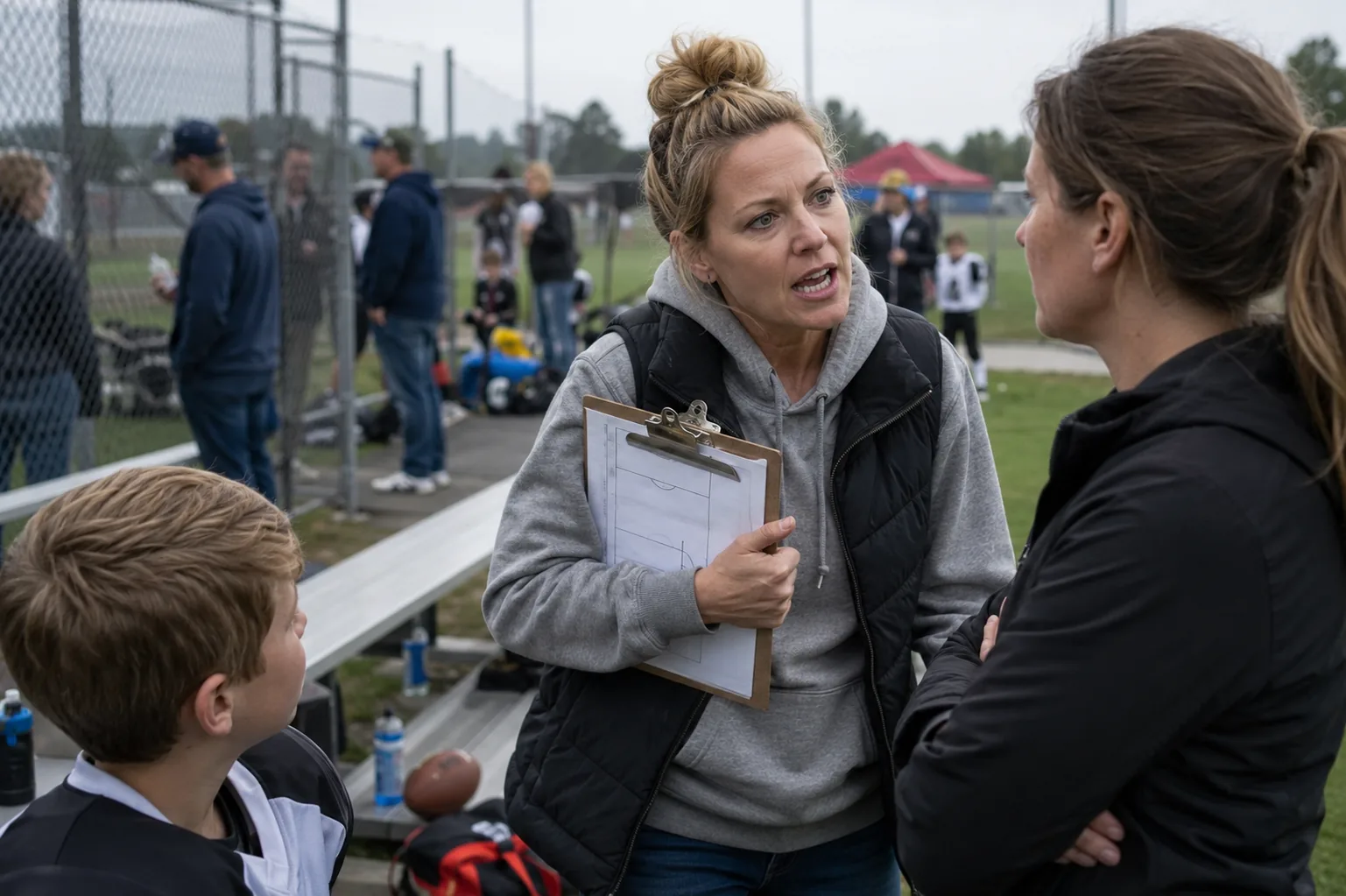
By the next practice, I wasn’t waiting to see whether Dana would corner me again. I came early, set Eli’s equipment bag under the bench, and stayed close enough to the field that I could hear Coach Raul Bennett calling drill lanes without having to stand shoulder to shoulder with the parent cluster. I wanted clean air, a simple drop-off, and no conversation that could be twisted into some public lesson about gratitude. Dana found me anyway. She walked over with the lineup clipboard tucked under her arm and said, “I thought about what you said.” She said it in the same bright voice people use when they want nearby listeners to assume everything is civil. Two dads were unloading water bottles from a rolling cooler. A grandmother on the far end of the bench was zipping up a sweatshirt for a younger sibling. Dana placed herself right in the lane where anyone passing would catch a fragment. I said, “Good.” Her smile flattened. “No, I don’t think you understood me. You don’t get to dismiss what people do and call that a solution.” I had promised myself I wouldn’t get dragged into her rhythm again, so I stayed with the one point that mattered. “I didn’t dismiss anything,” I said. “I told you if helping my family is causing resentment, stop doing anything extra for us. We’ll handle our own rides, our own schedule, our own communication.” She shifted the clipboard higher against her side. “So now I have to reorganize around your feelings?” “No,” I said. “Around your own complaint.” The grandmother looked up for a second and then back down at the zipper. One of the dads went still with a case of sports drinks in his hand. Nobody stepped in. Nobody ever does at a bench like that. They just become very interested in whatever is in front of them. Dana gave a short laugh with no humor in it. “This is exactly the problem. I say I’ve been carrying too much, and instead of stepping up, you try to wash your hands of it.” That was the contradiction sitting right in front of me. She had complained about carrying too much. I had told her to put it down. Somehow that made her angrier. I said, “Stepping up isn’t the same as owing you.” She looked toward the field, then back at me. Coach Raul was bent over a cone stack, setting up the next station. A line of players cut behind us on their way to the far sideline. Dana waited until they had passed before speaking again. “Maybe you don’t realize how much context matters when lineups get tight,” she said. Her fingers pressed into the edge of the clipboard. “Coaches notice which families are supportive and which ones create friction.” There it was again. Still not direct enough to quote as a formal threat. Still clear enough to land. I kept my voice low. “Are you saying my kid’s playing time depends on whether I flatter you?” “Don’t be dramatic,” she said immediately. “I’m saying teams run on trust. People remember who makes things easier.” Eli came jogging over for his water bottle, stopped when he saw us, and glanced from my face to the clipboard. That one look told me he knew enough to know this wasn’t about snacks or carpool. I handed him his bottle and said, “Head back when Coach calls you.” He nodded and stayed one second longer than usual before jogging off. Dana watched him go, then lowered her voice. “See? This is what I’m trying to prevent. Kids pick up on tension when parents refuse to cooperate.” I said, “No. Kids pick up on adults making everything personal.” Her mouth tightened. She flipped the clipboard open in front of me like she was showing evidence in court. Rows of names. Position notes. Scratched changes in pen. Her own handwriting all over the margins. She tapped Eli’s name once, not hard, but not casually either. “Do you have any idea how many adjustments I’ve made to keep things fair?” she said. “How many times I’ve stayed late making sure boys who deserve a chance get one?” I looked at the page, then at her hand still resting on it. She wasn’t showing me proof that she had to do this. She was showing me how badly she wanted me to see that she was inside the process. So I gave her the same release, even more clearly than before. “Then stop,” I said. “Take your hands off anything connected to my son. Don’t manage his ride, don’t speak for our family, don’t do favors, don’t adjust one thing for us. If Coach Bennett needs something from me, he can ask me directly.” For a second she didn’t move. Then she closed the clipboard so fast the metal clip snapped. “That would make everything harder,” she said. “For who?” She stared at me. Not surprised. Not relieved. Just stuck there with the board locked against her chest again, as if the idea of not holding our family inside her list of sacrifices was the one option she could not stand. Coach Raul called for scrimmage sides. Parents shifted, kids ran, cleats hit the dirt in quick bursts. Dana took one step closer and said, almost under her breath, “You don’t want to do this in a way that affects Eli.” I heard the words. I saw where her hand was, flat over his name on that clipboard a second earlier. I saw how fast she rejected every chance to set the burden down. And that was the moment the story she kept telling stopped matching what was right in front of me. If she was exhausted, release would have helped her. If she was overextended, distance would have helped her. But the only thing that upset her was losing the right to keep us in debt. I still wasn’t going to make a scene at the bench. But.