Story code: ST-000914
Part 2: What the Postcard Could Prove
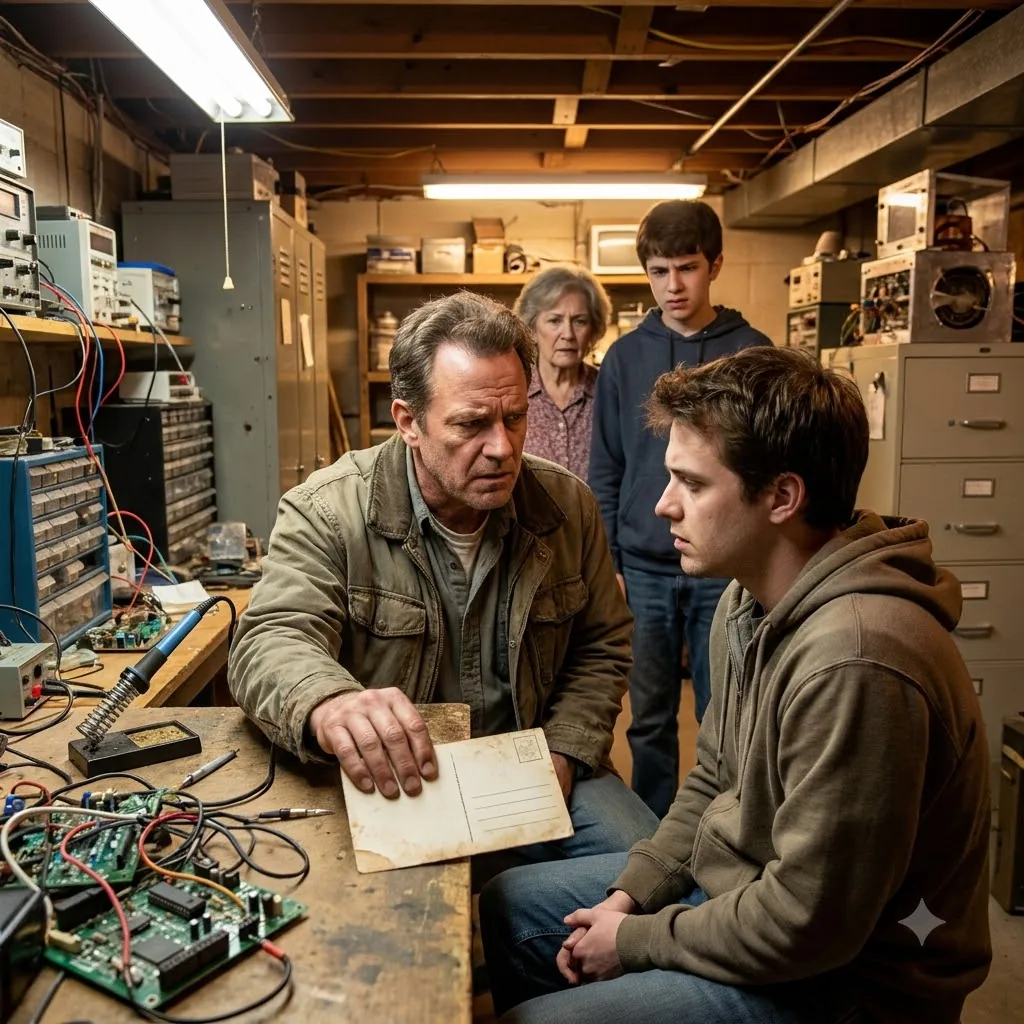
By Monday, Uncle Dean had changed the basement passcode, moved the future postcard into the lockable cabinet between runs, and started calling that normal because “we needed tighter discipline.” He said it in front of Noah while I was carrying a box of ceramic spacers down the stair landing, like my punishment for asking a direct question should sound like a safety upgrade. What he could not explain was why a man crushed under some impossible sacrifice suddenly got sharper, louder, and more territorial the second I offered to lighten his load. I found Noah at the workbench redoing labels that did not need redone. He had the procedural board open, a dry erase marker in one hand, and the kind of careful posture people use when they don’t want to be caught standing still. “Did he really change every password?” I asked. Noah nodded once. “Rig account, parts ordering, environmental logs. Mara has the new door code.” “Do you?” He capped the marker. “No.” That told me more than whatever excuse Dean had given. Noah had been running hardware checks with us since college. If this were about protecting the basement, Noah would have access before Mara. Instead the access had narrowed around the people most willing to repeat Dean’s story without touching it. I set the spacer box down. “When the postcard first came through, where were you standing?” He glanced toward the stairs before answering. “By the tray. Why?” “Because everybody keeps telling me what it means, and I’m asking what you actually saw.” He took a second, then pointed to the copper-lined receiving tray bolted beside the rig frame. “Third pulse of that cycle. There was the usual flash distortion. Then the card was just there. Half in, half out, like it snagged. Dean reached it first.” “Did he read it first?” “Yeah.” “Before anyone else?” “By a few seconds.” A few seconds was not proof of anything. It also wasn’t nothing. I was careful not to pretend it was more than it was. The whole basement trained you to respect small differences. “Did he ever let Dr. Bennett examine it alone?” I asked. Noah shook his head. “She asked for chain-of-custody notes. He said this wasn’t criminal evidence, it was family material.” He gave a short, humorless smile. “She didn’t love that.” That was how I ended up texting Dr. Lila Bennett from the top of the basement stairs while Dean and Mara were at the supply store. She had consulted on our shielding math twice before. She never acted impressed by the rig or by Dean. That already made her useful. She agreed to stop by for twenty minutes. When she came in, she ignored the family history entirely and went straight to the bench. Gray jacket, flat voice, reading glasses halfway down her nose. Dean hated that kind of calm on other people. I unlocked my old photo archive on my phone and pulled up the pictures I’d taken of the postcard the first week, back before Dean started guarding it like a relic. Front, back, corners, paper grain, the line spacing in my name. Dr. Bennett studied them without touching my phone. “I can tell you what this object can support and what it cannot,” she said. “That’s all I want.” She nodded toward the image of the front. “The altered skyline matters as anomaly evidence if your timestamping is clean and the image substrate tests unusual. The delivery path matters if your receiving tray logs are intact. The handwritten message matters as a message. It does not, by itself, prove the full story attached to it.” “Meaning?” “Meaning a physical artifact can be authentic and still be interpreted in self-serving ways. ‘Do not let Dean leave before the third run’ is an instruction. It is not a blanket transfer of authority for every decision after that event.” I almost laughed, but there wasn’t anything funny in it. Hearing somebody say it out loud made the last six weeks sound even more ridiculous. “Could the card be real and his sacrifice story be bigger than what the card actually supports?” I asked. “Yes,” she said. “Easily. Especially if no one maintained neutral custody, complete logs, and contemporaneous notes.” That word stuck with me. Neutral. Nothing in our basement had been neutral since the card appeared. The door opened before I could ask another question. Dean came in carrying a plastic tote of connectors, Mara behind him with paper towels and a new pack of batteries. He stopped when he saw Dr. Bennett. Not froze. Stopped. The tote hung at his side for one beat too long. “I wasn’t told we had company,” he said. Dr. Bennett turned from the bench. “You were not required to be. Erin asked a technical question. I answered it.” Mara set her things down carefully. “About private family business?” “About what an artifact can establish,” Dr. Bennett said. “Those are different categories.” Dean put the tote on the workbench and looked at me. “What exactly are you trying to do?” I kept my voice level. “Figure out what is observable and what is just your version of it.” “My version?” He let out one sharp laugh. “I crossed a line in time you people still treat like a hobby, and now suddenly I’m giving a sales pitch?” “Then let somebody else carry it for a day,” I said. “If this burden is real, let Noah hold the cabinet key. Let Mara manage the run logs. Let me take over the rig account and you can supervise without being the center of every step.” Mara started to object, but Dean cut across her so fast his words ran together. “No. Absolutely not. Nobody is touching the run account, nobody is moving that card, and nobody is making procedural changes off one conversation with an outsider who doesn’t understand what happens if I step back.” Dr. Bennett’s face did not change. “That is not a technical answer.” Dean looked.