Story code: ST-000174
Part 4: I Left Him Holding His Own Story
The drawer stayed shut under Gerald’s hand.
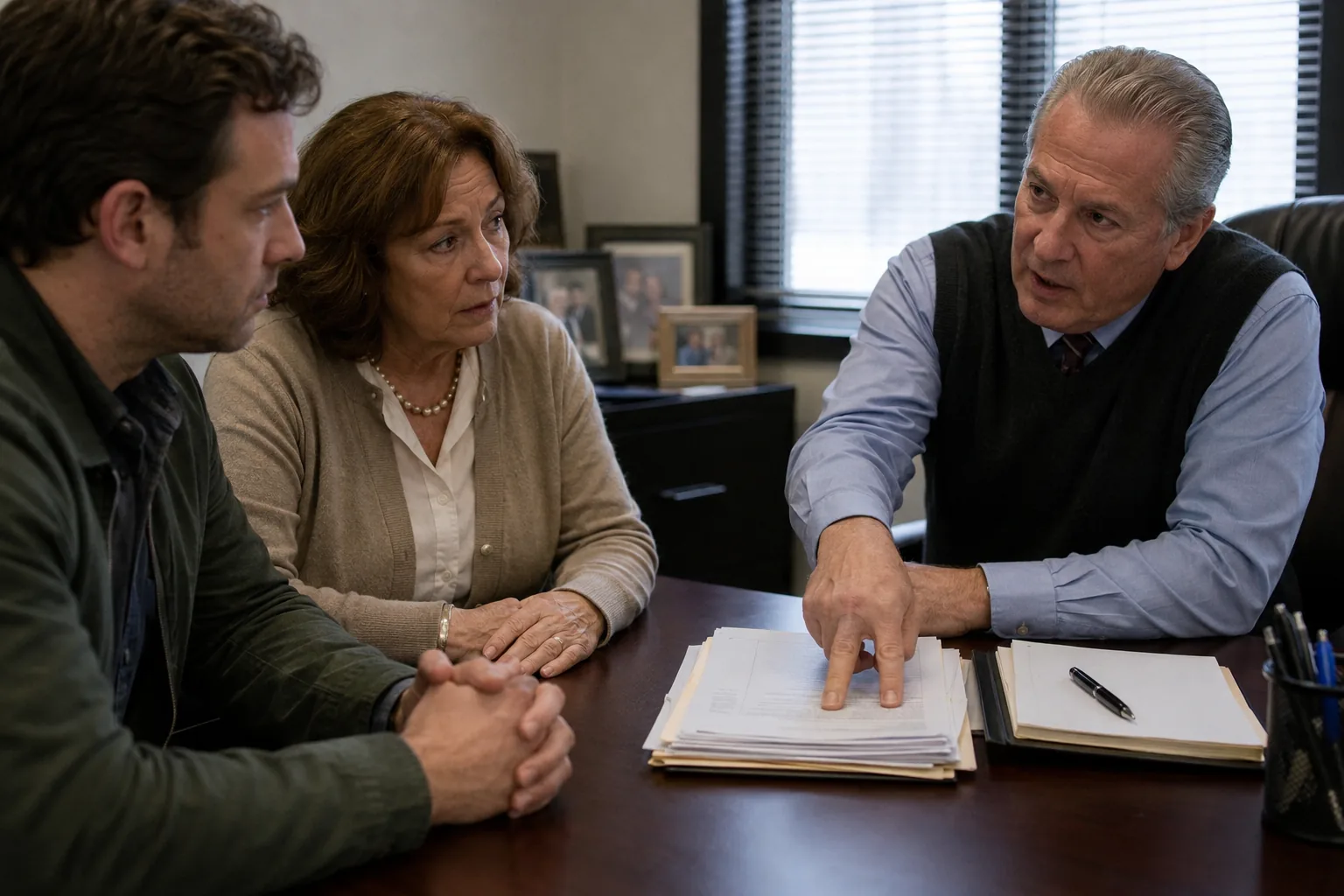
He kept his palm on the knob as if the ledger might somehow leave without him if he let go. The office around us carried on like it always had. A phone rang at the front, someone said they’d be right with a client, and a printer kicked on again. Inside our little seating area, all the air had changed.
“That isn’t how this works,” Gerald said.
“It is for me,” I said.
He gave a slow, disbelieving shake of his head. “You do not get to come into a complex estate review, accuse me by implication, and then freeze the process because you don’t like how responsibility looks.”
“I didn’t accuse you of anything,” I said. “I asked for the ledger, an explanation, and copies of our estate records. You turned all three into a loyalty test.”
Diane sat very still beside me. Her hands, which had spent the whole meeting twisting together, were flat on her knees now.
Gerald looked at her first. “Diane, tell her this is reckless.”
Diane opened her mouth, then closed it. She glanced at the drawer where the ledger was locked away, then at me. “I don’t think refusing copies helps,” she said quietly.
It wasn’t a speech. It was barely more than a sentence. But it broke the last little piece of the performance he had been running.
Gerald pulled himself up straighter in his chair. “You are all reacting emotionally to materials you are not qualified to interpret.”
Evan said, “Then a second accountant should be able to interpret them.”
Gerald’s lips pressed into a line.
I stood up. My chair gave a small squeal against the carpet. “We’re done for today.”
That got him moving. “Sit down, Alyssa.”
It was the first outright command he’d used with me all morning, plain and stripped of the polished language. Diane looked at him. Evan looked at him. I just picked up my bag.
“No,” I said.
He pointed at the desk, at the drawer, at the spot where the ledger had been sitting. “You cannot walk out in the middle of this and start shopping for people who will tell you what you want to hear. There are consequences when files like this get reopened by outsiders.”
“Then send those concerns in writing,” I said.
He stared at me.
I took the legal pad page where I had written my request, tore it off cleanly, and set it on his desk. My handwriting looked steadier than my pulse felt.
“Mail digital copies of the full estate ledger, including inserted notes and adjusted entries, to all three of us,” I said. “If you won’t, that’s your answer. Either way, nothing moves without copies. No signatures, no new plan, no more office meetings.”
He did not reach for the page.
I could see the fight in the little motions instead: the twitch in his cheek, the way his thumb tapped once against the desk edge, the way he kept glancing at Diane like she might still restore him if he waited long enough.
She didn’t.
“Gerald,” she said, and even now her tone was softer than mine, “just send the records.”
He gave a humorless laugh. “You have no idea what you’re inviting.”
Maybe we didn’t. Maybe there were more ugly details in that drawer than I had seen. Maybe there were explanations for every changed line. But I didn’t need final proof of everything to know what I was refusing.
I was refusing his story about sacrifice as the price of access to my own family’s estate.
I moved around the guest chair and stepped into the aisle leading back to reception. Evan stood too. After half a second, Diane rose with us, slower, like her body was catching up to a decision her mouth had finally made.
Gerald stayed behind the desk.
“If you leave like this,” he said, “don’t expect me to keep cleaning up confusion that other people create.”
I turned back once.
“Good,” I said. “Don’t carry it for me anymore.”
That was the closest thing to an ending he was getting from me.
We walked past the front desk without explaining ourselves. I heard Gerald’s chair scrape hard behind us, but he didn’t follow us into the reception area. The receptionist looked up, smiled automatically, then looked back down when she saw none of us were stopping.
Out in the hall, the office door closed behind us with a soft hydraulic pull that felt cleaner than any final word could have.
Diane exhaled through her nose and stared at the carpet for a second. Evan took out his phone and said, “I’m texting for another accountant now.”
“Include me,” I said.
He nodded.
Diane looked back once at the closed office suite door, then reached into her purse for her keys. “He has the original ledger,” she said.
“For now,” I said.
I took out my phone and, before anyone could talk me back into being polite, sent one group text to Diane and Evan while we were still standing in the hallway: No one meets with Gerald alone. No one signs anything. All requests stay in writing.
Both of their phones chimed almost immediately.
That was the visible consequence. Not a speech. Not a showdown. Not me proving every line in that ledger before lunch.
Just a shut drawer behind him, a written boundary in front of me, and his access to us narrowed down to a message he would have to answer without the room arranged around his story.
Then I put my phone away, turned toward the elevators, and kept walking.