Story code: ST-001378
Part 3: The Measurement Test
Director Vance walked with a brisk, even pace down the third-floor corridor, his boots striking the linoleum with a rhythmic click. I followed a step behind, carrying the replacement light bulbs as a pretext for my presence. We found Marcus near the elevator bay, packing up his tools. His heavy aluminum ladder rested against the wall.
Marcus looked up as we approached, his expression shifting from a casual grin to a neutral, professional mask. He wiped his hands on a grease rag. “Afternoon, Director. Just finished replacing the ballasts on the north side.”
Vance stopped, crossing his arms. “Leo tells me we had an incident in the North Corridor earlier today. A disposal of a tenant’s storage box.”
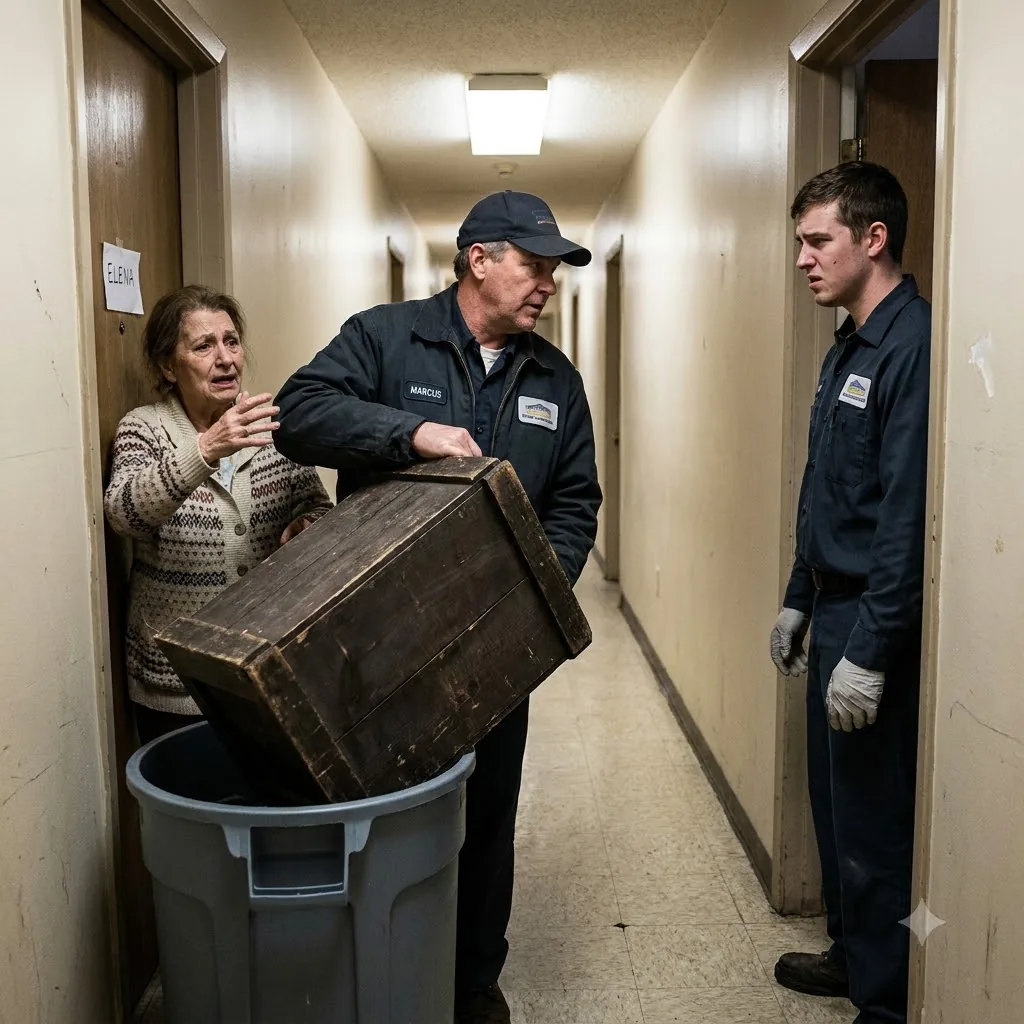
Marcus nodded, his posture stiffening slightly. “Yes, sir. Unit three-B. The tenant had a large cedar chest blocking the egress path. I cleared it under the standard fire safety protocols.”
“Which protocols specifically?” Vance asked. His voice remained conversational, but his eyes stayed fixed on Marcus’s face.
“The thermal-load volumetric compliance regulations,” Marcus said. He spoke quickly, his words sliding together with practiced ease. “Section four, paragraph twelve of the state annex. The box exceeded the allowable dry-organic volume for a restricted egress zone. It was a clear hazard, so I removed it to keep us compliant.”
I watched Marcus’s hands. He was folding his grease rag over and over, his fingers tight against the fabric.
Vance didn’t look at me. He kept his gaze on Marcus. “I don’t recall that specific phrasing in our quarterly updates. I want to make sure our staff is applying the measurement rules consistently. Let’s do a live calculation right now.”
Vance pointed to a large plastic storage bin sitting outside unit three-D, belonging to another resident. “Let’s use that container as a test case. Show me how you determine the thermal-load volumetric compliance for that unit.”
Marcus paused. He looked at the plastic bin, then down at his digital tablet. He tapped the screen, scrolling through a menu that wasn’t there. “Well, Director, the plastic bins are different. They don’t have the same BTU potential as high-density organic materials like cedar. The calculation changes based on the material density.”
“That’s fine,” Vance said. “Show me the density calculation. Use your tablet’s inspection ledger to input the variables.”
Marcus’s thumb hovered over the screen. He cleared his throat. “The system is running slow today, sir. The offline database doesn’t always load the localized annex tables. I usually calculate the volume by hand first.”
“Perfect,” Vance said, his voice flat. He turned to me. “Leo, go to the Main Supply Room. Bring the printed compliance ledger and the physical copy of the State Fire Code Annex. Let’s record Marcus’s manual calculation step-by-step so we can add it to the property’s official safety protocol.”
I nodded. “I’ll be right back, Director.”
As I turned to walk down the corridor, I saw Marcus shift his weight from one foot to the other. He adjusted his heavy tool belt, the metal wrenches clinking against his thigh, but he didn’t say a word. The air in the hallway felt suddenly still.