Story code: ST-000975
Part 2: The Story Started Slipping on the Screen
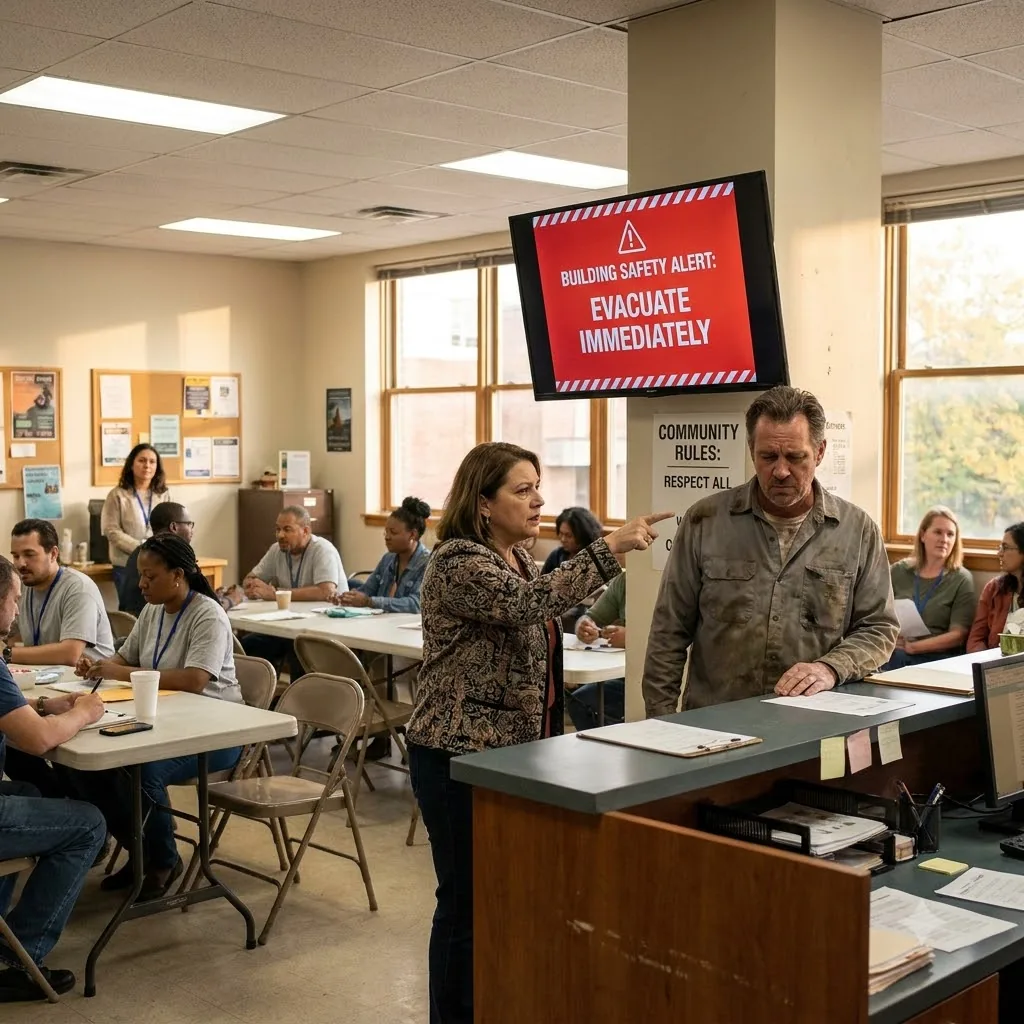
Once Dana blocked Eli from using the radio, people stopped looking at me like I was the problem and started watching her mouth. The room got quiet in that sharp, careful way a public room does when everyone realizes the emergency might not be matching the volume. Dana still had one hand raised toward Eli, and the announcement screen kept rotating above us like it hadn’t heard any of it. Eli lowered the radio but didn’t unclip his hand from it. “If this is a building safety issue,” he said, calm as ever, “I have to notify front desk.” Dana turned halfway toward him and pointed at the console by my elbow. “Or Maya can do the responsible thing and stop debating.” Responsible thing. She kept using language that made any delay sound reckless, but she still wasn’t naming one concrete hazard. Not smoke. Not a locked exit. Not a wrong room assignment sending people into danger. Just urgency, over and over. I looked up at the screen again. The closing reminder faded out. The next slide came in with tonight’s room schedule: ceramics in Studio B, literacy in Multipurpose, teen basketball in the gym at seven-thirty. The time stamp sat in the bottom corner. Seven twelve. “Dana,” I said, “what alert should be on there?” “The evacuation instruction,” she snapped. “For what?” She pressed her lips together, then said, “For the maintenance issue everyone was already told about.” Eli glanced down at the schedule sheet in his hand. “Nobody at front desk got a building evacuation notice.” Dana swung toward him. “Because this place is always behind. That’s why I came in here myself.” Renee spoke from her table, not loud but clear enough for the nearest people to hear. “You said it was telling us to stay put.” Dana answered without looking at her. “That is the effect, yes.” That was not the same claim, and enough people caught it that I saw heads tilt and then turn back to the screen. Two volunteers who had been whispering near the coffee urn stopped whispering. The little girls with the markers were still now, each holding a cap in midair. Eli stepped closer to me instead of to Dana. “What controls this room only?” he asked. “Nothing,” I said. “If I push an alert from here, it goes to the shared loop unless front desk unlocks the emergency channel.” He nodded once. That mattered because now the room could hear this wasn’t me refusing out of habit. The system was set up so one person under pressure couldn’t blast a false instruction across the building. Dana heard it too. Her voice changed a little, not softer exactly, but more crowded. “Then call whoever opens it. I’m not saying don’t do process. I’m saying don’t stand here acting helpless.” Eli touched the radio again. Dana cut in before he could lift it. “No police, no officer, none of that. I am not asking for that. I’m asking for a correction.” That was the first time she named the kind of help she didn’t want, and she named it before Eli had said who he would call. He looked at her for a second. “I didn’t say police.” Dana crossed her arms, then uncrossed them right away. “Fine. Security. Management. Whoever. But don’t make an announcement that panics people.” Nobody had suggested making a public verbal announcement either. The screen changed again. This time it showed the recurring safety slide every evening program gets at the top of the hour: in case of emergency, await staff direction or posted alert. White letters on blue. Plain. Routine. A few people read it in silence while Dana was still talking. Renee pointed up. “Is that what you mean?” Dana turned and looked. “No. That’s the old one. That’s exactly the problem.” Eli asked, “What newer one?” Dana didn’t answer him directly. She stepped toward the screen and jabbed a finger at it from six feet away like the gesture itself could fill in the details. “That should not be cycling if there is an active issue.” “If there is,” Eli repeated. She wheeled back around. “There is.” “Who reported it?” he asked. She paused just long enough for the room to feel it. “I did.” “To who?” “People on site,” she said, then added quickly, “I shouldn’t have to build a case file in the middle of a danger window.” That line would have worked better if she had not spent the last five minutes blocking the only simple step that would make the situation official. You could see the room catching up to that. Nobody was helping her fill the silence anymore. Nobody was pushing me toward the console. Eli finally lifted the radio. Dana took one step in and said, “Do not escalate this over a technical display issue.” Technical display issue. A minute earlier it had been the building in danger. Eli held the radio near his mouth but looked at me first, then at the screen. “Maya, when did that safety slide last refresh?” I checked the lower corner. “Seven o’clock. It’s on its normal loop.” “Can the front desk see that from their terminal?” he asked. “Yes. And they can pull the log for every change.” The second I said log, Dana stopped talking. It was a small thing, just a break in her rhythm, but half the room heard it because she had been filling every open space until then. Her eyes went from me to the screen, then to Eli’s radio, then to the posted schedule in his hand. Eli pressed the side button. Dana reached out again, not touching him this time, just cutting her hand through the air between the radio and his face. “Wait,” she said. “Before you call anybody, I want to make sure we’re not confusing a scheduling update with a safety channel change.” That was the cleanest sentence she had said all night, and it was nothing like how this.