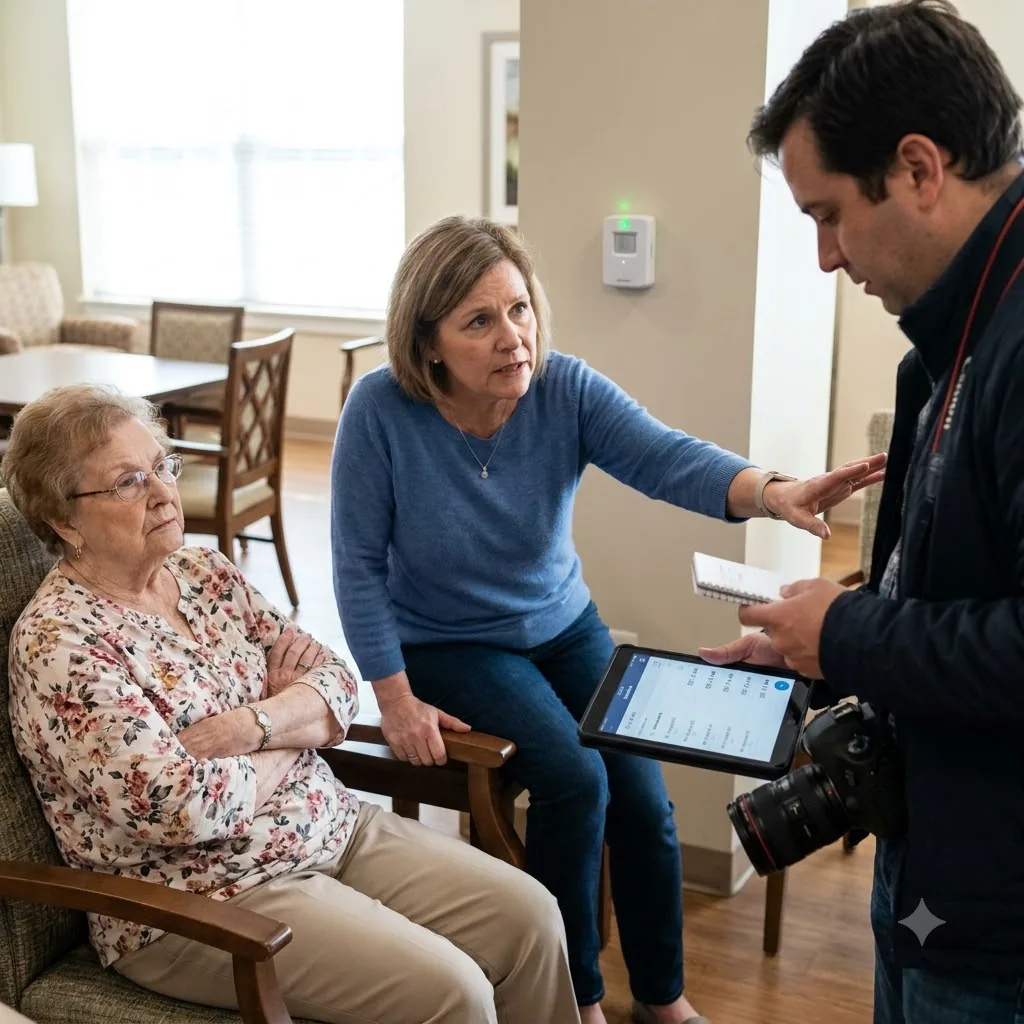
Story code: ST-000766
Part 4: She Kept One Part Off the Record
The desk supervisor called the administrator down after the camera clip ended. By then the proof no longer depended on tone or trust. It sat in four places at once: Nina’s note, the hall clip, the obstruction alert, and the raw chain showing an assist marker with no staff badge behind it. Victor stopped using the phrase completed care. He switched to event closure and synchronization behavior, which was only a cleaner way to say the same bad thing.
The administrator arrived with a facility key card on a blue lanyard and read the screen in silence. She asked Victor whether Unit C-14 could close a routine care event from threshold data under fallback conditions. He answered after a pause that the system could, in limited circumstances, accept environmental confirmation where human confirmation was delayed. She asked whether the resident-facing report still displayed that as care complete. He said the customer-facing display did not distinguish between those states.
That was the point where the building finally moved.
The administrator told the desk supervisor to suspend Unit C-14 from independent room-close functions pending review. She said it plainly, not loudly, and asked for the vendor access credential linked to room 214. Victor removed a badge from his jacket and set it on the counter beside the tablet. The desk supervisor typed a note into the incident field and printed a one-page restriction order for the robot’s care mode. The printer clicked, fed, and stopped. A small sound, but it changed the room more than any speech had.
Eli looked at the paper first. “So the log was wrong.”
The administrator kept her hand on the printout. “The log presented a completed care sequence that was not completed in the room.”
He nodded once, but he stayed where he was. “Then what actually happened?”
That question had two answers now. One belonged on the counter. The other did not.
I had enough to reconstruct the missing event without stepping outside what we could prove. Nina requested help. The robot approached. The hamper and doorway angle blocked the path. Diane was upright, holding the rail. The system accepted partial room signals and treated them as a successful assist state. The room closed on the report while the resident still waited. That was the public truth, and it was enough to break the vendor defense.
But there was one more thing visible in the room sequence that did not belong to the vendor and did not need to become public. Diane had watched the robot too closely from the start. Back in the room, before we came to the desk, she had kept the hamper nudged just far enough into the threshold to interfere with a full approach. I had seen the wheel mark against the baseboard and the hamper’s angle against the door trim. When Nina returned to the room after the desk review, the hamper had been pulled back into place and the path was clear. Diane did that herself while the rest of us were at the counter. I saw the changed position when we walked back, and I wrote down only the position, not a motive.
That left me with a boundary to hold.
Eli asked again, this time to me. “What happened in there before 8:14?”
I kept my notebook closed. “The record closed the room without a real completed assist. The proof for that is enough to correct the file and restrict the unit.”
He watched my face for a second. “That’s not the whole answer.”
“It’s the answer this record can support,” I said.
Diane was back on the chair by the bed when we returned to room 214. The second sock was on. The water cup sat within reach. Unit C-14 was docked against the wall with its care mode restricted, a yellow banner across the screen reading manual completion required. Nina checked the room and then checked it again, this time without waiting for the robot to tell her what the room already showed.
The administrator came in long enough to read the correction aloud for the chart: prior automated completion entry voided; resident assistance delayed; manual staff verification required for future checks in room 214 until further notice. She left a copy clipped to the outside rail folder.
Victor did not come back into the room. At the desk, his access had already been disabled for live care-state overrides until the vendor submitted a corrected configuration note. The consequence was ordinary and expensive in the way facility consequences usually are: lost access, a printed restriction, a documented correction that would follow every review after this.
Eli stood at the foot of the bed holding the old printout and the new one. He looked at Diane, then at me.
“You knew more than you said,” he said.
I did not answer the part I could not prove cleanly without taking something from her that the record did not deserve. I handed him the corrected incident copy instead.
“I said what the room can carry,” I told him.
He took the paper, but not gently. That was the cost. The vendor lost the clean sequence. The facility reversed course too late to spare the waiting. Diane kept the one opening she still had. Eli walked out with a correction in his hand and less trust than he had brought in.
After he left, Nina adjusted the rail, checked the cup, and signed the manual verification line. Unit C-14 stayed silent under its yellow banner. The room was finally accurate. It just was not repaired.