Story code: ST-000569
Part 3: The Room Could See What She Had Done
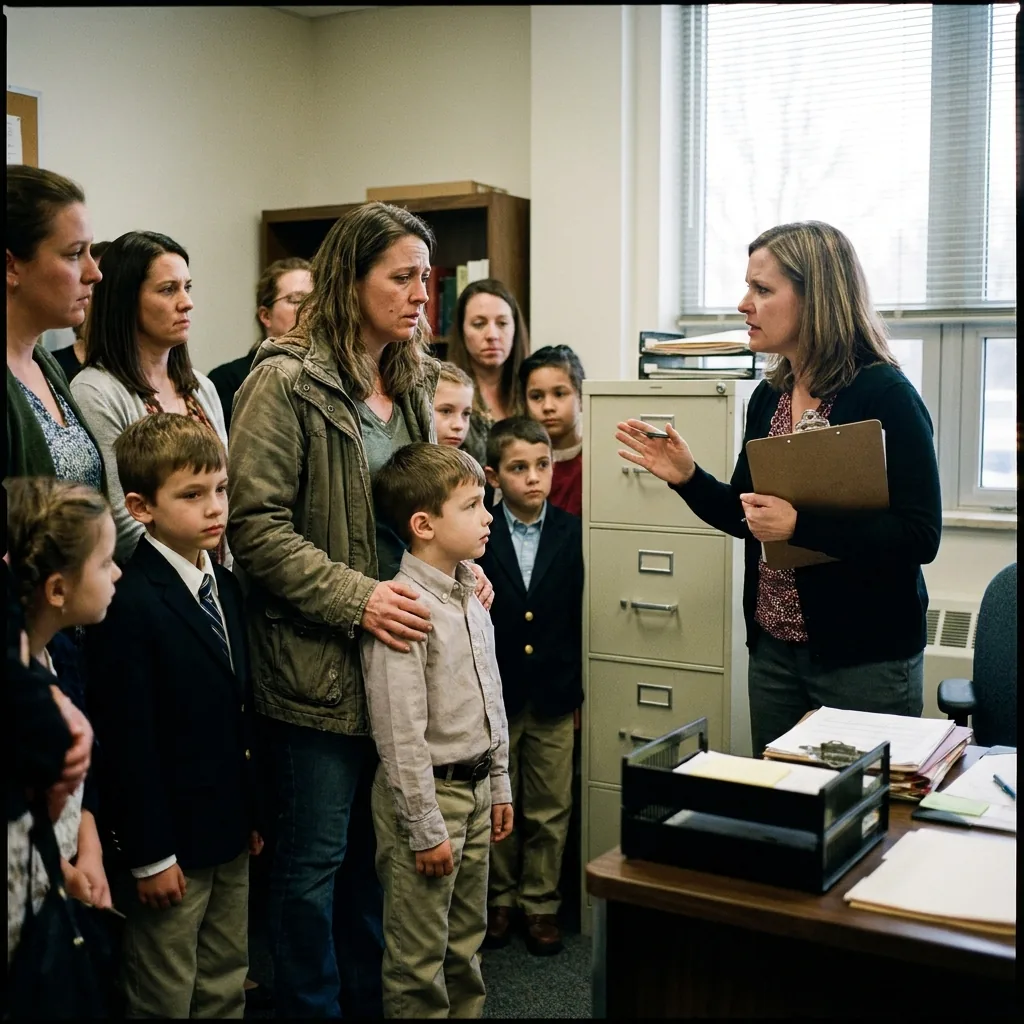
When Principal Bell said he was going to reset the room, he stepped away from his desk and into the narrow open space between the chairs and the sign-in table. That mattered. Until then, Dana Whitcomb had been acting from the edge of school procedure, one hand always near clipboards and lineup papers, like proximity could become authority if nobody challenged it fast enough. Now the principal was physically in that space, and everybody had to look at him instead.
“Eli stays with Ms. Patel’s group,” he said. “That’s not under discussion.”
He said it toward the room, not only toward Marisol. The children by the wall heard it. The parents near the file cabinet heard it. Renee Lawson straightened her clipboard and started shifting families back into place with small hand motions, as if the sentence had given ordinary office movement permission to resume.
Dana did not move.
“Aaron, that’s fine if he’s on her list,” she said, still trying to sound like the person protecting order. “But my point is that families were confused because some of us followed directions and some clearly did not. I was trying to prevent a mess.”
Marisol answered with the same controlled tone she had kept from the start. “You didn’t ask a question. You told my son he wasn’t one of their kids.”
Nobody talked over her. That silence did more than any gasp would have. It fixed the exact language back in the room where nobody could pretend it had been softer.
Dana gave a short shrug. “I said this part was for the families involved.”
“You said our families,” Renee said from beside the sign-in table. “I heard it from three feet away.”
That was the first time Renee had repeated Dana’s wording out loud. She did it in the plain front-office voice people use when they are correcting a date or reading back a phone number. No speech. No outrage. Just record.
Ms. Patel was still near Eli, one hand open at waist height while he held the front pocket of the backpack unzipped. She looked inside once more and said, “Eli, is the other piece still in the side sleeve? The little oak leaf card?”
Eli nodded and reached carefully into the frayed mesh pocket Dana had pointed to earlier like it proved he was out of place. He pulled out a stiff paper leaf, laminated the same way as the zipper tag, with marker writing across it in two different sizes. Even from where I was standing, I could see one name in a child’s large block letters and another in smaller, steadier print.
Ms. Patel did not take it from him. She bent enough to read. “This is his reading buddy card,” she said. “The younger student’s name is on one side, and Eli’s is on the back. My recognition group kept these all month because today’s ceremony includes the Oak Day board photos. That’s why some of my students brought classroom bags. They were carrying the clovers and buddy cards back and forth.”
A father by the bookcase said, “So the bag was part of the project.”
“Yes,” Ms. Patel said.
A mother closer to the door added, “Then she singled him out for the exact thing that connected him to it.”
That was when the room started changing sides in a way Dana could not control. Not loudly at first. Just people saying the obvious in sequence, each sentence making the next one easier.
“He was holding the project pieces.”
“She blocked them before staff checked in.”
“She made it sound official.”
Dana turned toward Principal Bell with both palms out. “This is becoming ridiculous. Parents help here all the time. If I misunderstood one family, are we really going to make me the story?”
Principal Bell did not answer right away. He looked at Eli, at the backpack, at the laminated leaf card, and then at the children waiting in their ceremony clothes with paper flowers and crooked collars and shoelaces that kept coming loose. Ordinary school activity was still pressing around the conflict. A copier light blinked. Someone’s phone vibrated against a chair arm. A kindergartner in the doorway asked Renee where to stand and was quietly redirected without the room breaking apart.
Then Principal Bell said, very clearly, “You didn’t misunderstand a family. You publicly challenged a student’s belonging while acting like school staff.”
Dana’s mouth opened, but he kept going.
“Renee, note that Dana was not assigned check-in or lineup control. Ms. Patel, note that Eli is part of the recognition group and that the backpack items are connected to the class activity for today’s ceremony. I want that written down now, while everybody involved is here.”
Renee flipped to the back of her clipboard and uncapped her pen. Ms. Patel nodded once.
Marisol’s hand stayed on Eli’s shoulder, but her posture changed a fraction. Not relaxed. Just steadier.
Dana took one step toward the desk. “You’re writing me up over this? In front of parents?”
“I’m documenting what happened in front of parents,” Principal Bell said.
Then he looked across the office and raised his voice enough to catch every cluster in the room.
“And before this ceremony starts, I need to address one more thing. Dana Whitcomb will not assist with student access, lineup, or family check-in for the remainder of this event.”
The whole office snapped toward him at once, because now the choice was public, specific, and impossible to walk back.