Story code: ST-000554
Part 2: The Favor Kept Getting Bigger on Screen
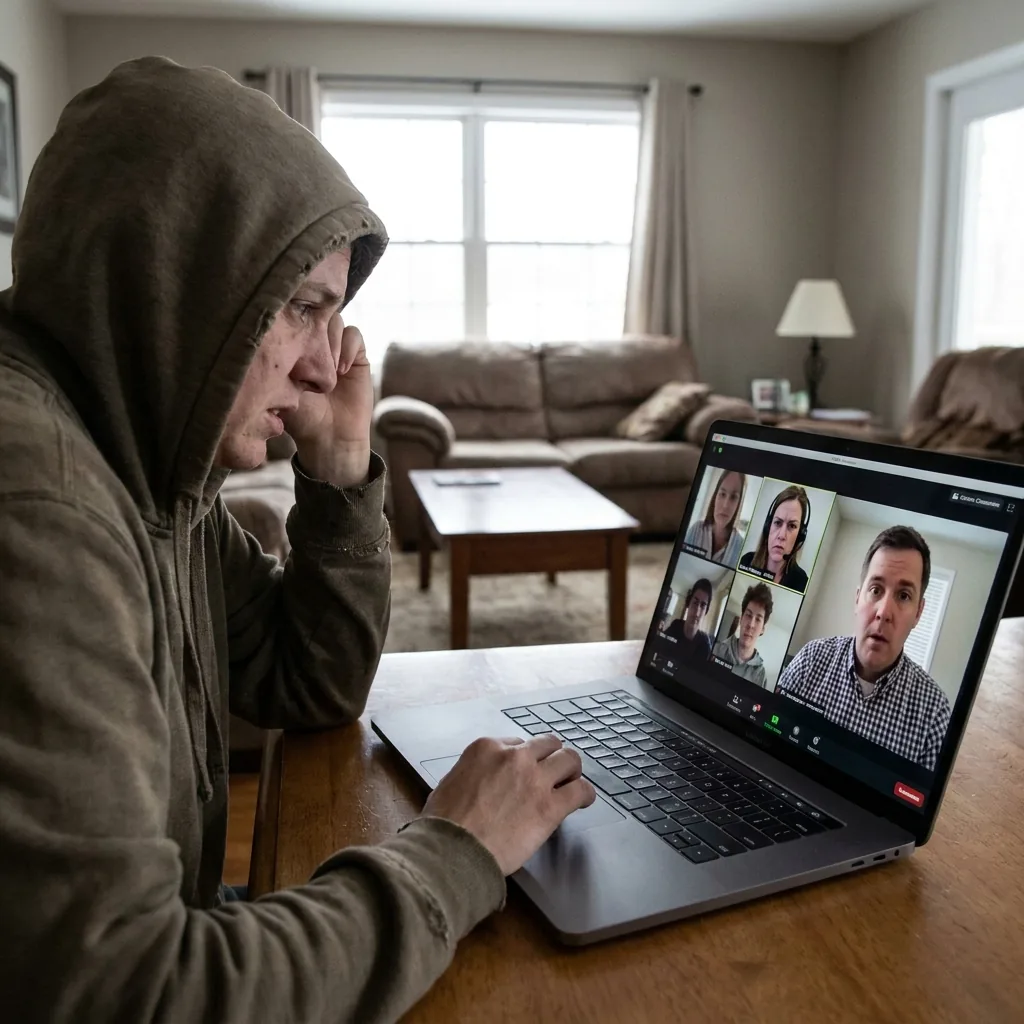
By the end of that week, Dana Holloway had turned one speech about helping me stay enrolled into a running class routine, and every version of it somehow reached back to my webcam. She never said, “Obey me because you owe me,” in one clean sentence. She said it in pieces, in front of witnesses, with pauses that made everyone else stare at their screens until I answered. I clicked into her follow-up meeting from the same desk I used for class. My headset was on, my laptop camera light was glowing, and Dana was already in the virtual room before me. The background behind her was the same blurred office wall she always used, but I could only see what the platform showed me: her face, her name, and the way she leaned toward the camera when she wanted to make something sound official. “I want to help you succeed,” she said first. Then she said, “But help only works if it is respected.” I kept my voice even. “I attend every day. I turn my work in. If there’s a class issue, you can tell me exactly what it is.” She gave a small smile and looked down for a second, like she was checking notes. “The issue is tone. Resistance. Mr. Mercer and I both notice when support is met with reluctance.” Mr. Mercer was not in that meeting. She still said his name like it settled things. “I wasn’t resisting,” I said. “You asked me to move my camera. I moved it.” “After a pause,” she said. “That kind of hesitation communicates more than students realize.” There it was again. A pause was now disobedience. A neutral face was now attitude. Basic attendance was now evidence that she should be thanked better. When the meeting ended, I sat there long enough for the room to close itself. Then I opened the class recording folder again. The school platform kept attendance sessions in a library tab, and I started checking older ones, not because I had a full theory yet, but because I wanted to know if I was imagining the pattern. I wasn’t. In one recording from the week before, Dana dropped into class for seven minutes and told everyone that “some students” had been kept afloat by unusual effort from administration. While she said it, she looked at my square twice. In another, Janelle’s camera had cut out from bad bandwidth, and Dana barely reacted, but when I reached off screen for my charger, Dana immediately said, “Maya, stay with us visually. Presence matters.” I started clipping timestamps in a notebook: date, class topic, exact wording, who else was on, what happened right before she spoke. It was all ordinary enough to be brushed off one moment at a time. Together, it looked uglier. During Friday’s session, Mr. Mercer was explaining a quiz correction when Dana joined again. Her tile popped into the top row, and the class energy shifted so fast I could almost feel it through the screen. Janelle sent me one private message: Here we go. Dana said she only needed sixty seconds. She took four minutes. She talked about commitment. She talked about how resources had to be justified. Then she said, “Students who receive exceptional advocacy should not act inconvenienced by visibility requirements.” Mr. Mercer muted and unmuted himself twice like he might interrupt. He never did. My face was hot, but I kept looking at the screen. If I went dark, she would point to that. If I argued, she would point to that too. So I said the only thing that had started feeling clean. “You don’t need to keep doing anything special for me.” The whole call went quiet in that weird online way where nobody moves at the same time. Dana blinked. Her smile held for a beat too long. “I’m not sure you understand what has been done on your behalf,” she said. “Then stop counting it as something I’m supposed to repay,” I said. “If there is a normal rule for class, I’ll follow the normal rule. If there’s extra support attached to me personally, you can release it.” Janelle’s camera froze again. Mr. Mercer looked straight at his screen for the first time since Dana started talking. Dana leaned closer to her webcam. “That is not how this works. You can’t simply opt out of institutional effort after people have invested in you.” There was no reason for her voice to sharpen over a student saying, politely, that she did not need personal advocacy. But it did. That was the first crack I could actually hear. I said, “I’m asking for the same treatment as everyone else.” Dana started explaining, quickly now, that my situation was different, that context mattered, that support structures depended on mutual respect, that students damaged trust when they minimized what had been done for them. She talked over herself trying to pin the burden back on me. Mr. Mercer finally said, “Let’s return to the lesson,” but by then she had already shown more than she meant to. After class, I replayed that section three times. The shift was right there in the recording. She had been smooth when I accepted the debt. The second I tried to release her from it, she lost the polished rhythm and started overexplaining why I was not allowed to. That evening my mother, Renee, stood in the doorway while I played the clips through my speakers. She did not say much. She listened to the line about visibility requirements. She listened to Dana tell me I could not opt out of what had been invested in me. Then she asked one practical question. “Does this woman still have the separate meeting link she keeps using to pull you in after class?” I looked at the latest message sitting in my inbox. Dana had already sent another one for Monday. And for the first time, I stopped wondering whether she was trying.