Story code: ST-001149
Part 2: The Demand for Validation
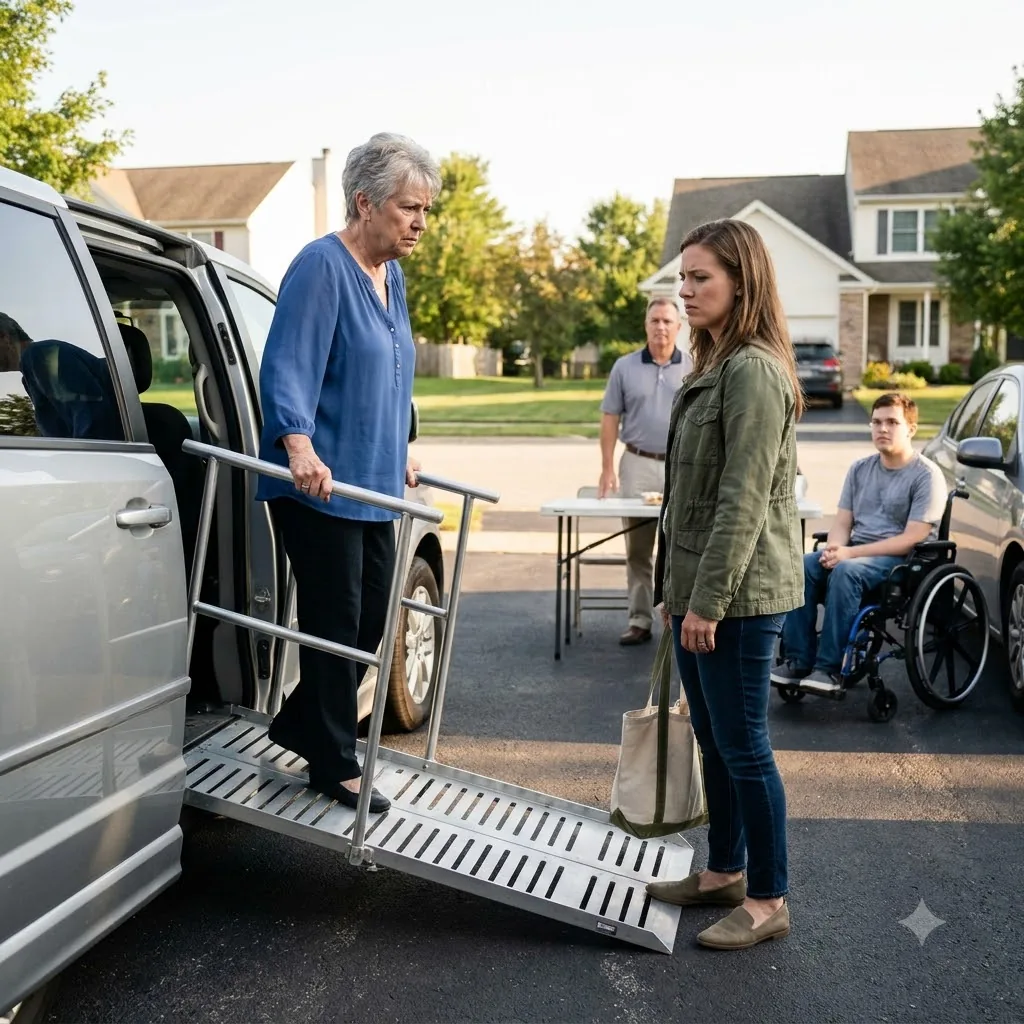
The second camera angle, captured from a vehicle parked opposite the driveway, shows the confrontation escalating as Helen Vance sought to secure her position. Helen did not merely want to exclude Sarah; she required the family members watching from the patio to witness Sarah’s submission. The audio logs show Helen stepping halfway down the wheelchair ramp, pointing a finger toward the gathered relatives.
‘Tell them, Sarah,’ Helen demanded, her voice rising in pitch. ‘Tell everyone here who bought this van. Who has been here every single Tuesday? Who does David actually rely on?’
The investigator’s review of the scene notes that Helen was attempting to force Sarah to validate Helen’s status as the sole caregiver in front of the others. By demanding this public validation, Helen hoped to codify her role as the ultimate gatekeeper, forcing the family to choose between the sibling who had moved away and the caregiver who bore the daily physical burden. Helen’s eyes swept the patio, seeking nods of agreement from the relatives, but the onlookers remained still, their attention locked on the driveway.
Sarah remained at the base of the ramp. Her facial muscles, visible in the zoom enhancement of the video, were completely still. She did not raise her voice, nor did she look to Uncle Ted or the other relatives for support.
‘You think you can just walk up and interact with him without checking with me first?’ Helen continued, her knuckles whitening as she gripped the van’s metal door frame. ‘I am the one who manages this vehicle. I am the one who handles the ramp. You have no rights to this routine anymore.’
Inside the van, David’s hands moved slightly on his armrests. He was listening. Helen’s demand for validation hung in the hot afternoon air, a direct challenge designed to force Sarah into a public apology or an embarrassing argument. Instead, Sarah slowly withdrew her hand from her pocket.
The sun glinted off a heavy, metallic object in her palm. It was not a phone or a set of standard keys, but a worn, vintage custom-engraved ramp remote keychain-an item that predated Helen’s employment by several years. The keychain, made of solid brass with David’s initials and the original conversion date deeply etched into the metal, clinked softly as she held it up. As Sarah held it visible, David’s eyes focused directly on it, his posture shifting forward in his chair, his hands lifting slightly off the armrests in a clear gesture of recognition.
The audio recording captures a sharp intake of breath from Helen. The family members on the patio leaned forward, trying to discern what Sarah was holding. Helen’s gaze dropped to Sarah’s hand, her chest rising and falling rapidly as she stared at the brass fob. The remote was the original, custom-paired transmitter from the van’s initial accessibility conversion-a device Helen believed had been lost or discarded years ago.
For the first time during the confrontation, Helen stopped speaking. Her lips parted, but no sound came out. She took a step back up the ramp, her eyes darting between the remote in Sarah’s hand and David, who was now leaning forward, his gaze fixed entirely on the engraved brass. The silence in the driveway grew heavy as David made a distinct vocalization of recognition from his seat inside the vehicle. The power balance, built entirely on Helen’s claim of exclusive operational custody, began to fracture in front of the entire family. Yet, Sarah made no move to speak, keeping her finger resting lightly on the remote’s primary button, leaving both Helen and the watching relatives suspended in tension over what would happen when she pressed it.