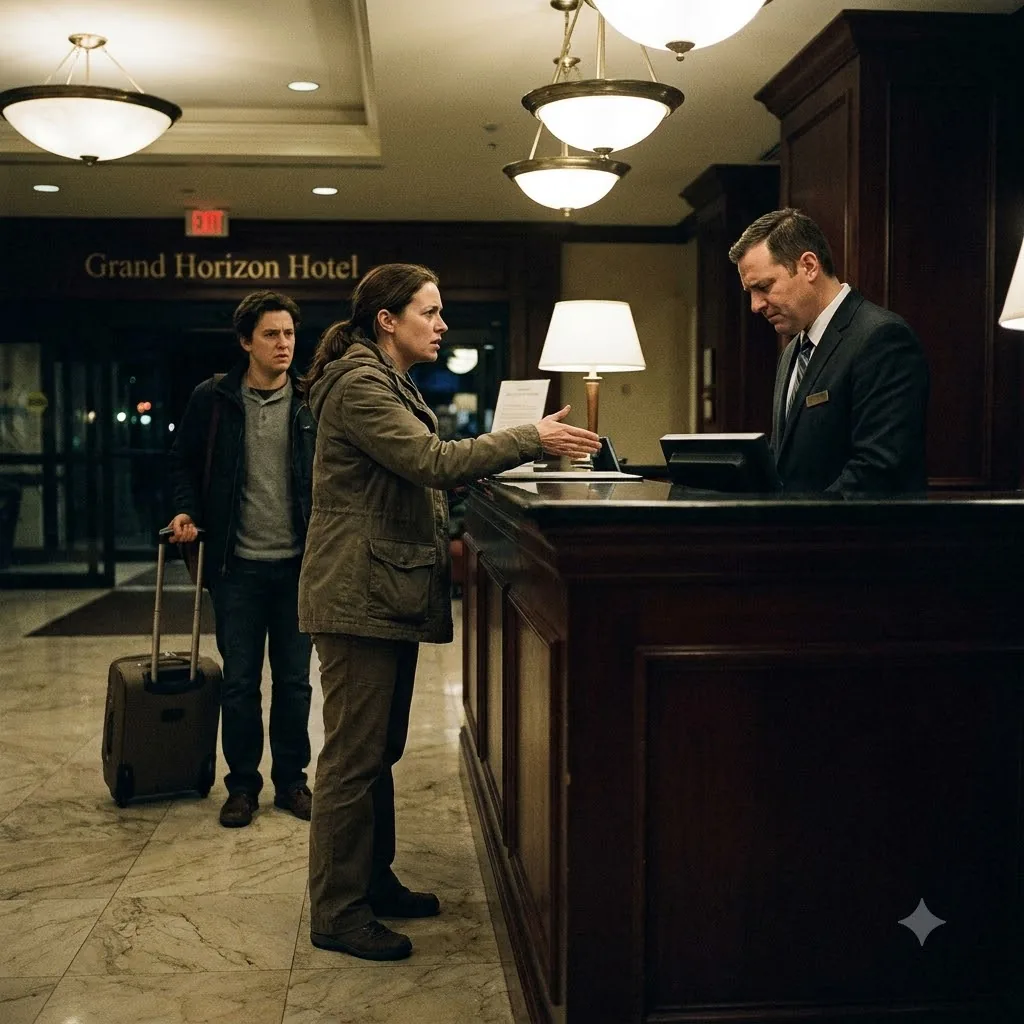
Story code: ST-001097
Part 4: The Final Override
At 11:51 PM, the terminal log records the finalization of the administrator override sequence. Donald Miller does not look at Arthur Pendelton as he inputs the system commands. The only sound in the lobby is the rapid, rhythmic tapping of the keys on terminal two. The security camera captures the cursor moving across the screen, unlocking the restricted fields that Arthur had claimed were inaccessible.
‘Arthur,’ Miller says, his tone flat and administrative. ‘Program the keycard for Room 412. Use the active reservation file on the screen.’
Arthur steps forward, his movements slow and deliberate on the security footage. His hand reaches behind the monitor, retrieving the green-striped reservation keycard that he had hidden. He places the plastic card onto the desktop encoder. The device emits a single, sharp beep as the green indicator light flashes, signaling that the guest data has been successfully written to the magnetic strip. Arthur picks up the card. With his eyes fixed on the marble counter, he slides the keycard across the surface to Clara Jenkins.
Clara picks up the keycard, checks the room number printed on the back, and slides it into her purse. She looks at Miller, offering a brief nod of acknowledgment, before turning toward the elevator bank. The camera captures the elevator doors sliding shut behind her at 11:53 PM.
‘Now process Mr. Vance’s check-in,’ Miller instructs, his voice maintaining its level cadence. ‘Select the original rate code of two hundred dollars. Do not apply the walk-in surcharge.’
Arthur taps the keyboard, pulling up the reservation file for Robert Vance. His fingers move stiffly. Under Miller’s direct observation, Arthur completes the check-in process without additional fees, programming a second keycard and handing it to Vance. Vance takes the card, mutters a brief word of thanks to Miller, and moves toward the elevators. The remaining guests in the queue are processed in quick succession by the junior clerk, their original reservations honored without further delay.
Once the counter is clear of waiting guests, Miller opens the corporate policy compliance application on terminal two. The screen displays the incident reporting template, a form that automatically routes to the vice president of hospitality operations. With cold finality, Miller begins typing the official entry. The log entry documents the exact sequence of events: the attempted unauthorized resale of Room 412 to secure a higher walk-in rate, the invention of a non-existent database maintenance policy to block a pre-paid guest, and the attempt to double-charge an existing booking. Miller attaches the terminal transaction log timestamps to the report, linking the physical keycard creation with the false cancellation attempt. He signs the entry using his corporate credentials, locking the record in the regional compliance database where it cannot be modified or deleted.
The guest who had been recording the incident lowers their phone, slips it into their pocket, and departs from the lobby. The heavy tension that had filled the space for the last twenty minutes dissipates, replaced by the normal, quiet hum of the late-night air conditioning. The lobby returns to its baseline state of clean, empty luxury.
Miller removes the blue USB security key from the terminal, placing it back into the zippered compartment of his leather portfolio. He zips the case shut with a single, clean motion. He looks at Arthur, whose eyes remain fixed on the blank screensaver now active on terminal two. Arthur does not speak or move from his position behind the desk, his hands resting flat against the edge of the counter.
Miller turns and walks toward the back office corridor, the heavy security door clicking shut behind him. The lobby counter remains quiet, the policy violation fully documented and the resources properly restored under the silent, bright lights of the Grand Horizon.