Story code: ST-001266
Part 1: The Exit Vestibule Standoff
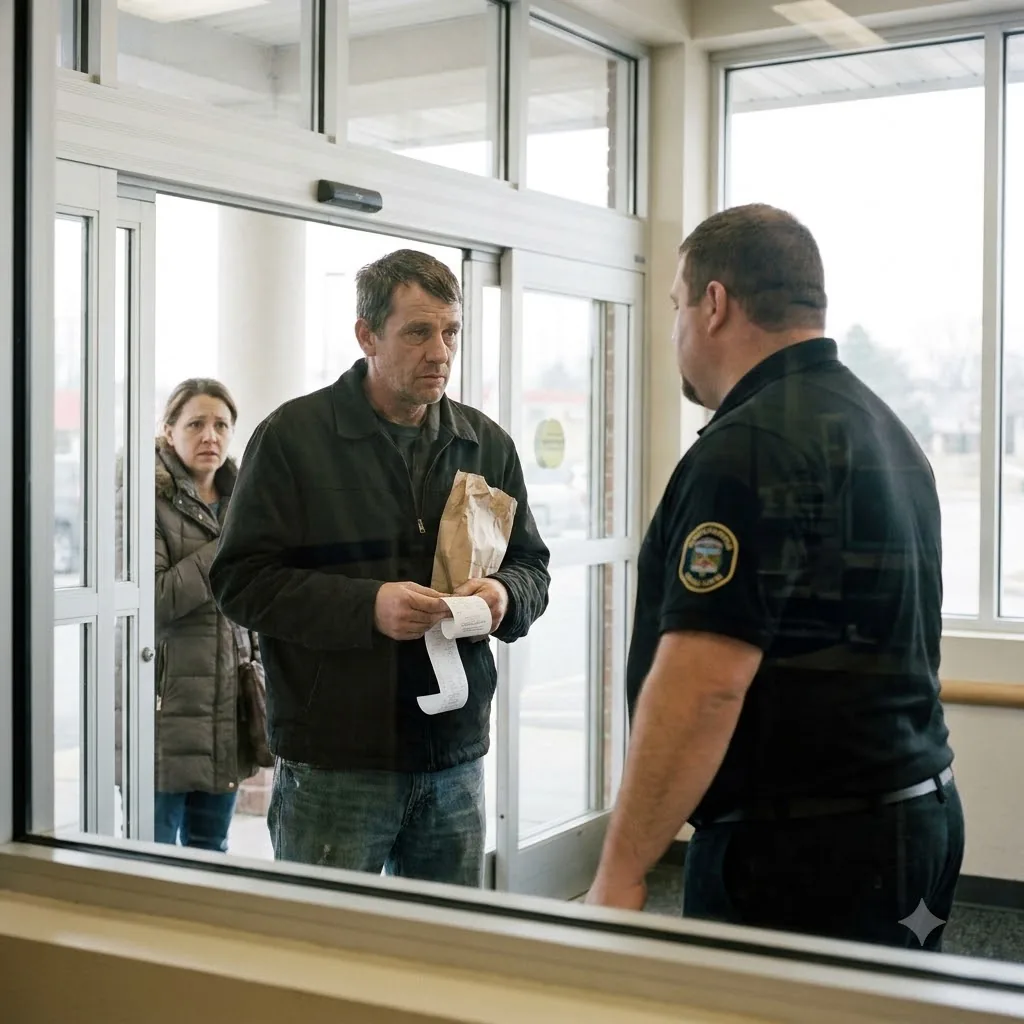
I was standing in the Exit Vestibule of the suburban MedCare Pharmacy, clutching my paper prescription bag and a fresh thermal shopping receipt, when a broad-shouldered man in a black security polo shirt stepped directly into my path. Marcus Finch, the store’s loss prevention guard, crossed his arms and planted his boots on the rubber door mat, blocking the automatic sliding exit. Under the pharmacy’s strict corporate directives, he was prohibited from physically touching me, but his broad frame was an effective wall. He pointed a rigid finger at the stapled bag in my hand, citing store policy to justify detaining me right there by the entrance.
“Ma’am, you need to step back over to the counter,” Marcus said, his voice carrying across the front of the store. “I have you logged for concealing unpurchased items before bypassing the register lanes.”
“I didn’t bypass anything,” I said, keeping my voice even and controlled. “I just paid for my medication, and I was on my way to my car.”
Around us, the ordinary activity of the pharmacy checkout continued. A cashier scanned bottles of vitamins at Register Lane 3, the rhythmic beeping contrasting with the sudden tension in the vestibule. A couple of shoppers slowed down, looking between me and the guard. The public embarrassment was immediate, a sharp pressure designed to make me comply out of sheer discomfort. Marcus did not budge. He held a black clipboard with an incident sheet clamped to it, representing the institutional power he was using as a weapon.
“Store protocol requires me to stop and verify any customer suspected of concealment,” Marcus said, his posture defensive. He tapped his finger against the paper on his clipboard. “I monitored your movements on the floor, and I logged the concealment event myself. You can’t just walk out.”
“I haven’t concealed anything,” I repeated. “Every item in this bag is accounted for, and I have the proof right here.”
“We will see about that,” Marcus replied. He looked down at his sheet, then back up at me with absolute certainty. “I logged you concealing merchandise in the aisle at exactly 5:14 PM before you walked past the registers. If you have those items in your bag now, and you didn’t pay for them, it’s a policy violation. I need to see the bag.”
I looked down at the physical thermal shopping receipt clutched in my hand, then at the digital watch on my wrist. It was currently 5:16 PM. Then, I looked closely at the automated network timestamp printed at the bottom of my receipt.
“You claim you saw me conceal items at 5:14 PM?” I asked.
“Yes,” Marcus said, his voice tightening. “I watched you place the items into your bag in the personal care aisle, and then you walked straight past the registers toward the exit. I followed you here.”
“And you wrote that time down?”
“It’s right here in the log,” he said, pointing to the hand-written entry on his clipboard: 5:14 PM – concealment observed in Aisle 4.
I stared at the paper, then back at my receipt. The sequence of Marcus’s accusation did not just contain a simple clerical mistake. The impossible timeline of my purchase rendered his entire claim physically impossible.
I was standing in the Exit Vestibule of the suburban MedCare Pharmacy, clutching my paper prescription bag and a fresh thermal shopping receipt, when a broad-shouldered man in a black security polo shirt stepped directly into my path. Marcus Finch, the store’s loss prevention guard, crossed his arms and planted his boots on the rubber door mat, blocking the automatic sliding exit. Under the pharmacy’s strict corporate directives, he was prohibited from physically touching me, but his broad frame was an effective wall. He pointed a rigid finger at the stapled bag in my hand, citing store policy to justify detaining me right there by the entrance.
“Ma’am, you need to step back over to the counter,” Marcus said, his voice carrying across the front of the store. “I have you logged for concealing unpurchased items before bypassing the register lanes.”
“I didn’t bypass anything,” I said, keeping my voice even and controlled. “I just paid for my medication, and I was on my way to my car.”
Around us, the ordinary activity of the pharmacy checkout continued. A cashier scanned bottles of vitamins at Register Lane 3, the rhythmic beeping contrasting with the sudden tension in the vestibule. A couple of shoppers slowed down, looking between me and the guard. The public embarrassment was immediate, a sharp pressure designed to make me comply out of sheer discomfort. Marcus did not budge. He held a black clipboard with an incident sheet clamped to it, representing the institutional power he was using as a weapon.
“Store protocol requires me to stop and verify any customer suspected of concealment,” Marcus said, his posture defensive. He tapped his finger against the paper on his clipboard. “I monitored your movements on the floor, and I logged the concealment event myself. You can’t just walk out.”
“I haven’t concealed anything,” I repeated. “Every item in this bag is accounted for, and I have the proof right here.”
“We will see about that,” Marcus replied. He looked down at his sheet, then back up at me with absolute certainty. “I logged you concealing merchandise in the aisle at exactly 5:14 PM before you walked past the registers. If you have those items in your bag now, and you didn’t pay for them, it’s a policy violation. I need to see the bag.”
I looked down at the physical thermal shopping receipt clutched in my hand, then at the digital watch on my wrist. It was currently 5:16 PM. Then, I looked closely at the automated network timestamp printed at the bottom of my receipt.
“You claim you saw me conceal items at 5:14 PM?” I asked.
“Yes,” Marcus said, his voice tightening. “I watched you place the items into your bag in the personal care aisle, and then you walked straight past the registers toward the exit. I followed you here.”
“And you wrote that time down?”
“It’s right here in the log,” he said, pointing to the hand-written entry on his clipboard: 5:14 PM – concealment observed in Aisle 4.
I stared at the paper, then back at my receipt. The sequence of Marcus’s accusation did not just contain a simple clerical mistake. The impossible timeline of my purchase rendered his entire claim physically impossible.