Story code: ST-001210
Part 1: Broadcasted Grief
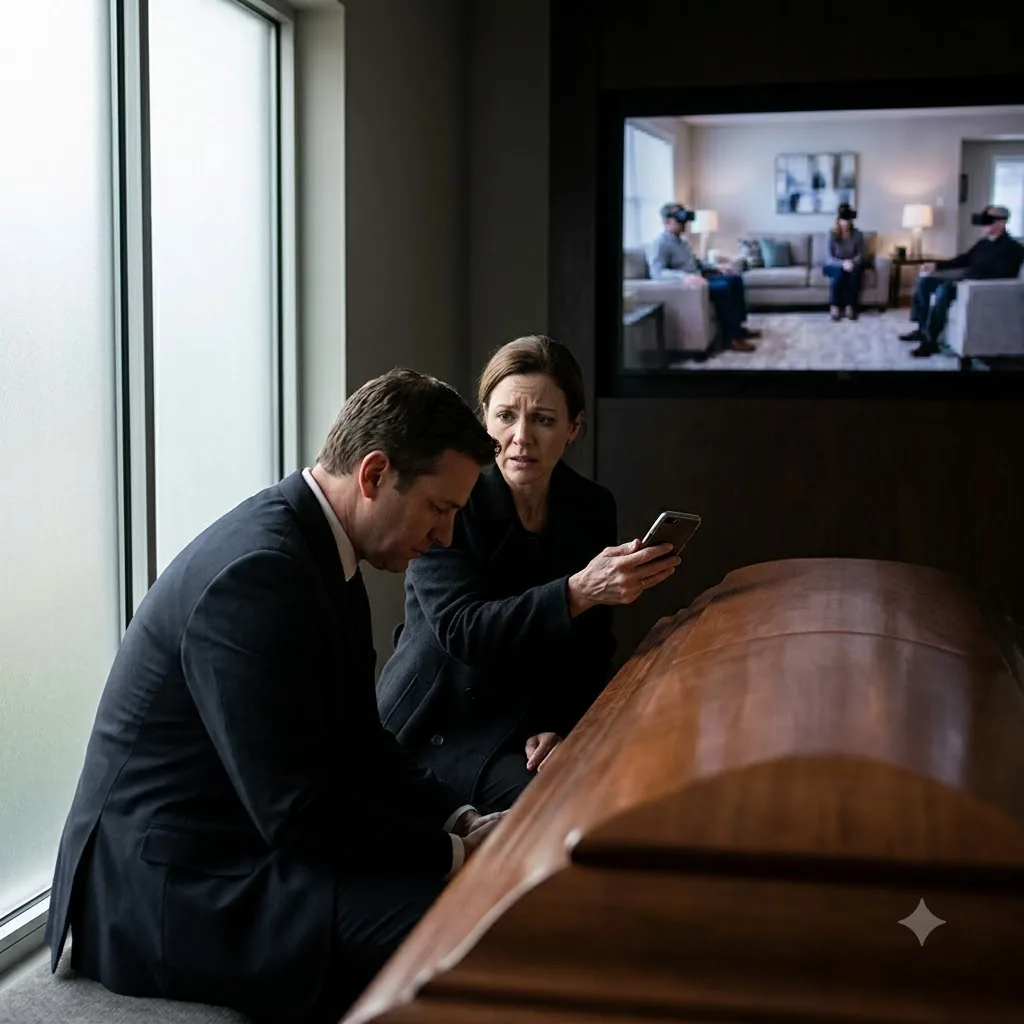
I was kneeling by my father’s casket in the quiet alcove of the Memorial Chapel when my sister, Sarah, handed me her phone, her thumb trembling against the glass. The private VR memorial link we had sent to our small circle of remote relatives had been posted to a public online forum. My cousin Marcus, who was supposed to be mourning virtually from his apartment three states away, had cast our private, unedited family feed to a public chat room. Dozens of strangers were watching my raw grief in real-time, posting laughing emojis and mocking my father’s memory. What was meant to be a quiet, dignified farewell had instantly been turned into public entertainment.
“Who did this?” I whispered, my voice shaking as I stared at the stream chat.
“It’s Marcus,” Sarah said, pointing to the user profile hosting the restream. “He’s broadcasting the raw feed.”
We had set up a specialized VR camera near the altar, meant to capture only a tight, cropped view of the podium for family members who couldn’t travel. But the stream currently broadcasting to the public wasn’t the cropped version. It showed the entire front row of the chapel, including my mother crying in her seat and my own tear-streaked face as I gripped the edge of the casket.
The chapel was silent except for the soft hum of the air conditioning and the quiet sniffling of our close relatives in the pews. We had spent hours configuring the stream, specifically setting up the boundary lines so that only the minister and the podium would be visible to the virtual attendees. We wanted our distant relatives to feel present, but we also needed to protect our family’s privacy during this devastating moment. Now, looking at Sarah’s screen, I saw that all our precautions had been dismantled.
Marcus immediately responded to my urgent text with a defensive message in our family group chat. “It’s not my fault,” he typed. “The funeral home’s system must have glitched and broadcasted the wrong feed. I just shared the link with a couple of friends who wanted to support us.”
He was already trying to blame the technology, claiming he was just a grieving relative trying to help. But he was also telling everyone on Facebook that we set it up this way, claiming the family was forcing everyone to watch the raw, unfiltered grief of our mother. The public chat on the forum was scrolling rapidly. People who didn’t even know my father were commenting on our clothes, our tears, and the layout of the chapel. My stomach twisted with a sickening mix of anger and exposure. Marcus was playing the role of the helpful coordinator online, but the feed he was sharing was stripping away every ounce of dignity we had left.
I took the control tablet from the side table, intending to shut the entire stream down. But before I could press the button, a user in the chat posted a direct link to the uncropped source of the broadcast. When I tapped the link, the view changed. The uncropped frame didn’t just show the chapel; it captured the edge of a web browser window, exposing a detail that completely changed the accusation.
I was kneeling by my father’s casket in the quiet alcove of the Memorial Chapel when my sister, Sarah, handed me her phone, her thumb trembling against the glass. The private VR memorial link we had sent to our small circle of remote relatives had been posted to a public online forum. My cousin Marcus, who was supposed to be mourning virtually from his apartment three states away, had cast our private, unedited family feed to a public chat room. Dozens of strangers were watching my raw grief in real-time, posting laughing emojis and mocking my father’s memory. What was meant to be a quiet, dignified farewell had instantly been turned into public entertainment.
“Who did this?” I whispered, my voice shaking as I stared at the stream chat.
“It’s Marcus,” Sarah said, pointing to the user profile hosting the restream. “He’s broadcasting the raw feed.”
We had set up a specialized VR camera near the altar, meant to capture only a tight, cropped view of the podium for family members who couldn’t travel. But the stream currently broadcasting to the public wasn’t the cropped version. It showed the entire front row of the chapel, including my mother crying in her seat and my own tear-streaked face as I gripped the edge of the casket.
The chapel was silent except for the soft hum of the air conditioning and the quiet sniffling of our close relatives in the pews. We had spent hours configuring the stream, specifically setting up the boundary lines so that only the minister and the podium would be visible to the virtual attendees. We wanted our distant relatives to feel present, but we also needed to protect our family’s privacy during this devastating moment. Now, looking at Sarah’s screen, I saw that all our precautions had been dismantled.
Marcus immediately responded to my urgent text with a defensive message in our family group chat. “It’s not my fault,” he typed. “The funeral home’s system must have glitched and broadcasted the wrong feed. I just shared the link with a couple of friends who wanted to support us.”
He was already trying to blame the technology, claiming he was just a grieving relative trying to help. But he was also telling everyone on Facebook that we set it up this way, claiming the family was forcing everyone to watch the raw, unfiltered grief of our mother. The public chat on the forum was scrolling rapidly. People who didn’t even know my father were commenting on our clothes, our tears, and the layout of the chapel. My stomach twisted with a sickening mix of anger and exposure. Marcus was playing the role of the helpful coordinator online, but the feed he was sharing was stripping away every ounce of dignity we had left.
I took the control tablet from the side table, intending to shut the entire stream down. But before I could press the button, a user in the chat posted a direct link to the uncropped source of the broadcast. When I tapped the link, the view changed. The uncropped frame didn’t just show the chapel; it captured the edge of a web browser window, exposing a detail that completely changed the accusation.