Story code: ST-001108
Part 1: The Dashboard Receipt
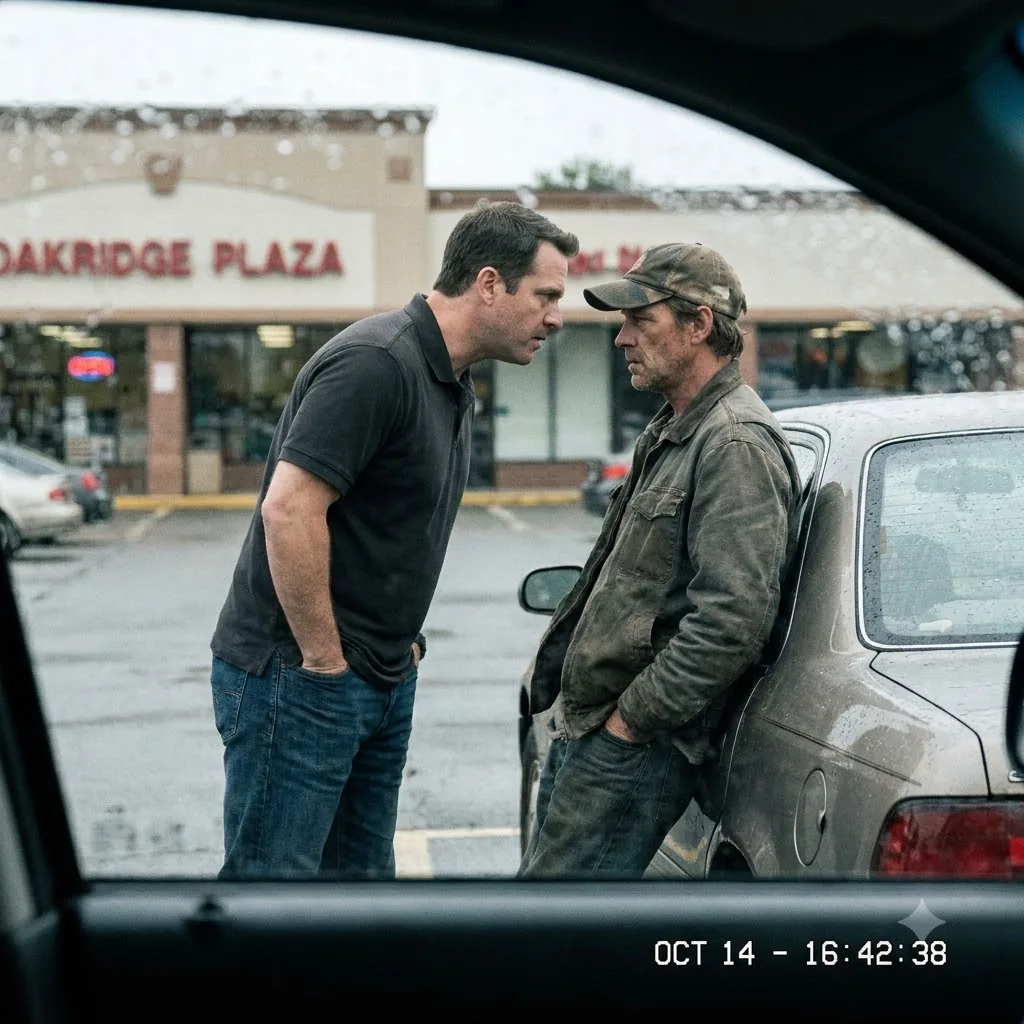
The surveillance footage from the Oakridge Plaza parking lot on October 14th shows off-duty patrol officer Marcus Vance cornering his brother-in-law, David Miller, to demand three thousand dollars under the guise of an urgent family medical emergency. In the security video, Marcus blocks David’s sedan with his personal black SUV, stepping out with his silver police badge clipped to his belt to attack David’s private financial boundaries. The physical pressure is immediate, but a crumpled receipt lying on Marcus’s own dashboard reveals a contradiction that changes the entire nature of the encounter.
Our reconstruction of this incident, compiled by Investigator Harris from the precinct’s evidence files, relies on the store’s high-definition exterior cameras and a recovered audio recording from David’s phone. At 6:14 PM, David is seen placing paper grocery bags into his trunk under the flickering fluorescent lights of the parking lot. The ambient activity around them is normal for a weekday evening, with shoppers pushing carts and vehicles slowly driving down the aisles. Marcus’s SUV pulls in at a sharp angle, pinning David’s car against the concrete divider and preventing any quick exit. Marcus exits his vehicle, wearing civilian clothes but adjusting his jacket to make his official police badge clearly visible. He approaches David with rapid, aggressive strides, initiating a conversation that quickly turns hostile.
According to the audio log, Marcus immediately frames the request as a non-negotiable family obligation. Marcus says, ‘Mom is in the clinic, and they will not release her prescriptions without three thousand dollars cash right now. I need you to transfer it to my account immediately. I do not have time to argue.’ David stops loading his groceries and holds his car keys tightly in front of him, keeping his posture defensive. David’s breathing is visible in the cold autumn air as he steps back. He makes no sudden movements, knowing Marcus’s history of aggressive escalations. David responds, ‘Marcus, we just went over our family budget. I do not have three thousand dollars to transfer without seeing an invoice or talking to my wife first. We simply do not have that kind of liquid cash sitting around.’
Marcus’s physical behavior becomes confrontational. He steps within inches of David, using his physical presence to crowd David against the open trunk of the sedan. Marcus’s voice rises, saying, ‘So you are going to let her sit there in pain? This is family, David. Your refusal is pure cruelty, a complete betrayal of this family.’ On the video, two shoppers walking past with a cart stop and turn their heads at the sound of the argument. David remains still, avoiding direct eye contact with Marcus, but his gaze shifts to the windshield of the black SUV parked just feet away.
On the dashboard of the SUV, right behind the steering wheel, lies a fresh slip of thermal paper. The high-resolution camera zoom from the parking lot’s pole-mounted camera reveals the header: Golden Hour Jewelers. The timestamp printed on the receipt reads 4:45 PM-less than two hours before Marcus arrived at the grocery store. The total listed at the bottom shows a charge of two thousand eight hundred dollars for a luxury watch. David’s gaze remains fixed on the receipt, his hands gripping the keys harder as he observes the massive discrepancy between the claimed medical emergency and the fresh luxury purchase. Marcus continues to demand the transfer, raising his voice even louder, unaware that his brother-in-law has just spotted the evidence of his real spending. When David points directly at the windshield and asks about the jewelry store purchase, Marcus’s facial expression hardens, his stance shifting from a demanding relative to an angry police officer.
The surveillance footage from the Oakridge Plaza parking lot on October 14th shows off-duty patrol officer Marcus Vance cornering his brother-in-law, David Miller, to demand three thousand dollars under the guise of an urgent family medical emergency. In the security video, Marcus blocks David’s sedan with his personal black SUV, stepping out with his silver police badge clipped to his belt to attack David’s private financial boundaries. The physical pressure is immediate, but a crumpled receipt lying on Marcus’s own dashboard reveals a contradiction that changes the entire nature of the encounter.
Our reconstruction of this incident, compiled by Investigator Harris from the precinct’s evidence files, relies on the store’s high-definition exterior cameras and a recovered audio recording from David’s phone. At 6:14 PM, David is seen placing paper grocery bags into his trunk under the flickering fluorescent lights of the parking lot. The ambient activity around them is normal for a weekday evening, with shoppers pushing carts and vehicles slowly driving down the aisles. Marcus’s SUV pulls in at a sharp angle, pinning David’s car against the concrete divider and preventing any quick exit. Marcus exits his vehicle, wearing civilian clothes but adjusting his jacket to make his official police badge clearly visible. He approaches David with rapid, aggressive strides, initiating a conversation that quickly turns hostile.
According to the audio log, Marcus immediately frames the request as a non-negotiable family obligation. Marcus says, ‘Mom is in the clinic, and they will not release her prescriptions without three thousand dollars cash right now. I need you to transfer it to my account immediately. I do not have time to argue.’ David stops loading his groceries and holds his car keys tightly in front of him, keeping his posture defensive. David’s breathing is visible in the cold autumn air as he steps back. He makes no sudden movements, knowing Marcus’s history of aggressive escalations. David responds, ‘Marcus, we just went over our family budget. I do not have three thousand dollars to transfer without seeing an invoice or talking to my wife first. We simply do not have that kind of liquid cash sitting around.’
Marcus’s physical behavior becomes confrontational. He steps within inches of David, using his physical presence to crowd David against the open trunk of the sedan. Marcus’s voice rises, saying, ‘So you are going to let her sit there in pain? This is family, David. Your refusal is pure cruelty, a complete betrayal of this family.’ On the video, two shoppers walking past with a cart stop and turn their heads at the sound of the argument. David remains still, avoiding direct eye contact with Marcus, but his gaze shifts to the windshield of the black SUV parked just feet away.
On the dashboard of the SUV, right behind the steering wheel, lies a fresh slip of thermal paper. The high-resolution camera zoom from the parking lot’s pole-mounted camera reveals the header: Golden Hour Jewelers. The timestamp printed on the receipt reads 4:45 PM-less than two hours before Marcus arrived at the grocery store. The total listed at the bottom shows a charge of two thousand eight hundred dollars for a luxury watch. David’s gaze remains fixed on the receipt, his hands gripping the keys harder as he observes the massive discrepancy between the claimed medical emergency and the fresh luxury purchase. Marcus continues to demand the transfer, raising his voice even louder, unaware that his brother-in-law has just spotted the evidence of his real spending. When David points directly at the windshield and asks about the jewelry store purchase, Marcus’s facial expression hardens, his stance shifting from a demanding relative to an angry police officer.