Story code: ST-000958
Part 2: She Kept Explaining It
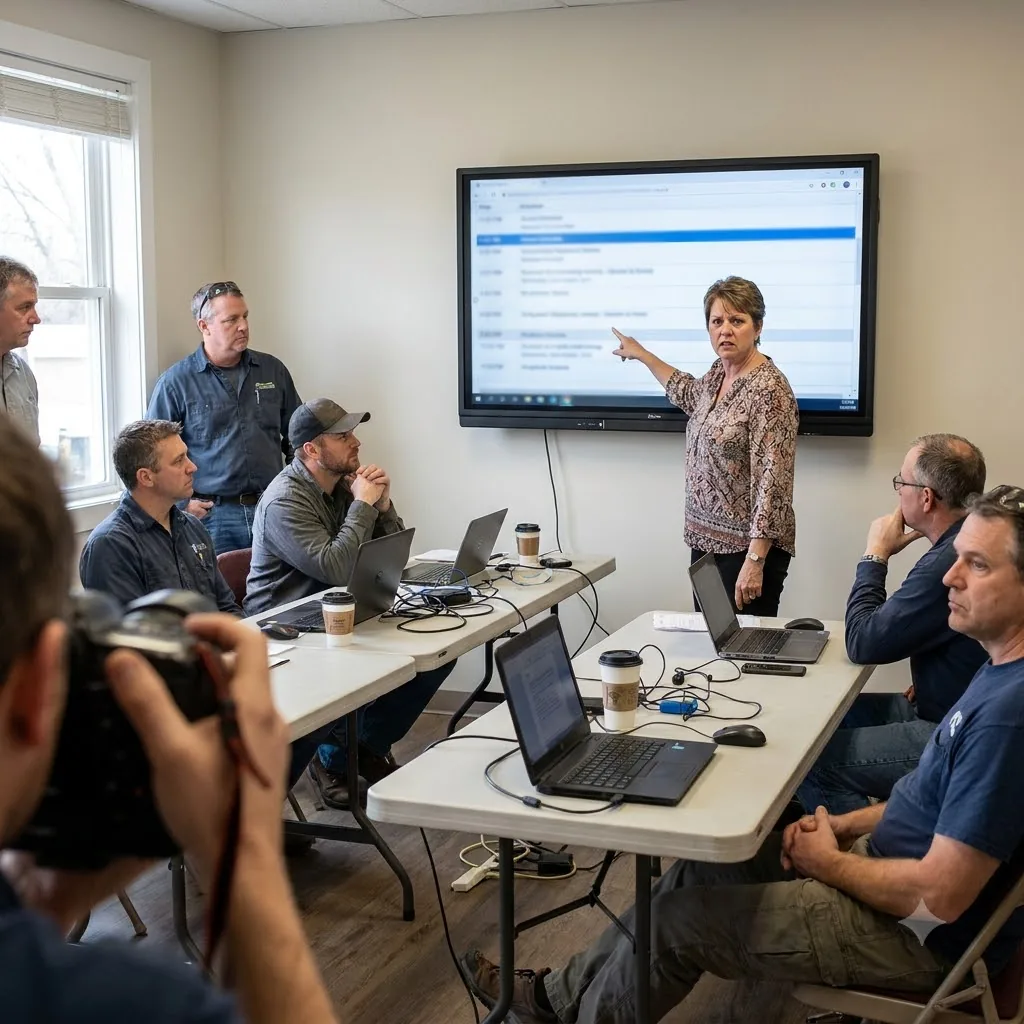
By the time Sharon paused with the remote in her hand, the room had gone into that quiet where people pretend they are still setting up while listening to every word. A man near the door straightened a stack of handouts without looking down at them. Evan stayed by the side wall, eyes on the screen. I was still beside the equipment cart, close enough to the laptop to see the timer on the first slide inch forward.
Sharon reset her voice and tried again.
“It’s not something you can see if the bleed has not fully surfaced,” she said. “The issue is latent until the announcement layer cycles back through memory.”
I said, “The announcement layer isn’t active. I changed the input.”
“That is exactly the oversimplification I’m talking about,” she said.
She turned to the group instead of to me. “These screens retain municipal post data in a soft cache. If you hard-switch source without clearing the stability bleed, the next posted schedule can inherit presentation residue.”
She said it smoothly, with her binder tucked under one arm and the remote in the other hand like a pointer. It sounded official enough that two people looked up at the room schedule taped by the door, as if the paper list might somehow prove she was right.
Evan asked, “Has that happened on this screen before?”
Sharon answered too fast. “It has happened on units with the same display family.”
“This exact screen?” he asked.
She angled her body toward him. “The principle is the same.”
I said, “If it’s sequence-based, show the sequence.”
She looked back at me. “I am trying to keep us on schedule.”
That was the new move. A minute earlier, the problem had been serious enough to stop the room and lecture me in front of everybody. Now it was suddenly too inconvenient to demonstrate.
I said, “You stopped the room already. Show me what I missed.”
Her jaw set. She pointed the remote at the screen and pressed a button. The slide advanced to the next page in her deck: a bullet list about volunteer coordination. Nothing else changed.
She pressed another button, then another. The deck went backward, then forward. No warning bar appeared. No hidden layer. No leftover announcement strip drifted across the bottom. The image stayed clean.
“That’s not the sequence,” she said.
Nobody answered. The only sound was the HVAC and one of the metal chair legs scraping the floor in the back row.
Evan asked, “Where is the sequence? In the menu?”
“Not exactly,” Sharon said.
“Then where?” he said.
She lowered the remote and stepped to the cart. For the first time, she touched the laptop. She tapped the trackpad, opened the display settings, closed them, then clicked back to the slide deck. From where I stood, I could see nothing on the laptop that matched the term she kept using. Just the normal output menu and the presentation window.
“Because it’s integrated,” she said, still facing the cart. “It doesn’t announce itself as stability bleed.”
I said, “What is it called on the system?”
That hung there for a second.
She straightened up. “Different firmware labels it differently.”
Evan took two steps closer, not enough to crowd her, just enough to see the screen and laptop together. “Can you point to the function you’re saying she skipped?”
Sharon drew her hand back from the keyboard. “Again, the point is not a label. The point is proper screen handling.”
That was when the room started shifting. Not loudly. No speeches. Just small changes. The woman with the tripod banner stopped pretending to fold it. A volunteer in a green center shirt looked from Sharon’s hand to the remote to the screen like he was following a ball that had stopped bouncing.
I said, very plain, “I connected the HDMI, selected source two, and opened your file. If there is a required step between those actions, show it on this equipment.”
Sharon gave me a long look, then looked around the room like she expected somebody to rescue the sentence for her.
Nobody did.
Instead, Evan asked, “What happens if she skips it? Right now, on this screen. What should we see?”
Sharon lifted the remote again but did not point it. “You won’t necessarily see it immediately.”
I said, “Then how did you know I skipped it the second you walked in?”
That landed harder than anything else I had said, mostly because it was short. Sharon’s mouth opened, then closed. She turned halfway toward the screen, as if the answer might be written on it.
The slide behind her stayed sharp and flat and ordinary.
Then a voice came from the hallway entrance. “What’s the hold-up in here?”
Lydia Cho stood in the doorway with her tablet and the printed room checklist clipped behind it. She took in the screen, the cart, Sharon holding the remote, and the whole room facing the same direction.
Before I could say anything, Sharon lifted her chin and said, “We’re dealing with a display-chain stability issue on the announcement screen.”
Lydia stepped inside, looked once at the wall-mounted display, and said, “Show me.”
Sharon did not move.