Story code: ST-000793
Part 2: What Counted As Proof
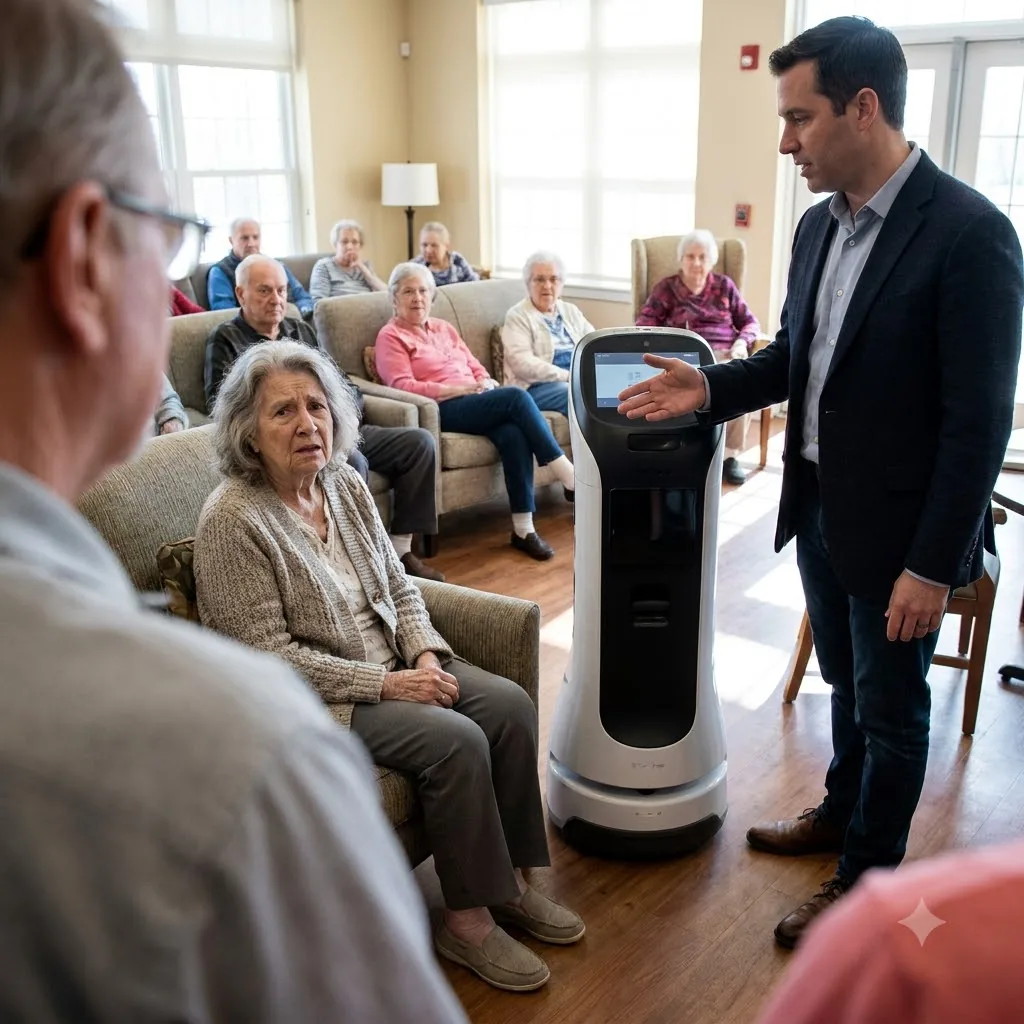
Derek did not refuse Evelyn’s request outright. He did something Marisol had started to recognize instead: he kept accepting the shape of the question while shifting the conditions under it. By the time he answered, it sounded as if Evelyn had asked for something unreasonable instead of something simple. “A live demo can be useful,” he said, resting his tablet against his palm, “but only if it’s done correctly. These systems respond to timing, settings, and user phrasing.” Nina gave a short laugh with no amusement in it. “That’s a lot of qualifiers for a robot that’s supposed to help people.” Derek turned slightly toward her, then back toward Evelyn, as if refusing to let Nina become the center of the exchange. “I’m saying accuracy matters.” Evelyn sat straighter in her chair. “Accuracy is exactly what I am asking for.” Marisol moved her supply cart closer to the medication cart corner, then stopped again. Nobody wanted puzzle books now. A resident near the TV muted it without being asked. The room had narrowed to Derek, Evelyn, Milo, and the quiet around them. Derek said, “To recreate a valid interaction, we would need the exact schedule state, the exact medication profile, whether a meal prompt had already been triggered, and the wording used by the resident.” “The resident is sitting right here,” Nina said. “But memory after a frustrating interaction can become compressed,” Derek replied. “That’s normal.” He still had not said the word forgetful. He did not need to. Marisol saw Walter’s mouth tighten. She saw Evelyn stop with her fingers on the folded tissue, then place it flat on her knee like she had decided not to fidget where anyone could call it agitation. Evelyn repeated his phrasing back to him. “Compressed.” “I’m not criticizing you, Ms. Price.” “You are revising me.” That landed. Derek gave one of those small professional nods that could pass for courtesy at a distance. “I’m clarifying the limits of anecdotal recall.” Walter let out a soft sound through his nose. “That’s a fancy way of saying she remembers it wrong.” Derek’s smile flickered toward him. “Not wrong. Incomplete.” Marisol watched Derek crouch beside Milo again. He touched the side of the robot’s tablet face and woke a menu. “If we do this, we need to avoid leading prompts. Otherwise people hear what they expect to hear.” Nina folded her arms. “So she has to remember every word perfectly, but you get to explain every answer afterward.” “That’s unfair,” Derek said. Marisol noticed that he had still not run the demonstration. He kept building a frame around it first, one condition at a time. Every explanation made the test smaller. Every smaller test made his earlier confidence sound broader than the room was now allowed to check. Evelyn looked at Milo, not Derek. “You said I heard commands where there were only reminders. Fine. Show the room the difference.” Derek answered quickly this time. “That distinction depends on context.” “Then use context.” “We don’t have yesterday’s exact variables.” Walter lifted one hand from his checkers board. “You said this thing helps keep people on track every day. Doesn’t that mean it should handle a plain question today?” Derek stayed crouched. “It handles routine use very well.” Marisol heard the strain in the wording now, not because he raised his voice, but because it had started curling in on itself. Routine use. Plain question. Exact variables. No leading prompts. Common sense. Best-use guidance. The room had been offered a steady companion. Now it was being told the robot was reliable except in the exact kind of moment when someone needed reliability proven. Nina stepped to the side table and picked up Evelyn’s glasses, then set them back down when Evelyn gave the slightest shake of her head. “Ask him what Mom asked,” Nina said. “Not the whole day. Just the point where the robot gave two instructions that could not both be followed.” Derek looked at Milo’s screen. “That’s not how these interactions work.” “How do they work?” Marisol asked. Everyone turned toward her. She had not meant to break in so plainly, but the question was out. Derek rose halfway from his crouch. “They work over time, with patterns and reminders.” Marisol nodded once. “Then the pattern matters.” He looked at her for a beat too long before answering. “Of course the pattern matters.” Evelyn leaned back against her chair. Her voice stayed controlled. “Good. Then stop asking me for impossible precision while you ask the room for broad trust.” Nobody moved for a second after that. Walter’s fingers rested on a checker piece without sliding it. Nina lowered her arms. Even Milo seemed to sharpen the silence just by sitting there with its bright ring and blank patient screen. Derek cleared his throat. “I’m not asking for trust without basis. I’m saying any proper demonstration has to be structured.” “Structured by who?” Nina said. “By the system as designed.” Evelyn said, “Or by the person explaining it.” Marisol looked at Milo’s medication drawer, then at Derek’s tablet, then back at the robot’s face. The more Derek defined a fair test, the less room he left himself. He had denied that Milo made practical promises. He had denied that two reminders could box someone in. He had denied that Evelyn’s account counted unless she reproduced every condition exactly. But the robot’s language lived in the room already. Walter knew some of it. Marisol had heard some of it. Evelyn could repeat whole lines without searching. Derek finally said, “If we continue, I’ll need someone to initiate the sequence in a neutral way.” Evelyn lifted her chin a fraction. “No. You initiate it. You’re the one saying there’s nothing wrong with the sequence.” His hand stopped on the edge of Milo’s screen. The room did not rush him. That was what made the pause heavier. For the first time, Marisol could see the shape of the next step clearly enough to name it without speaking:.