Story code: ST-001226
Part 3: The Logical Gap
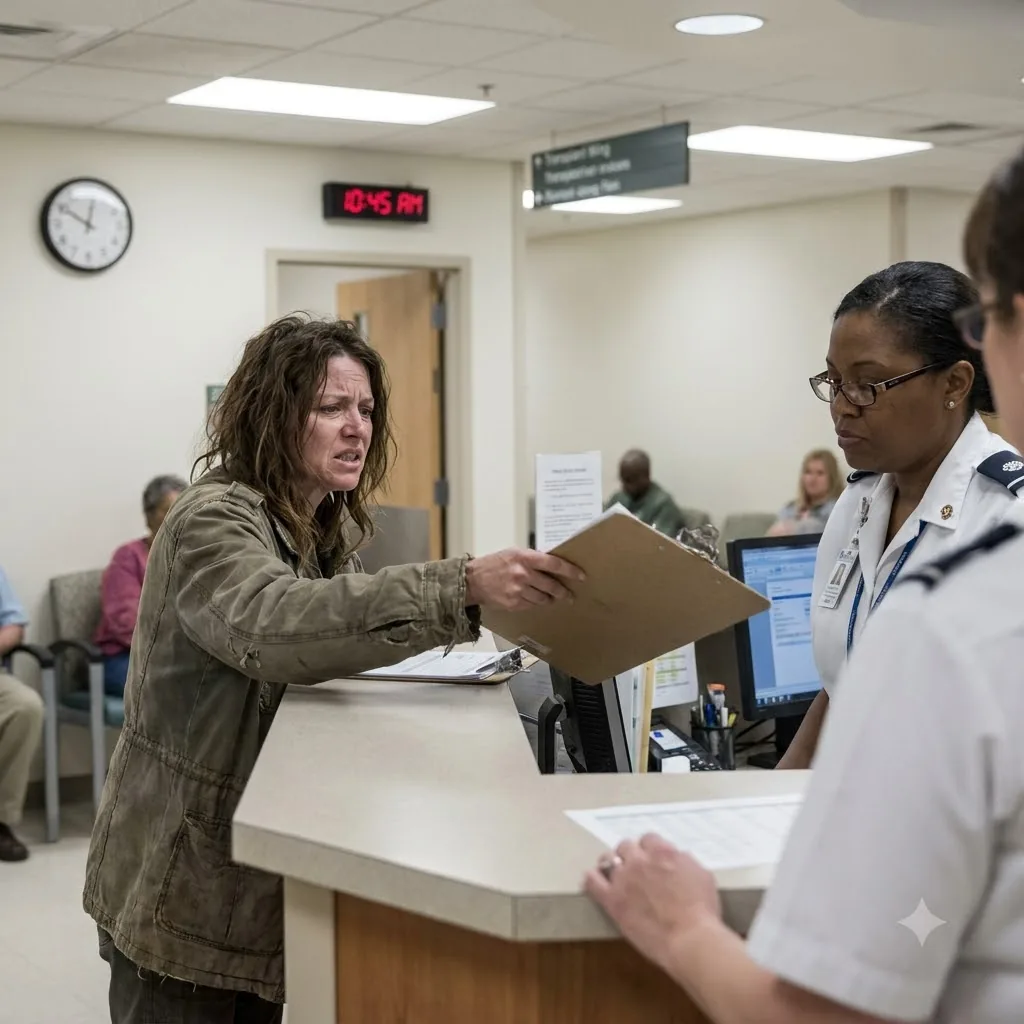
Dr. Randall Harris stood under the harsh fluorescent lights of Transplant Waiting Room 3B, the blue vinyl donor bracelet resting in the palm of his hand. He did not look at the document Sarah Miller was pushing toward him. Instead, his eyes remained fixed on the small strip of plastic.
“Mrs. Miller, this isn’t a clerical delay or a machine error,” Dr. Harris said, his voice dropping into a quiet, measured register. “The timestamp on this bracelet is generated by the hospital’s central server the exact second the primary attending physician submits the legal declaration of brain death. That occurred at 14:02. Once that entry is finalized, the federal registry locks the donor file. It is automated, instantaneous, and permanent.”
Sarah did not step back. Her fingers pressed harder against the manila folder, leaving a damp, creased smudge on the paper. “The doctor in Room 402 told us we had time. Thomas was still on the ventilator. His heart was beating. We had the notary present, and Thomas signed the directive. The notary witnessed the signature and stamped it at 14:30. That is a legal signature.”
“A beating heart sustained by mechanical ventilation does not override a legal declaration of brain death,” Dr. Harris replied. “The law is absolute on this point. For a directed donation to be valid, the patient must possess cognitive capacity at the moment of signing. At 14:30, Thomas Miller was already legally deceased. He had been for twenty-eight minutes.”
Elena Vance turned back to her terminal. She opened the secure network log that tracked the electronic badge scans for the ICU wing, specifically ICU Patient Room 402. The system recorded the exact second any badge-staff, visitor, or vendor-passed through the electronic door locks. She scrolled down the list of entries for that afternoon.
“Dr. Harris,” Elena said, pointing to the screen.
Dr. Harris leaned over the counter, his eyes scanning the digital log. Sarah stood rigid, her chin tilted upward, though her gaze flickered toward the monitor behind the safety glass.
“According to the security log for Room 402,” Elena read from the screen, “the visitor badges assigned to Sarah Miller and the independent notary, James Vance, did not scan into the patient room until 14:24. That was twenty-two minutes after the brain-death declaration was logged and the donor bracelet was printed at the bedside.”
Dr. Harris looked from the monitor back to Sarah. The silence in the waiting room seemed to grow heavier, punctuated only by the hum of the vending machines down the hall.
“The timeline is physically impossible, Mrs. Miller,” Dr. Harris said. “The declaration was finalized, the records locked, and the patient prepped at 14:02. You and the notary did not enter the room until 14:24. The signature on this document could not have been executed by Thomas Miller while he possessed the legal capacity to do so.”
Sarah’s breathing became visible, her chest rising and falling in quick, shallow movements. “He was still warm. The machines were running. If you sign the authorization now, the registry will accept the override. We just need your signature to bypass the lock.”
She slid the consent document a fraction of an inch closer to Dr. Harris, holding out a black ballpoint pen. The blue plastic bracelet lay between them, the machine-printed “14:02” timestamp glaring under the fluorescent light, an unyielding physical record of the timeline.