Story code: ST-001226
Part 2: The Blue Band
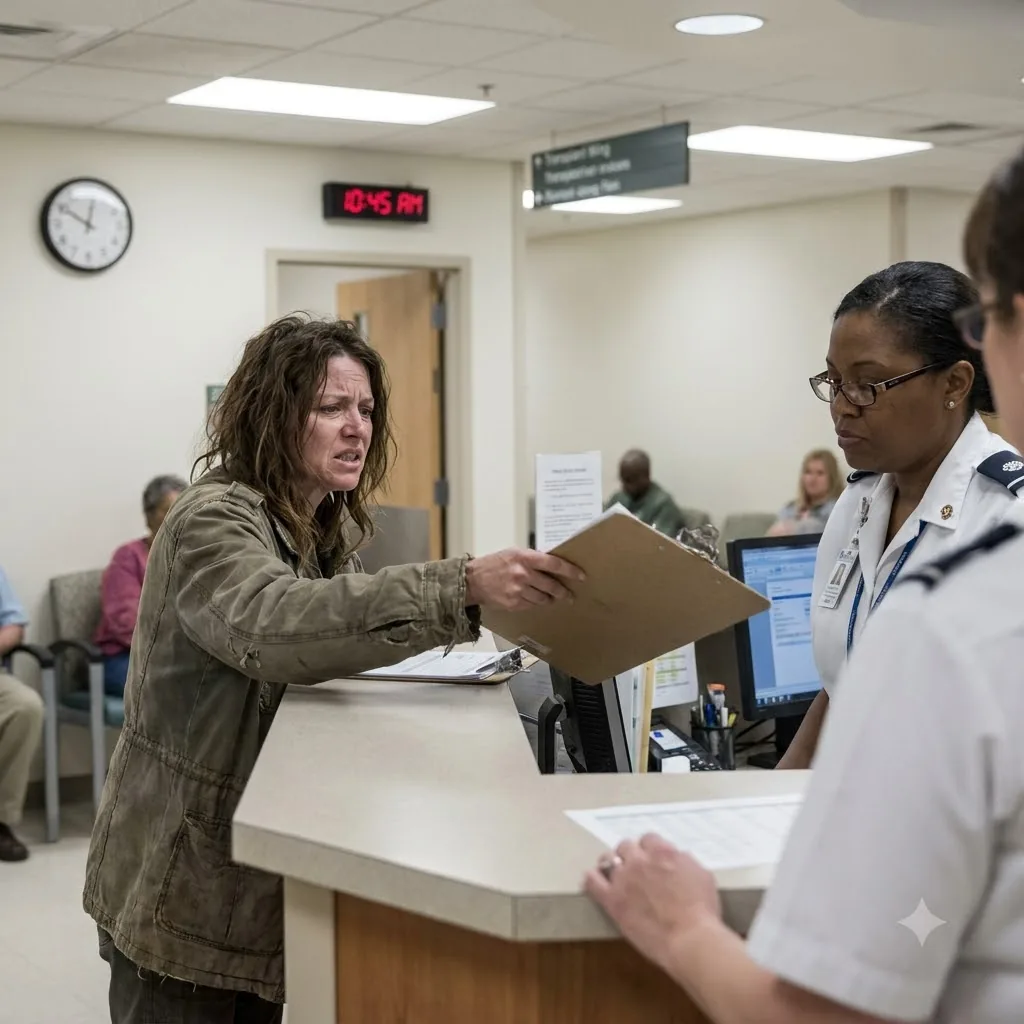
Elena Vance slid the blue donor bracelet out of the folder’s plastic sleeve and placed it on the counter beside the laminated protocol sheet. Dr. Randall Harris looked down, his gaze dropping to the thin band of blue vinyl. Sarah Miller’s hand remained on the counter, her fingers twitching slightly as she stared at the object.
“What is that?” Sarah asked, her voice dropping a fraction in pitch.
“This is the physical donor bracelet printed at the bedside,” Dr. Harris said. He picked up the band, holding it under the fluorescent light. “The hospital’s declaration system automatically prints this tag the moment the primary physician signs the legal declaration of brain death. The printer draws its time directly from the secure network log to prevent manual alteration.”
Elena pointed to the black ink stamped on the blue plastic. “The printed timestamp is 14:02,” she said, her voice steady and controlled.
Sarah did not look at Elena. She kept her eyes on Dr. Harris. “The clock on your machine must be off. Or maybe the nurse printed it early. Thomas signed the consent form at 14:30. The notary logged it at 14:30. That is the legal document.”
“The network printer is synchronized with the federal registry system,” Dr. Harris explained, showing the bracelet to Sarah. “It cannot print early. A declaration of brain death locks the patient’s record at the exact minute of the entry. At 14:02, Thomas Miller was legally declared deceased, and his organs were locked into the national database.”
Sarah pulled her manila folder closer, her shoulders tensing. “He was still on the ventilator. We were in the room. He signed the paper. We have the notary’s signature.”
“A notary witnesses the act of signing, Mrs. Miller,” Dr. Harris said. “But a notary cannot certify the medical or cognitive capacity of a patient who has already been declared legally dead. If the declaration occurred at 14:02, any signature obtained at 14:30 was placed on that paper twenty-eight minutes after the patient had legally ceased to exist.”
Elena watched Sarah’s gaze shift from the bracelet to the computer monitor, where the red flag of the locked registry slot glowed. Sarah’s breathing became shallow, but she did not step back from the counter.
“The family has rights,” Sarah said, her voice low. “We are his next of kin. My husband is dying. You are letting a piece of plastic stop us from saving a member of our own family.”
“The protocol doesn’t allow for exceptions,” Dr. Harris said. “If the timeline contains a contradiction, the allocation system automatically rejects the directed donation and reverts to the primary registry queue. The heart is already matched.”
Sarah stood silent, her fingers gripping the edge of the manila folder so hard the paper began to crease. She looked at the blue bracelet, then at the clock on the wall, realizing the physical proof of the timeline had already been logged. But how could a signed and notarized document exist for a time when the patient was already legally dead?