Story code: ST-000706
Part 4: When the Room Turned
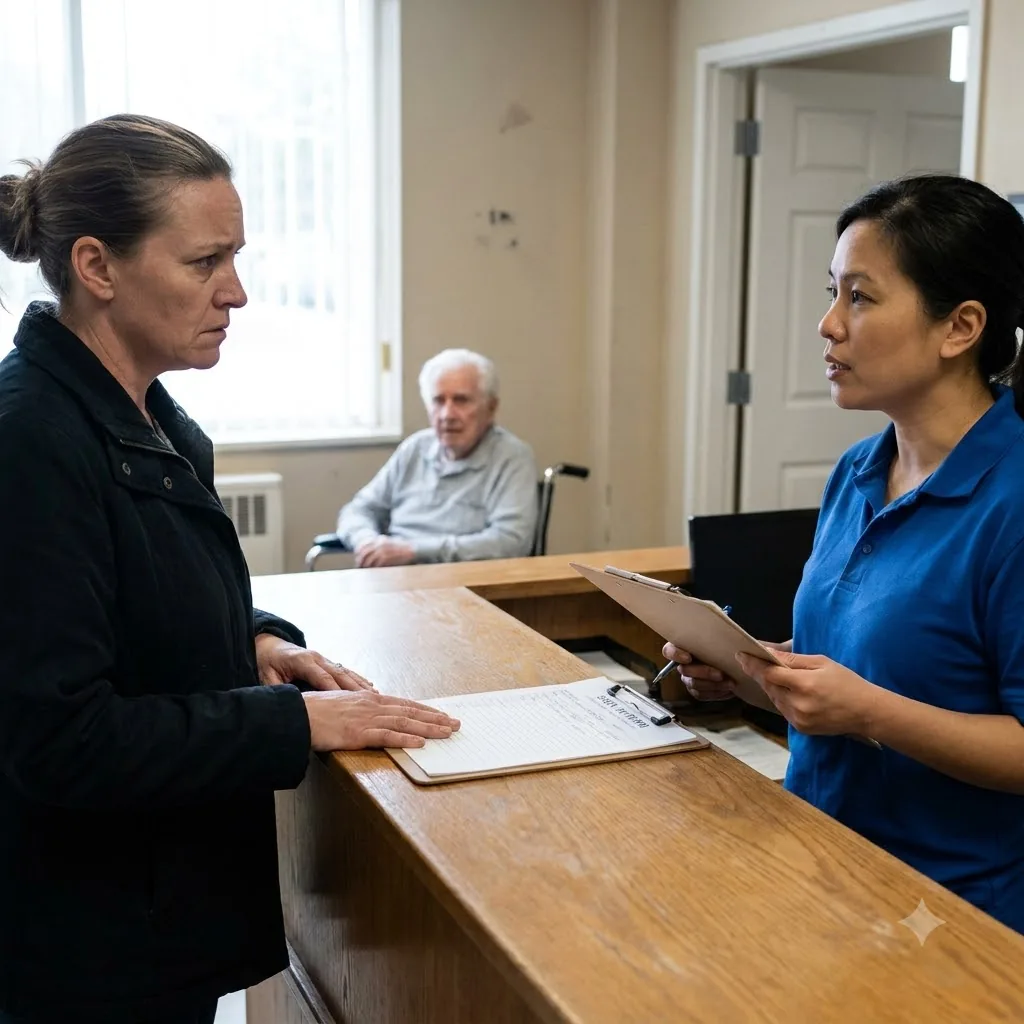
After Tasha said it out loud, the desk stopped sounding like a desk and started sounding like a sequence being pulled apart in public. The phones still rang. The printer still spat slips. The elevator chimed once and shut again. But every ordinary sound now sat behind one fact everybody in the lobby could hold onto: Dana Mercer had been blocked with a bracelet number that belonged to a strip not yet started at the time she was accused of being upstairs. Sharon Bell put both palms on the counter edge. “The serials can be entered manually,” she said. “A staff member could have corrected the field after the fact.” Dana answered before anyone else could. “Corrected from what?” Sharon looked at the screen. “From a mistaken entry.” “Then the original color and time still have to exist somewhere in the physical order,” Dana said. “A band was either torn off a strip for me or it wasn’t. A wrist either passed this desk or it didn’t.” That was the shape of it now. Not a debate about tone, not a speech about policy. Just the order of actions in a lobby full of visible objects. Eli watched Tasha move with more certainty than she had a minute earlier. She pulled the green tray closer, then the clipped first tab from the current strip, then the unused strip itself so the next serial could be seen beside the already-torn run. She lined them up on the counter in a row. It looked almost childish in its simplicity, which made Sharon’s earlier certainty sound worse. “This is the current strip,” Tasha said, tapping once near the intact band. “This is the first tab from when green started at one-twenty-two. The bracelet number in Dana Mercer’s log falls four issues after that.” She pointed down the row of torn tabs. “That places it after one-thirty-six, not one-fifteen.” The woman with the flowers said, “So that number belonged to somebody else later.” No one corrected her. Dana turned slightly toward Sharon. “You used a later green serial to support an earlier story. That’s why the colors wouldn’t hold still.” Sharon tried another route. “The exact minute does not change the behavioral concern.” Colleen Avery was still by the desk. She folded her gloves once in her hand. “It changes whether the desk had a valid basis to deny access,” she said. “If the sequence is wrong, the restriction is wrong.” That landed with the force of a stamp. Eli saw two people by the coffee station exchange a look. The man in the cap came fully back from the elevator now and stood behind Dana instead of off to the side, like the whole room had unconsciously redrawn where the line was. Dana did not look around for support. She kept her attention on the counter. “Call my father now. In front of the same desk that kept saying no.” Sharon did not reach for the resident phone. Tasha did. That was the turn. It was small, almost ordinary: Tasha lifting the handset from its cradle while Sharon was still talking. But the room changed on that motion. Sharon’s authority had been coming from the idea that the process was already settled. The second her own desk stopped waiting for her version, it showed exactly what had broken. “Tasha, hang up,” Sharon said. Tasha kept dialing the floor extension. “I need to verify access status for Leon Mercer,” she said into the receiver, using the clipped front-desk voice people use when they are back inside a rule instead of hiding behind one. The nurse on the other end must have answered quickly, because Tasha listened, gave Leon’s room number, then looked up. “He can receive a visitor,” she said to the room, then directly to Dana: “There is no active floor restriction on your name.” A sharp murmur moved across the lobby. Not loud enough to be a cheer, but louder than politeness. Sharon’s face stayed set, but her voice had lost its smooth edge. “We will need to review this internally.” Dana picked up her tote. “Review it after I see my father.” Colleen held out a hand toward the bracelet strips. “Issue her one correctly.” For half a second nobody moved. Then Tasha tore a fresh green band from the current strip, fastened nothing, and slid it across the counter for Dana to put on herself. The plastic snapped around Dana’s wrist with a neat click that seemed to travel through the whole waiting area. Everyone could hear the difference between that sound and the story that had been used against her. Tasha printed a new visitor slip and set it beside the phone. She also reached for the monitor, typed, and read aloud as she did it, not performative, just plain enough for the people standing there to catch: “Previous access denial voided. Visitor reissued at desk after serial mismatch.” That was the visible consequence. It did not fix the last half hour. It sat on the screen where the old version had sat. Sharon stepped back from the counter for the first time since Dana had arrived. Not out of sight, just back toward the office doorway she had come from. No one followed her with questions. No one offered her rescue lines either. The silence around her had changed shape. Dana adjusted the bracelet once, thanked Colleen with a short nod, and walked toward the elevator access point. The man in the cap pulled the door for her before his own floor buzzed. The woman with the flowers moved up to the counter next, but not as if nothing had happened. She set her bouquet down and said to Tasha, clearly enough for everyone nearby, “I’d like you to check my band against the tab too.” That was when Eli knew the room would not go back to the old order by evening. The lobby still looked the same: brochures, printer, clip trays, sign-in monitor, polished counter. But.