Story code: ST-000708
Part 3: The Fireline Math
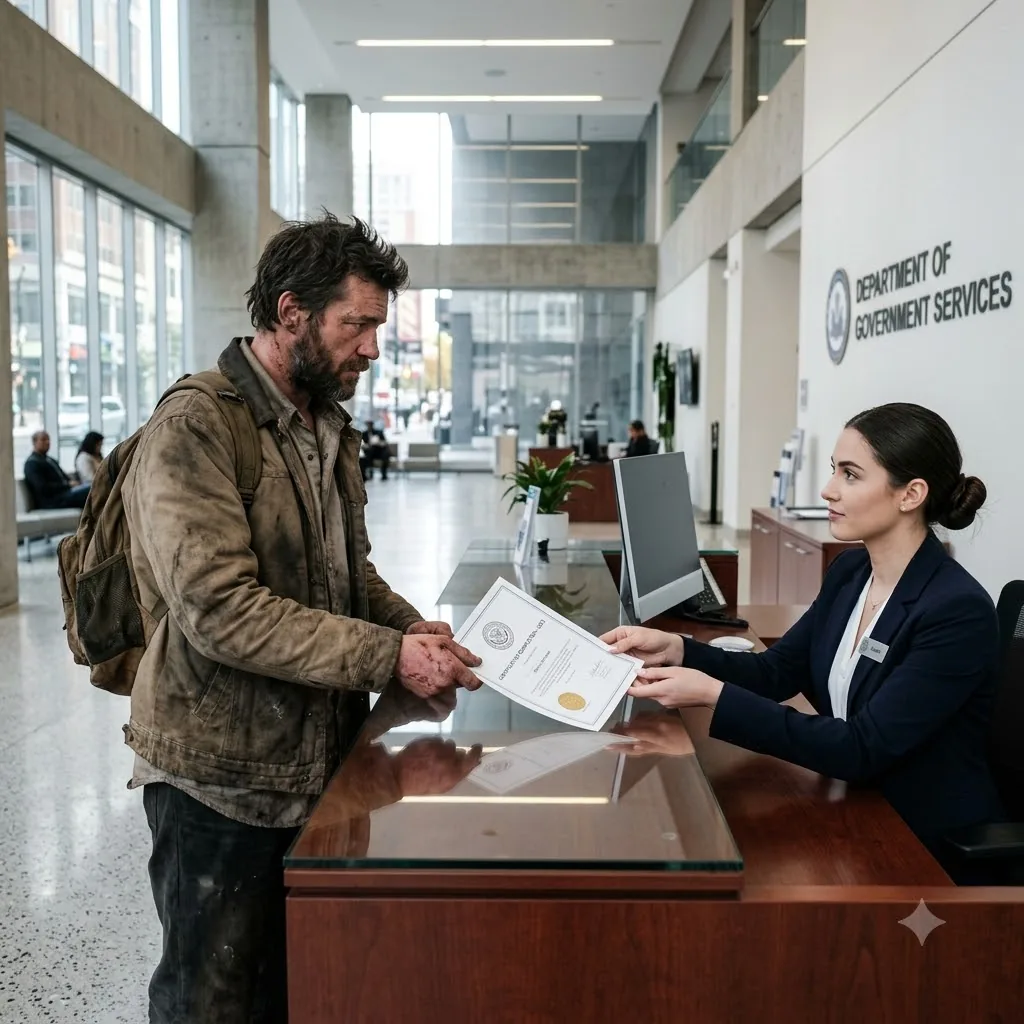
The red laser dot of the Taser vibrated violently against the faded plaid of Cole’s flannel shirt. Barrows was breathing through his mouth, his knuckles white around the yellow plastic grip of the weapon. Cole kept his hands elevated, his palms open and perfectly visible. He had stood his ground against a hundred-foot wall of crowning timber roaring like a jet engine; a trembling security guard with a battery pack didn’t spike his adrenaline. What spiked it was the dull, metallic clang of the drop-box eating his life.
The receptionist’s voice was a frantic, hushed whisper into her headset. “Yes, an agitated felon. He’s refusing commands. Send units immediately.”
“I haven’t moved a single muscle,” Cole said. His voice was a low, gravelly rasp that scraped through the pristine acoustics of the lobby. He didn’t look at Barrows. He locked his gaze entirely on Hayes.
Hayes stood safely behind the reinforced glass partition, adjusting the cuffs of his tailored suit. The deputy director had the serene, insulated posture of a man who believed a locked box and a laminated badge could make a problem disappear entirely.
“Keep your mouth shut,” Barrows barked, his heavy boots squeaking against the tile. “Get on your knees and lace your fingers behind your head!”
“If I get on my knees, Barrows, that’s a compliance submission to an arrest,” Cole said, keeping his tone as steady as a radio dispatch. “That automatically triggers a parole violation. I go back to the Chino facility tonight. And Deputy Director Hayes over there gets exactly what he wants.”
Hayes frowned, his brow furrowing in practiced distaste. “What I want is for a volatile, unauthorized criminal to be removed from my facility.”
“No,” Cole said, projecting his voice. The civilians huddled against the far wall had stopped murmuring. The lobby was dead quiet, amplifying every harsh syllable tearing from Cole’s damaged throat. “What you want is your fireline labor back.”
“This is absurd. Do not engage with him, Barrows,” Hayes ordered, glancing nervously at the civilians who were now watching with wide eyes.
“Four thousand hours,” Cole said, stepping into the space not physically, but verbally. “You know the municipal rate for a Type 2 Wildland certification? Thirty-two dollars an hour, plus hazard pay. The state pays civilian crews roughly a hundred and thirty grand a season. You know what I got paid?”
Hayes’s jaw tightened. He didn’t answer. He just stared at the scarred man standing under the harsh fluorescent lights.
“Two dollars a day,” Cole said. He pointed his calloused, soot-stained index finger at the locked metal drop-box. “Plus an extra dollar an hour when I was actively choking on smoke. You want to talk about insurance liability and employment classifications? Let’s talk about the math.”
“Your compensation was commensurate with your status as a ward of the state,” Hayes snapped, his bureaucratic armor slipping just a fraction to reveal the cold irritation beneath. “You owed a debt to society.”
“And I paid it,” Cole shot back. “I paid it in melted skin. I paid it in lung capacity. I held the line on the Sierra ridge when your insured municipal crews tapped out and pulled their engines back to the highway. We saved three hundred homes. At two dollars a day.”
“You were convicted of a felony. You don’t get to dictate the terms of your rehabilitation,” Hayes said, his voice rising, fighting to regain control of the narrative.
“It’s not rehabilitation!” Cole’s voice boomed, a sudden, concussive force that made Barrows flinch and the Taser dot jerk wildly off Cole’s chest before snapping back. Cole forced his breathing to slow, feeling the heavy, restrictive pull of the burn scars across his collarbone. “If it was rehabilitation, you’d hire me right now. You trained me. The state handed me a chainsaw, certified me to cut line, and trusted me to watch the backs of the municipal boys in a firestorm. But the second I walk out the prison gate, suddenly my hands are too dirty to hold a shovel for a paycheck?”
Hayes stepped closer to the glass, his eyes narrowing into slits. “State policy dictates we do not put felons in positions of public trust.”
“State policy dictates you need a captive workforce,” Cole said. The pieces had clicked together perfectly in his mind during the long bus ride down from the mountain camp, but seeing the barcode trigger the red alert made it an undeniable, physical reality. “The climate is drying out. Fire season is twelve months long now. The forestry department’s budget can’t afford to fight these mega-fires with civilian crews. You’d go bankrupt in a week.”
Cole lowered his hands just an inch, his eyes burning into Hayes. “You need the inmate camps. And how do you keep them full? You rely on the opioid pipeline. Half my crew was in for possession. Oxy, fentanyl, heroin. The state doesn’t treat them. It lets the crisis fill the county courts, sweeps up the addicts, and ships them up the mountain to do the deadliest job in the state for pennies. You don’t want to solve the drug problem because you need those bodies holding a fireline.”
“That is a paranoid, delusional fabrication,” Hayes sneered. But his eyes darted nervously toward the civilians listening by the wall.
“Then why confiscate my paperwork?” Cole demanded. “If I’m just a liability, hand it back. Let me apply. Let the hiring board reject me on the merits.”
“Stand still!” Barrows yelled, his finger resting heavily on the trigger.
Cole ignored the guard completely. “You can’t do that. You can’t let a single inmate cross over into the civilian workforce. Because the second you do, you admit the skills are exactly the same. You admit the labor is equal. And if the labor is equal, then paying us two dollars a day to die in a canyon isn’t a debt to society. It’s slavery.”
Hayes opened his mouth, but nothing came out. The polished, insulated confidence had evaporated.
“That scanner didn’t flag me to protect the public,” Cole said, his voice dropping back to a lethal, gravelly calm. “It flagged me to make sure I can’t get a job. Because if I can’t work, I can’t eat. And if I can’t eat, I violate my parole. The system is designed to bounce me right back into an orange fire shirt by next season. You didn’t steal my certification to enforce policy. You stole it to protect your profit margin.”
The lobby was entirely silent, save for the faint hum of the air conditioning. The receptionist was still holding the phone to her ear, but she wasn’t speaking to dispatch anymore. She was staring blankly at Hayes.
Hayes gripped the edge of the marble counter. His knuckles were pale. He looked at the locked drop-box, then back to Cole. The deputy director’s mouth worked silently, searching for an administrative rule, a policy citation, a bureaucratic dismissal that could reseal the vacuum he lived in. But the sterile air had been breached. The ugly, soot-stained truth of his department’s survival was laid bare on the pristine tile, and the silence stretched out, waiting for an answer Hayes didn’t have.