Story code: ST-001820
Part 4: The Golden Ticket
The campaign manager stared at the cracked screen, all the aggressive color draining from his face. Detective Vance stepped around the booth, peering over Mateo’s shoulder at the looping footage. The steel handcuffs dangled loosely from Vance’s left hand.
“Well,” Vance muttered, his voice flat. “That’s not an assault. That’s a dozen witnesses doing absolutely nothing.”
The manager’s mouth snapped shut. He looked from Mateo’s phone to the yellow tarp by the kitchen doors. Just as a heavy silence settled over the wrecked dining room, a paramedic burst back through the shattered front entrance.
“We got a rhythm!” the medic shouted toward his partner. “Epi pushed, we have a pulse! Get him on the backboard, let’s move!”
Mateo watched in stunned disbelief as the yellow tarp was yanked away. The Senator wasn’t dead. Not yet. But Mateo knew the grim, unforgiving math of his weekend CPR course. Four to six minutes without oxygen. The man had been convulsing on the floor for far longer than that while his loyal voters filmed. He might have a heartbeat, but his brain was irrevocably gone.
The manager realized it just as quickly. The frantic hope in his eyes curdled into cold panic. A candidate with severe, permanent brain damage was the abrupt end of a multi-million-dollar campaign. But a leaked high-definition video showing the candidate’s own top-tier donors and VIP volunteers standing around watching him suffocate for internet clout? That would humiliate and destroy the entire political party’s reputation across the state.
“Turn it off,” the manager hissed, his eyes darting toward the busy patrolmen. He smoothed his sweat-drenched silk tie, his hands trembling slightly. The vicious rage was gone, replaced by a ruthless preservation instinct. “Son. Mateo. I apologize for my outburst.”
Vance scoffed, sliding the heavy cuffs back into his belt pouch. “I don’t need his phone anymore. No crime committed here. Just a terrible tragedy.”
“I need it,” the manager said quietly, stepping closer to the vinyl booth. He lowered his voice so the detective couldn’t hear. “The Senator’s career is over. We both know that. But if this video gets out, it ruins innocent people’s lives. It ruins the movement.” He pulled a sleek leather cardholder from his suit jacket. “The party operates a very well-funded collegiate foundation. We reward young citizens who show discretion. A full-ride scholarship. Anywhere you want to go. Tuition, housing, stipends. All of it.”
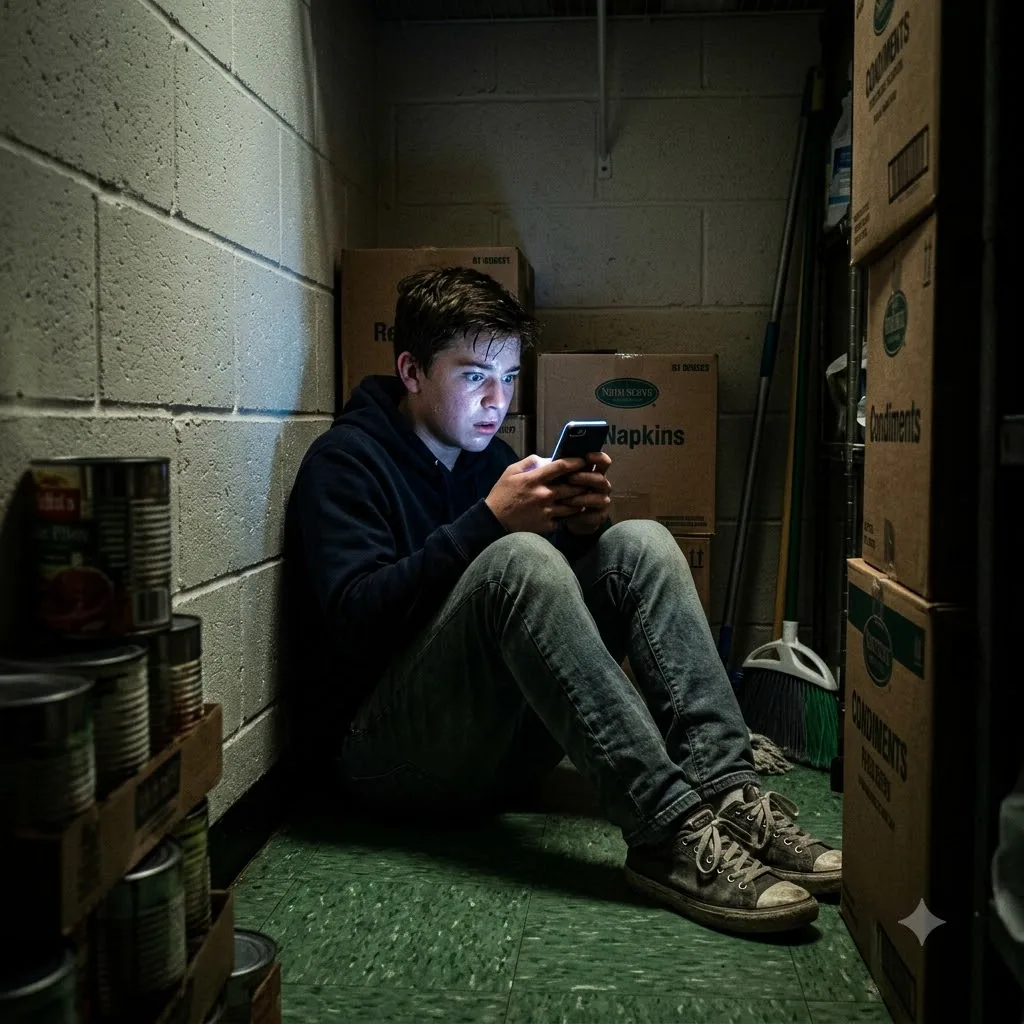
Mateo swallowed hard. He looked at his cracked screen, then down at the grease stains on his cheap uniform polo. He had been hiding in a dark mop closet just ten minutes ago because he was terrified of being poor, of being arrested, of having his future ripped away. Now, that same terrible forty-three seconds of footage was his golden ticket.
“Delete the file,” the manager whispered, sliding a thick, gold-embossed card onto the table. “Hand me the phone to verify it’s wiped, sign a standard non-disclosure agreement tomorrow morning, and your college is fully paid for.”
Mateo didn’t hesitate. He didn’t think about the ethics of burying the truth. His thumb pressed the red trash can icon. The footage vanished forever.
***
Four months later, the air inside the high school gymnasium was suffocatingly hot, smelling of cheap aerosol cologne and nervous sweat.
Mateo adjusted the stiff collar of his green graduation gown. The gold valedictorian stole felt like a weighted chain around his neck. He sat in the front row of folding chairs, staring blankly at the scuffed hardwood floor of the basketball court.
“And now,” Principal Higgins’ voice boomed through the screeching PA system, echoing sharply off the cinderblock walls, “to deliver our commencement address, this year’s valedictorian and the recipient of the prestigious Liberty Leadership full-ride scholarship… Mateo Vargas!”
A polite wave of applause rolled through the packed bleachers. Mateo forced a breath of stale air into his tight lungs. He stood up, his knees feeling dangerously hollow, and walked up the three wooden steps to the stage. His polished dress shoes clicked against the platform. He approached the podium, setting his crisp white index cards onto the slanted wood.
“Welcome, faculty, parents, and the graduating class,” Mateo read aloud from his first card. His voice sounded thin and distant, like it belonged to a complete stranger.
He looked up from the index card to make his practiced eye contact with the audience.
He stopped breathing.
The gymnasium overhead lights were dimmed, but the massive bleachers were alive with a terrifying, unified glow. Hundreds of people-proud parents, siblings, friends-had simultaneously raised their smartphones. They formed a solid, unbroken wall of glass and metal lenses, all pointed directly at his face.
The little red recording dots blinked in the darkness. The harsh white flashes of cameras strobed across the sea of faces in a relentless, silent rhythm.
Mateo’s hands gripped the edges of the wooden podium so hard his knuckles turned stark white. He couldn’t see their eyes. He couldn’t see their proud smiles. All he could see were the glowing screens. Dozens, hundreds of them, boxing him in.
His chest tightened into a hard, agonizing knot. The smell of cheap cologne instantly evaporated, replaced in his mind by the sharp, chemical sting of industrial bleach and damp mop strings. The gymnasium floor seemed to tilt, morphing into checkered linoleum.
*Push hard, push fast to the tempo of a pop song.*
The audience waited in polite, expectant silence. The wall of lenses stared back at him, completely mesmerized, perfectly still, waiting for him to perform.
Mateo stood absolutely frozen behind the podium, his mouth hanging open, unable to make a single sound as the hundreds of glowing cameras recorded his silent, suffocating panic.