Story code: ST-000498
Part 2: The Ghost Writer
“I sit on the community board for your subdivision, Mateo,” Mr. Caldwell said, his voice as calm and measured as if he were discussing my upcoming class schedule. “I take evening walks through the neighborhood to ensure our community standards are maintained. Last night, I saw the commercial truck blocking the sidewalk. I wrote the citation. And I took the liberty of removing this discarded shirt from the tailgate.”
The sheer violation of Caldwell prowling around my home, reaching into my father’s truck, and treating our lives like pawns on his mahogany desk made my hands shake. I stared at the dark grease stain on the collar of my dad’s shirt. I could almost smell the exhaust fumes and the sharp, earthy scent of pine mulch. My father woke up at four in the morning every single day. He wore that shirt until it was soaked through with sweat, all to save enough cash to keep the lights on and a roof over our heads. Now, the man entrusted with guiding my future was using it as a weapon against us.
“What do you want from me?” I asked, my voice cracking slightly. I hated how small I sounded in this massive, air-conditioned office.
Caldwell smiled, but the warmth didn’t reach his eyes. “I provide an exclusive college preparatory service for families in our district who have… ample financial resources, but lack the academic rigor required for elite admissions. They pay me handsomely to ensure their children secure spots in top-tier universities.”
He opened his top drawer and withdrew a sleek, silver USB drive, setting it precisely next to the neon green violation notice.
“You are a remarkably gifted writer, Mateo, and arguably the brightest student to walk these halls in a decade,” Caldwell continued, leaning back in his leather chair. “On that drive, you will find the login credentials for three different college application portals. You are going to write the personal statements for these three students. You will also log in this weekend to take a remotely proctored AP Calculus exam for one of them.”
The air in the office suddenly felt too thin to breathe. I stared at the silver drive, my mind spinning. “That’s academic fraud,” I whispered. “If I get caught doing that, I’ll be blacklisted. Every university in the country will rescind my acceptances. It’s illegal.”
“It is only a problem if you are careless,” Caldwell countered smoothly. “And we both know you are meticulous. You’ve maintained a flawless GPA since middle school. You’ve never missed a deadline or made a careless error.”
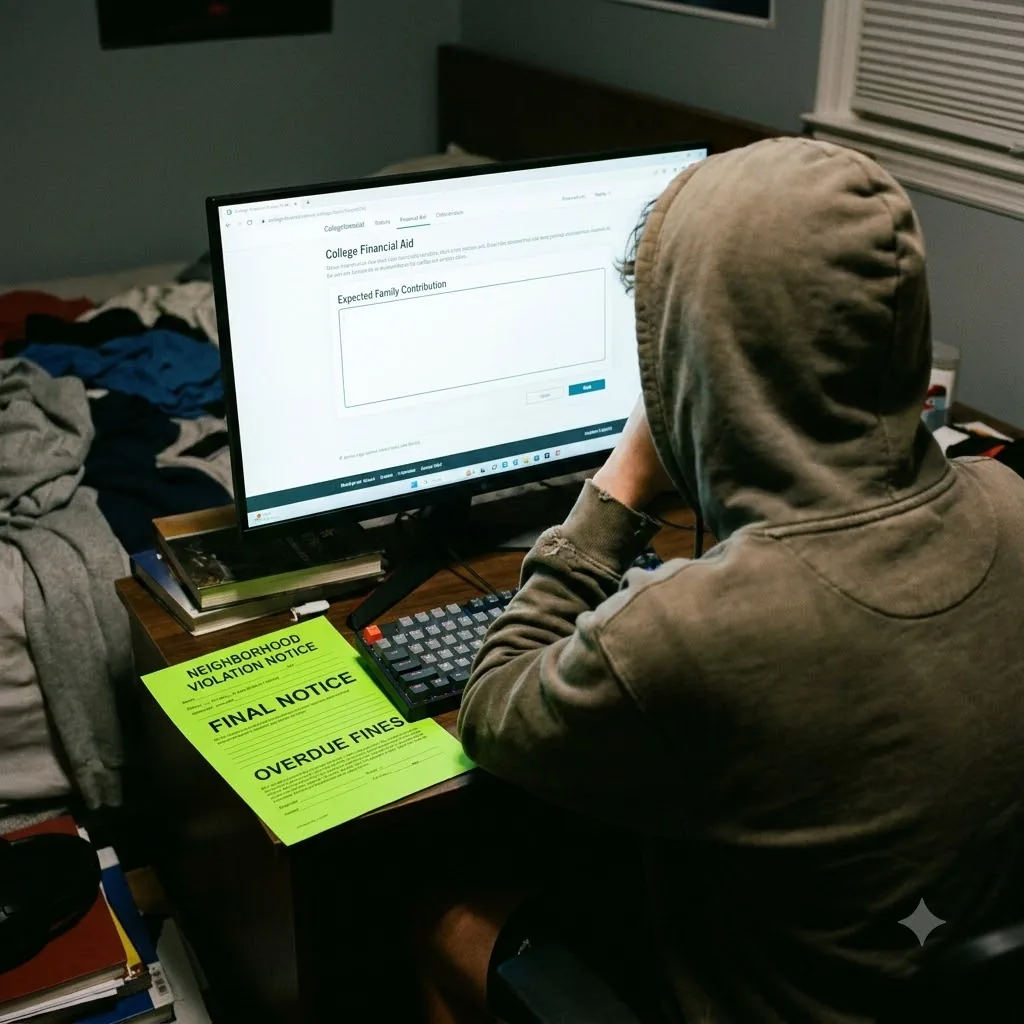
He reached forward and tapped his manicured index finger against the blank Social Security box still glaring red on my laptop screen. “If you refuse, I will submit the five-hundred-dollar fine to the HOA records this morning. The lien process will begin by Friday. Your landlord will be notified, and your family will be evicted for violating the lease terms. Furthermore, I will make a single phone call to the authorities regarding an undocumented laborer operating an unregistered commercial business out of a residential driveway. Your father will be detained before dinner.”
My stomach dropped so violently I thought I might be sick right there on his pristine desk blotter. He wasn’t just threatening my college dreams; he was threatening to tear my family apart, to deport my parents, to destroy everything we had built in the shadows over the last ten years. The walls of the office seemed to physically close in on me. The colorful elite university pennants hanging behind his desk mocked me.
“If I do this,” I managed to say, forcing the words through my tight, dry throat, “what happens to the fine?”
“I waive the fine entirely,” Caldwell said. “I throw this green slip in the shredder. I return your father’s shirt. And I log into the state counselor portal and instantly approve the tuition waiver you need to bypass that blank box. You get to enroll in your dream school. Your family stays safe. Everyone wins.”
It sounded so clean when he laid it out like a simple business transaction. But the heavy, sinking feeling in my chest told me this was a trap I might never escape. Once I committed fraud for him, he would own me. He could blackmail me every semester for the next four years.
“I need you to open the flash drive, Mateo,” Caldwell instructed, gesturing to my laptop. “I want to be sure you understand the assignment before you leave.”
My hands were trembling so badly I fumbled with the silver drive twice before successfully pushing it into the USB port on the side of my laptop. A folder instantly popped up on my screen. I double-clicked it. Inside were three sub-folders, each labeled with a student’s name. I didn’t recognize the first two, but the third folder made the blood freeze in my veins.
The folder was titled: *Hayes, Bradley – Chancellor’s Civic Grant.*
I stared at the screen, my eyes burning. Bradley Hayes was the son of a prominent local real estate developer. He drove a brand-new imported sports car to school and regularly slept through our AP English lectures. But that wasn’t what made my breath hitch in my throat.
The Chancellor’s Civic Grant was the only full-ride merit scholarship available in our state that didn’t require a federal FAFSA profile. It was my only lifeline. I had spent the last three months pouring my soul into my application for it. I desperately needed that grant to actually pay for my tuition, even if Caldwell signed the waiver to let me enroll. The worst part was the exclusivity of the award. There was only one grant awarded per congressional district. Only one winner.
“Bradley’s father is paying a significant premium,” Caldwell said quietly, watching my face pale. “He wants the prestige of his son winning the Chancellor’s Civic Grant. Which means the essay you write for him needs to be flawless. A masterpiece of adversity and triumph.”
I looked up at Caldwell, the true, devastating horror of his demand finally dawning on me. “There’s only one grant for our district. If I write his essay… and he wins…”
“Then you lose,” Caldwell finished for me, his expression entirely devoid of pity. “You will have the state waiver to attend the university, but you will have to find your own way to pay the tuition. Which, given your father’s current financial situation, will be quite the challenge.”
He slid my father’s mud-stained work shirt closer to the edge of the desk until it brushed against my arm. “But at least you’ll still have a driveway to park in. You have until Monday morning.”