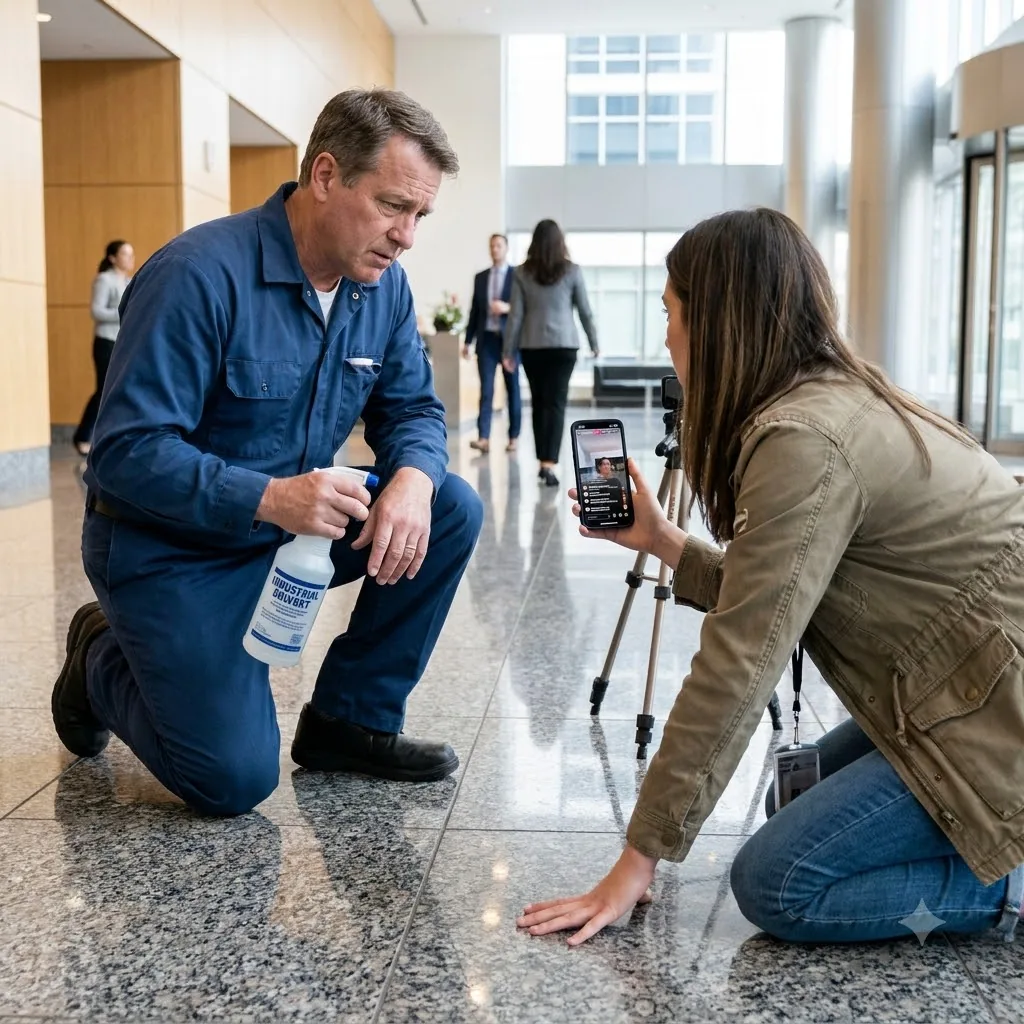
Story code: ST-000506
Part 3: The Redundancy
Six seconds.
Arthur did not hesitate. He pushed off his knees, his heavy boots slipping momentarily in the smeared, noxious puddle of solvent before finding purchase against the cold Italian marble. Warm blood sprayed from his temple, mapping a dark, scattered arc across the pristine floor.
He lunged forward, throwing his weight toward the locked teller glass. Four seconds. He crashed hard onto his left shoulder, the impact jarring his teeth, and scrambled forward on his belly. His thick, gloved fingers closed around the cracked plastic shell of the dispatch device.
Three seconds. He rolled onto his back, swiping a smeared, bloody thumb upward across the shattered glass. The camera interface staggered, lagging for an agonizing heartbeat before the lens flickered to life.
Two seconds. He shoved himself up on one elbow, aiming the device back at the hazard zone.
One second.
Chloe shrieked in defiance. She deliberately threw her body sideways, starfishing her limbs across the melted, steaming puddle of cyanoacrylate. She ignored the chemical burns weeping along her knuckles. She completely blanketed the area Arthur needed to capture, pressing her cheek near the stone while keeping her smartphone camera dead-centered on his bleeding face.
Arthur pressed the digital capture button.
Zero.
A sharp, synthesized double-beep echoed through the cavernous bank lobby. The dispatch app froze. The flashing red digits vanished. The screen flared with a blinding, clinical white light, then immediately locked into a solid, impenetrable gray.
A single line of block text rendered across the cracked glass: `CRITICAL FAILURE. CONTRACT TERMINATED. CREDENTIALS REVOKED.`
Arthur stayed on the floor. He did not drop the phone. He lay propped on his elbow, staring blankly at the gray screen. The frantic ringing in his ears slowly began to fade, replaced by the low, indifferent hum of the building’s HVAC system.
Chloe peered over her arm. She saw the gray light reflecting in Arthur’s wide, unblinking eyes. She recognized the finality of the synthesized chime. Slowly, she sat up, cradling her blistered hand against her chest. She adjusted the telescoping grip of her camera, bringing the lens closer to Arthur’s face, framing his blood-soaked collar and the dead dispatch device.
She modulated her voice, dropping the shrill panic of her activist persona and adopting a hushed, reverent tone.
“Did you guys see that?” she whispered to her livestream. “They just fired him. Over an app. They didn’t even speak to him. This is what corporate greed does to the working class.”
Arthur’s chest rose and fell in slow, shallow increments. The metallic taste of blood seeped over his lips.
“Listen to me,” Chloe said, crawling slightly closer, her face painted with tragic, theatrical empathy. “I know you’re scared right now. But you’re free. You don’t have to poison people for a paycheck anymore. We got this all on tape. The people watching right now, we take care of our own. I’m going to set up a mutual aid fund for you tonight. The viewers will cover your bills. You are more than a uniform to us.”
She waited for his reaction, anticipating a breakdown, a tearful realization of his liberation, or perhaps a sudden expression of gratitude.
Arthur slowly pushed himself to his feet. His knees popped in the quiet room. He wiped the dripping blood from his eyebrow, smearing it across his knuckles. He looked down at her, then shifted his gaze to the glowing smartphone lens capturing his every move.
When he spoke, his voice was eerily steady. It was completely devoid of the exhaustion he had carried all night, replaced by a cold, clinical precision.
“The mutual aid fund will not process before midnight,” Arthur said. “At midnight, the Automated Workforce Optimization Protocol will automatically transmit a severance notification to the underwriting department. By 12:01 AM, my dependents will be legally severed from the group medical policy. My daughter requires specialized pediatric infusions that cost four thousand, two hundred dollars a week. A crowdfunding campaign will not clear the administrative holds in time to prevent her default.”
Chloe frowned, her performance faltering slightly. “We can fight them on that,” she insisted, her voice losing its absolute certainty. “We fight the system together. We can beat their algorithm.”
Arthur towered over her, his shadow falling across the chemical burns on the marble.
“You cannot beat the algorithm,” Arthur said, his tone flat and absolute. “The algorithm does not care about your livestream. It does not care about optics, or public outrage, or mutual aid. It only measures variables in an actuarial table.”
“You don’t know that,” Chloe said defensively.
“I know exactly what it measures,” Arthur said, staring directly into her camera. “It calculated the legal liability of your potential injury against the cost of my health insurance premium. It determined that terminating my contract immediately was fourteen percent cheaper than risking a settlement over chemical burns.”
Chloe swallowed hard. “How could a janitor possibly know that?”
“I know the parameters because I approved them,” Arthur said.
He dropped the gray, useless dispatch device onto the floor. It clattered against the stone.
“Six months ago, I was not wearing polyester,” Arthur continued, his voice echoing off the high ceilings. “My office was on the forty-second floor of this exact building. I was the bank’s Director of Risk Assessment.”
Chloe’s mouth fell open. She looked at his nametag, then back to his bleeding face.
“I championed the AI integration,” Arthur said, stepping closer. “I implemented the Predictive Workforce Matrix to eliminate human oversight in facilities management. I built the machine to trim operational expenditure. And it worked perfectly. It worked so perfectly that within three weeks, it audited my own department, classified my eighty-thousand-dollar salary as an inefficient redundancy, and laid me off alongside three hundred other employees.”
Chloe stared up at him, paralyzed, her blistered hand trembling against her shirt.
“The algorithm blacklisted my executive profile across the entire financial sector,” Arthur said, his eyes hollow and dark. “The medical bills accumulated. The only system that would hire me without filtering my name out was the blind subcontracting app governed by the very protocol I installed.”
Arthur wiped another drop of blood from his chin, looking down at the young woman sitting in the toxic residue.
“You didn’t liberate a worker tonight,” Arthur said softly. “You didn’t strike a blow against corporate greed. You just fed the machine a variable it was already programmed to digest. You just helped my own software finish executing me.”
Chloe sat frozen on the Italian marble. The livestream chat on her screen scrolled in a frantic, unreadable blur, but she said absolutely nothing, her mouth opening and closing in the silent, chemical-soaked air.